Amefa AUENTHAL Ceramic Paring Knife Test & Review
Introduction
On our site dedicated to sustainable and high-performance kitchen tools, we typically analyze Japanese forged steel knives, tempered Western blades, and cast iron pans that last generations. The arrival of a ceramic paring knife like the Amefa AUENTHAL White Ceramic Paring Knife on our radar is therefore an interesting subject for analysis. Can such an object, made from a material fundamentally different from our metal references, be considered a serious tool for the demanding cook? Can it claim a place in a "buy-it-for-life" philosophy? Our analysis is based on the manufacturer's technical specifications, feedback from the user community, and common knowledge about ceramic as a blade material. We separate marketing from practical reality.
Key Strengths
- Initial Edge Sharpness and Light Weight: According to specifications and feedback, the white ceramic blade arrives extremely sharp, allowing for precise, clean cuts without tearing the delicate tissues of fruits and vegetables. Its lightness is also unanimously praised.
- Exceptional Edge Retention: This is the main theoretical advantage of ceramic. The material, much harder than steel, wears down much more slowly. For light paring tasks (peeling, trimming), the blade should retain its sharpness much longer than a low-end steel knife.
- Total Chemical Inertness: An often overlooked but crucial point. Ceramic is stainless and transfers no metallic taste to food. It is ideal for working with acidic products (citrus, tomatoes) or strongly scented foods with no risk of corrosion or flavor alteration.
- Ease of (Surface) Maintenance: The smooth, non-porous ceramic surface resists staining and is very easy to clean. Food hardly sticks to it.
Key Weaknesses
- Inherent Material Fragility: This is the absolute Achilles' heel, confirmed by negative reviews. Ceramic is hard but brittle. It tolerates neither twisting, lateral shocks, nor dropping. It can break cleanly, as reported by users when cutting broccoli or simply falling.
- Very Restricted Use: This knife is a specialist tool. It is strictly designed for straight cutting on soft products. Any attempt at deboning, cutting frozen foods, meats with bones, hard squash, or even simple leverage (to open packaging) risks resulting in a broken blade.
- Impossibility of Conventional Sharpening: When the edge eventually dulls (because even ceramic wears), the user hits a wall. Sharpening requires special diamond tools, often expensive and delicate to handle. For many, the knife then becomes a disposable item.
- Plastic Handle and Overall Durability: The ABS plastic handle, although reported as ergonomic, raises questions about long-term sturdiness and resistance to heat deformation, especially if washed in the dishwasher despite recommendations.
Detailed Analysis
Materials and Manufacturing: The Ceramic Paradox
The Amefa AUENTHAL bets everything on its white sintered ceramic blade. It is crucial to understand what this means. Unlike the carbon steels (White #1, Blue #2) or stainless steels (VG-10, AUS-10) we typically analyze, the ceramic here is zirconia (zirconium oxide). Its hardness is its main attribute: it typically reaches 1300-1500 on the Knoop scale (equivalent to approximately 70-75 HRC on the Rockwell C scale). This is considerably harder than the best knife steels (which peak around 62-65 HRC).
This astronomical hardness explains the legendary edge retention and fineness of the cutting edge. However, this same hardness comes at a high price: toughness (impact resistance) is very low. Where a good quality steel knife would bend or chip, ceramic, unable to deform, shatters. The molded/sintered construction means the blade is not forged but pressed and fired, a common technique for ceramics, but one that distances this product from traditional knife-making craftsmanship.
See priceCutting Performance and Ergonomics
User feedback is unanimous on one point: the initial sharpness is excellent. "It cuts," "sharp," "corta muy bien" are recurring themes in the reviews. For its intended tasks – peeling an apple, trimming a strawberry, detailing a mushroom – performance meets expectations. The lightness of the blade is also an advantage for prolonged precision work, reducing fatigue.
Regarding the ergonomic ABS plastic handle, the community notes a comfortable grip. The shape seems adapted to different hand sizes for occasional use. However, for intensive professional use, the durability and grease resistance of this plastic handle remain inferior to that of micarta, stabilized wood, or high-density composite resin handles found on "buy-it-for-life" knives.
Durability and "For Life" Perspective
This is where the analysis radically diverges from that of a steel knife. Can this ceramic knife be considered a "for life" purchase? The answer is clearly no, if we define the term as foolproof robustness and the ability to be passed down.
Its durability is conditional and fragile. It depends entirely on strict adherence to its intended use: straight cutting on soft materials, storage in its sheath, hand washing, and absolute protection against drops. A single accident can be fatal. Furthermore, the practical impossibility of sharpening for the average person means its useful lifespan is limited to that of its original edge. Once dull, it is often more economical to replace it than to have it professionally resharpened.
On the other hand, for a meticulous user aware of its limits, it can offer satisfactory longevity for light, specific use. It should not be seen as a universal knife, but as a specialized complementary tool to a serious kitchen arsenal.
For What Type of Cook?
The Amefa AUENTHAL White Ceramic Paring Knife is not aimed at the professional brigade chef or the enthusiast looking for a unique, repairable forged tool. However, it may appeal to:
- The home cook looking for perfect and lasting sharpness for fine vegetable prep tasks and who is willing to take great care of it.
- The person who hates rust maintenance and metallic taste on certain foods.
- The person looking for an aesthetic, lightweight, and easy-to-clean object for moderate daily use.
It is imperative to see it as a kitchen scalpel, not as a robust knife.
Technical Specifications
| Feature | Detail |
|---|---|
| Model | Amefa AUENTHAL White Ceramic Paring Knife |
| Blade Material | White Ceramic (Zirconia) |
| Construction Type | Molded / Sintered |
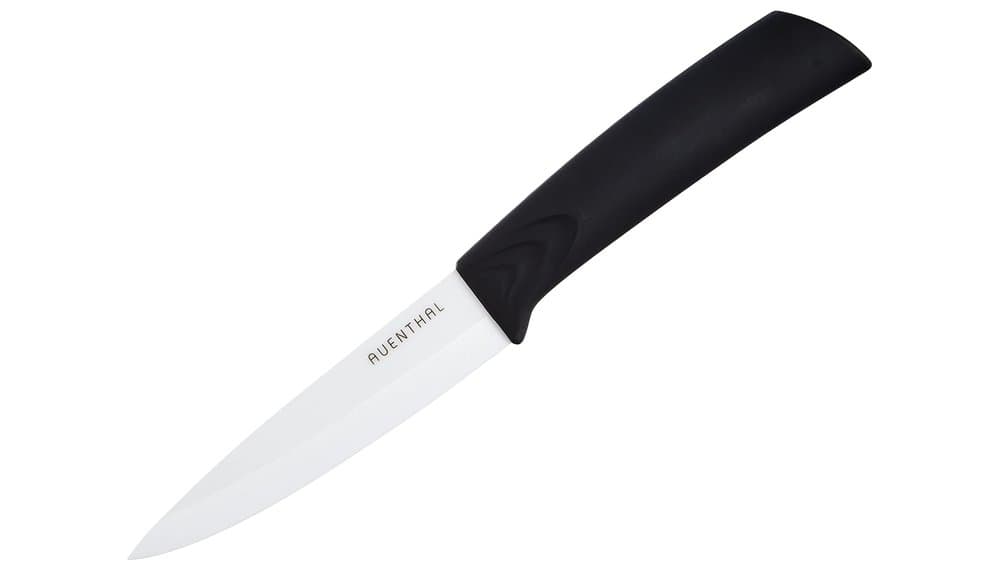
| Blade Length | 10 cm |
| Total Length | 20.5 cm |
| Handle Material | ABS Plastic (Ergonomic Soft-Touch) |
| Weight | 33 grams (approximately) |
| Estimated Hardness (HRC) | ~70-75 HRC (Knoop equivalent 1300-1500) |
| Edge Type | Straight (plain edge) |
| Included | Protective sheath |
| Dishwasher Safe | Not recommended (risk to handle and shocks) |
What Users Say: Review Summary
The overall rating of 4.2/5 stars from over 1400 reviews masks a polarization of experiences, which is very instructive.
The praise (majority) focuses on the extreme sharpness ("Excellent knife", "Perfect for paring", "Corta muy bien"), the light weight, and the perceived good value for money. Several users mention satisfactory daily use on cheese, vegetables, and fruit, with easy maintenance. The inclusion of a protective sheath is also appreciated.
The criticism (recurring and severe) is almost exclusively related to fragility. Users report blade breakage in various situations: while cutting broccoli, after a drop, or even without apparent reason after a few months ("Got broken in 2 months"). These reviews highlight the risk of sudden breakage, potentially dangerous. Another point of vigilance raised by experts is dishwasher washing: although some users do it without issue, most sources recommend hand washing to preserve the integrity of the blade/handle bond and avoid shocks.
The trend is clear: those who use it strictly for peeling and trimming soft foods and who take great care of it are generally very satisfied. Those who subject it to stresses outside its scope (twisting, lateral pressure, hard foods) break it and are deeply disappointed.
Conclusion
The Amefa AUENTHAL White Ceramic Paring Knife is a product that demands an honest reading of its strengths and limits. On paper, its technical specifications promise phenomenal sharpness and perfect chemical inertness. In practice, user feedback confirms these assets for targeted use.
However, in light of our "buy-it-for-life" analysis framework, it fails on the criteria of robustness, repairability, and versatility. It is not a knife for life; it is a niche tool with a conditional lifespan. For the serious and demanding cook, it can represent an interesting complement to their main arsenal – a scalpel for precision work on soft products, where their steel knives might oxidize or require more frequent sharpening.
Our verdict is therefore nuanced: recommended with significant caveats. It is an excellent peeler if, and only if, you accept its fragile nature, its restricted use, and the fact that it will very likely be a disposable product in the medium term rather than an heirloom. For general and durable paring tasks, a good quality stainless steel paring knife (like X50CrMoV15 with a good temper) remains, in our opinion, a wiser and more reliable choice for the demanding user.