Japanese Santoku Buying Guide
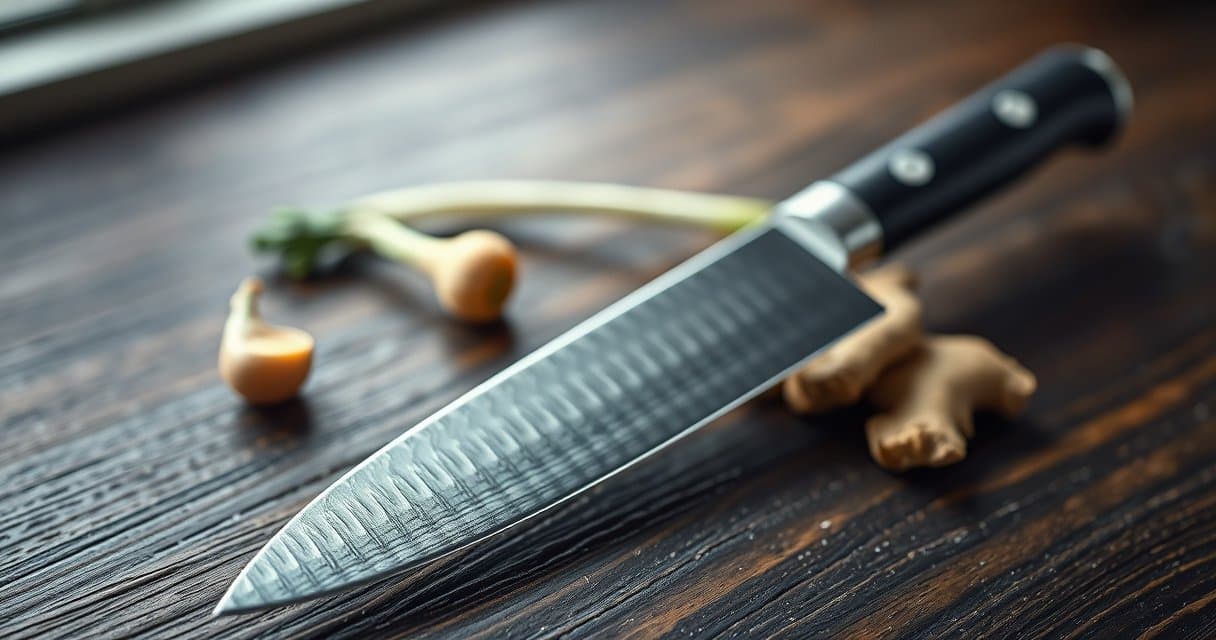
In the back of your kitchen drawer, a chef's knife lies around, dull and unsuitable for the thin vegetable slices you want to make? Yet, one single tool can radically transform your technique and your results: the Japanese santoku. Far from being a simple gadget, this versatile knife is a meeting between perfect ergonomics and a blade of extreme finesse. But to choose the right one, you must look beyond the appearance and understand what lies beneath the surface.
Key Points to Remember
- The choice of steel (stainless VG-10 for ease, carbon for sharpness) is the most crucial decision for the performance and maintenance of your santoku.
- The geometry of the blade, with a very fine sharpening angle and sometimes a hollow-grind effect, is what provides its unique and precise cutting feel.
- The type of handle (Wa or Western) determines the knife's balance and the in-hand feel, a purely personal choice that is made by holding it.
- A good santoku can be found in the 100 to 200€ range, offering an excellent price-quality ratio for high-performance steels and careful finishing.
- Rigorous maintenance (hand washing, proper storage, sharpening on a stone, and using a soft cutting board) is essential to preserve your investment in the long term.
Choosing Steel: Between Edge Retention and Corrosion Resistance
It is not the shape that makes the best Japanese santoku knife, but rather its heart. The steel. Everything else depends on it: its ability to stay sharp, its ease of sharpening, and the level of care you will need to provide. It is the first choice, and the most crucial one. We can simplify it into two main families, each with its champions.
Stainless Steels, for Peace of Mind
Here, compromise is your ally. A steel like VG-10 or AUS-10 is an excellent starting point for serious use. These steels are sophisticated alloys where chromium (often more than 13%) guarantees near-total rust resistance. You can leave it wet for five minutes without panic. Their hardness, typically between 58 and 62 HRC (Rockwell), offers edge retention far superior to most standard Western knives. A well-treated VG-10 will provide weeks of precise cutting before needing a pass on the stone. Honestly, for a first santoku or hassle-free daily use, it's often the smartest choice.
Carbon Steels, the Commitment of the Purist
Here, we're talking about a passionate relationship. Carbon steels like "white" (Shirogami) or "blue" (Aogami) are stars of traditional Japanese cutlery. With a high carbon content and little chromium, they can achieve an edge of absolute fineness and are remarkably easy to sharpen. Their hardness can approach 64-65 HRC, meaning the edge stays incredibly sharp for a very long time. But this superpower has a price: sensitivity to oxidation. A slice of acidic tomato, a damp cutting board, and a rust spot can appear in minutes. It must be wiped immediately after use. It's a commitment. But for those who accept this ritual, the reward is a scalpel-like cutting feel, frankly incomparable.
What About Super-Alloys or "Damascus" Steels?
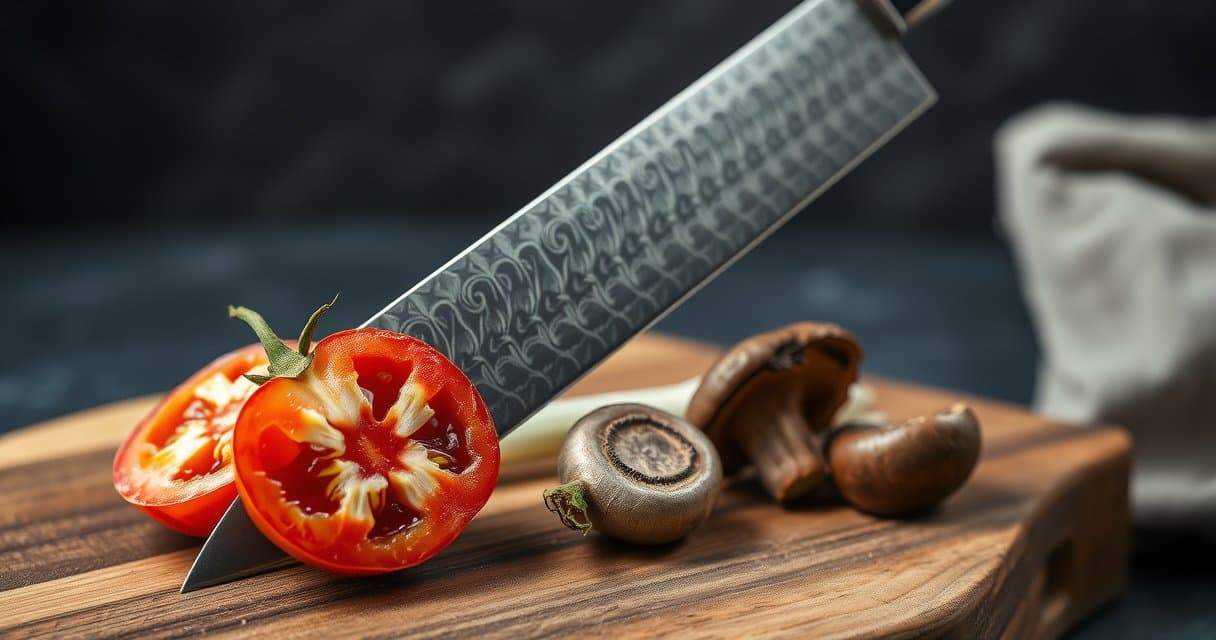
Don't be hypnotized by the pattern. Most often, it's a sandwich: a high-performance core steel (like VG-10 or blue steel) is wrapped in multiple layers of softer steel that form the decorative pattern. The goal is twofold: to protect the hard core and, according to some smiths, to slightly reduce food sticking. It's artistic work that comes at a cost. The bottom line? Performance comes from the core, not the outer layers. A beautiful damascus with a mediocre core will always be worse than a simple knife made of quality blue steel.
My advice? If you hate the idea of having to baby a tool, turn to a quality Japanese stainless steel. If you want to reach the pinnacle of cutting performance and maintenance is part of the pleasure, dive into carbon. In both cases, avoid soft and unspecified steels: "stainless steel" without any other details is often a sign of a blade that will go dull in a few days.
Blade Geometry, From Tip to "Kullenschliff" Effect
The steel provides the soul, but the shape gives life to the cut. A good santoku is not just a pointed rectangle; it is a series of curves and angles designed to guide the food. Look at the profile from the tip to the heel. You will see that the spine of the blade is almost flat, then descends sharply towards the cutting edge. This "belly" is not there just for looks. It enables a fluid rocking motion, a true, light rocking action, perfect for finely chopping herbs or an onion without the tip leaving the board. It is this versatility that distinguishes it from a Western chef's knife, which has a more pronounced belly.
The Cutting Edge: The Angle Makes All the Difference
This is the secret of Japanese blades. Forget the 20 degrees per side of a classic knife. A santoku is often sharpened with an asymmetric bevel, typically in a 70/30 ratio. This means one side of the blade is more inclined than the other, creating an even sharper edge, often between 10 and 15 degrees per side. The result? The blade slices more than it crushes. It glides through tomato flesh without tearing it and makes slices of raw fish with perfect clarity. It is this fineness that demands hard steel and proper stone maintenance. A bad pull-through sharpener would butcher this geometry in two seconds.
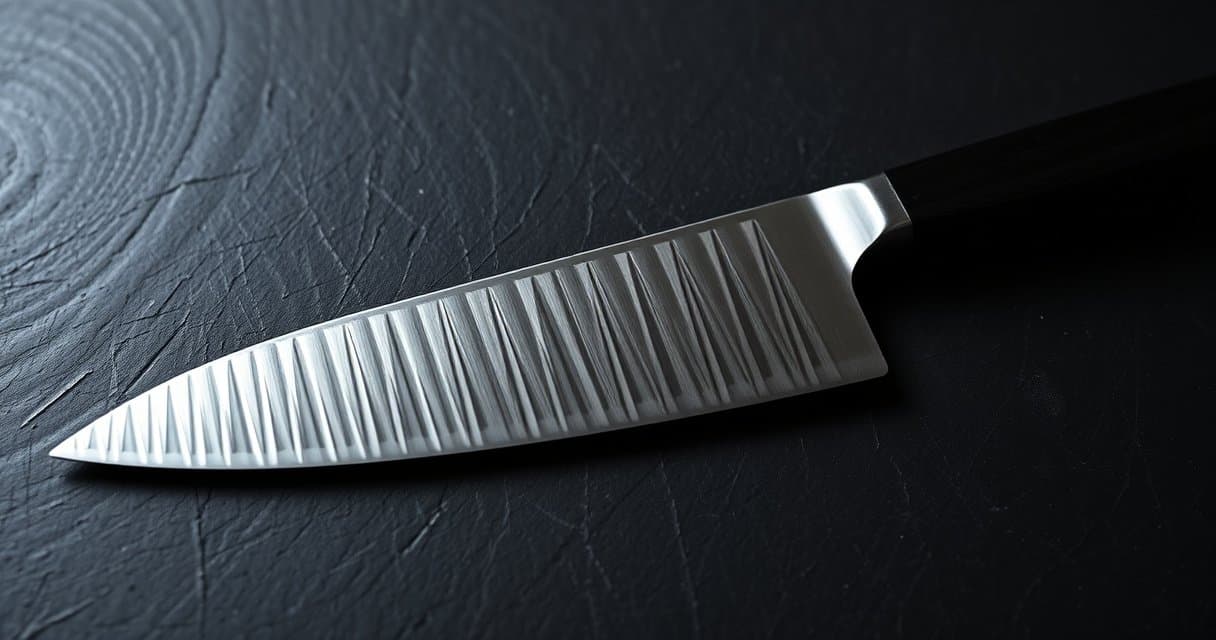
What Are Those Little Dimples on the Blade For?
You've seen them: those regular depressions along the cutting edge. This is the kullenschliff effect, sometimes called "grantons." It is not a marketing gimmick. By creating air pockets between the blade and the food, they radically reduce adhesion. Cutting slices of very starchy potatoes, sticky cheese, or thin cucumber rounds becomes child's play. The slices detach on their own, without you having to peel them off the side of the blade. It is a valuable aid for speed and precision. However, it adds complexity to long-term sharpening, as you must respect the shape of each dimple. For versatile daily use, a santoku without kullenschliff is simpler to maintain over ten years.
Weight and Thickness: The Feel in Hand
A santoku is not a cleaver. The idea is maneuverability and control. Look at the thickness of the blade's spine, near the handle. A thickness of about 2 to 3 mm is typical. Then, the blade should taper progressively to the cutting edge. This taper is what allows a knife with some presence in the hand to penetrate food with minimal resistance. The best Japanese santoku knife for you will be the one where you no longer feel the blade, but only the trajectory of your cut. A blade that is too thick or poorly tapered will push the food instead of slicing it. Weigh it. If it feels heavy for its size, that's often a bad sign. You want a light ally, an extension of your hand.
Our Selection
We have selected for you three Santoku knives, a staple of Japanese cuisine that has become indispensable in Western kitchens. Versatile, easy to handle, it is the perfect ally for slicing, chopping, and mincing. But not all Santoku knives are created equal. We have analyzed the technical specifications and feedback from thousands of users to present these three models, their strengths, and limitations. Which one will be yours?
To facilitate comparison, here is an overview of the key characteristics of each model:
| Product | Blade Length | Blade Material / Hardness (HRC) | Handle | Key Strengths (based on specs and reviews) |
|---|---|---|---|---|
| SHAN ZU Santoku Knife | 18 cm | German Steel 5Cr15MoV / 55-57 | Pakkawood, full tang | Factory sharpness, versatility, easy maintenance (dishwasher safe) |
| AIRENA Santoku Knife | 17.5 cm | Steel X50Cr15MoV / ~55 | Pakkawood, hollow edge blade | Damascus finish, hollow edge, lifetime warranty against defects |
| HOSHANHO Santoku Knife | 18 cm | Japanese Steel 10Cr15CoMoV / 62 | African Pakkawood | High hardness, brushed finish, non-stick design (grooves) |
SHAN ZU Santoku Knife
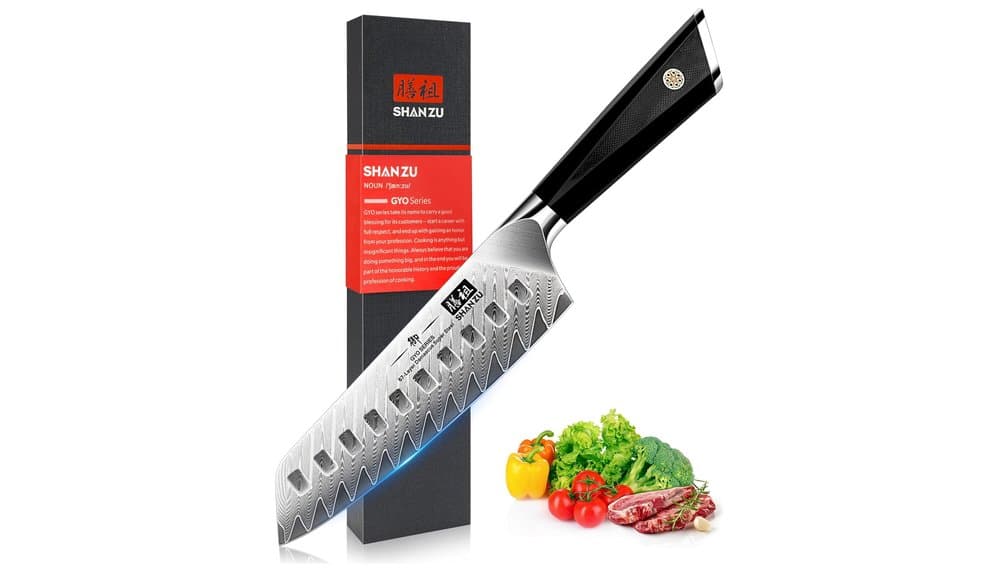
This model from SHAN ZU positions itself as a classic and reliable Santoku knife, designed to offer a simple and effective user experience. On paper, the specs promise an interesting balance with a blade made of German 5Cr15MoV steel with a hardness of 55-57 HRC, a standard 18 cm length, and a Pakkawood handle secured with rivets in a full tang construction, a guarantee of sturdiness.
According to user feedback, the main asset of this knife is its factory sharpness. Many reviews highlight that it arrives extremely sharp, capable of slicing tomatoes or onions with great ease, without excessive pressure. Its versatility is also appreciated for daily tasks, from vegetables to meats. Another positive point noted by the community: it is advertised as dishwasher safe, a practical advantage for many, even if purists generally discourage this practice to preserve the edge long-term.
Regarding limitations, some reviews suggest that edge retention requires regular sharpening, which is normal for steel in this hardness category. Its weight of 207g is sometimes perceived as a bit light by users accustomed to heavier knives, which can affect the feeling of "gravity" cutting. Finally, although the finish is generally considered good, a few comments mention minor cosmetic details on the handle or the blade/handle junction.
AIRENA Santoku Knife
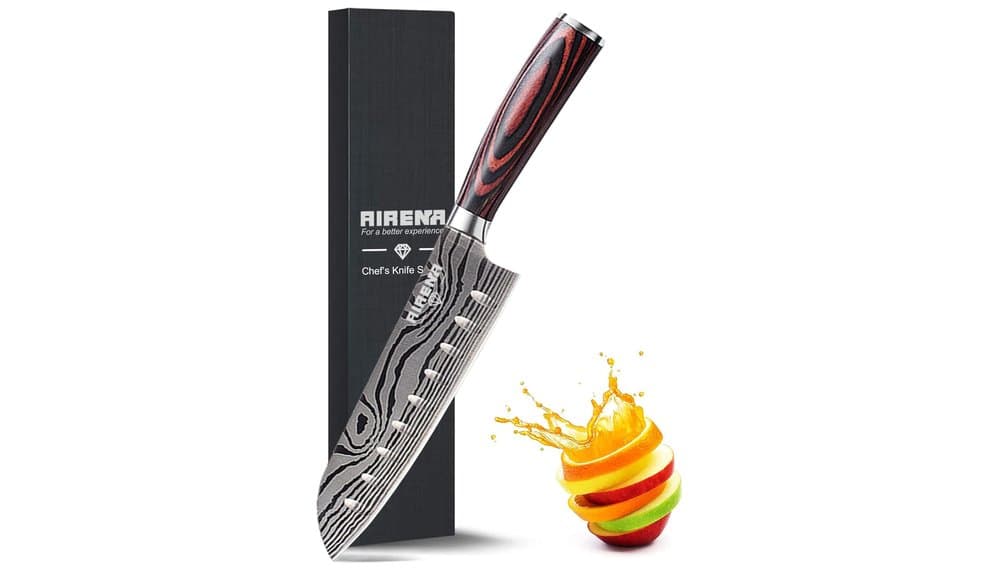
The AIRENA Santoku stands out with its specific design and technical characteristics aimed at cutting performance. It features a Damascus finish (pattern on the blade) and, crucially, a hollow edge blade (Hollow Edge). These hollows are designed to create air pockets and reduce food adhesion, such as potatoes or cucumbers, during cutting.
The technical specifications highlight X50Cr15MoV steel, a quality European standard, with a hardness of around 55 HRC. Customer reviews often confirm that the knife is very sharp upon receipt and that the hollow edge works well to prevent slices from sticking. The community also notes that control is precise, thanks to good balance and a comfortable Pakkawood handle.
However, this model presents some compromises. First, the blade length is slightly shorter (17.5 cm), which can be a drawback for those who prefer a longer blade for chopping large quantities. Secondly, and this is a crucial point raised by users, the manufacturer explicitly states that this knife is not suitable for the dishwasher. Its maintenance must therefore be manual. Finally, the hollow edge, while effective against adhesion, can make home sharpening more complex for a novice compared to a straight-edged blade.
HOSHANHO Santoku Knife
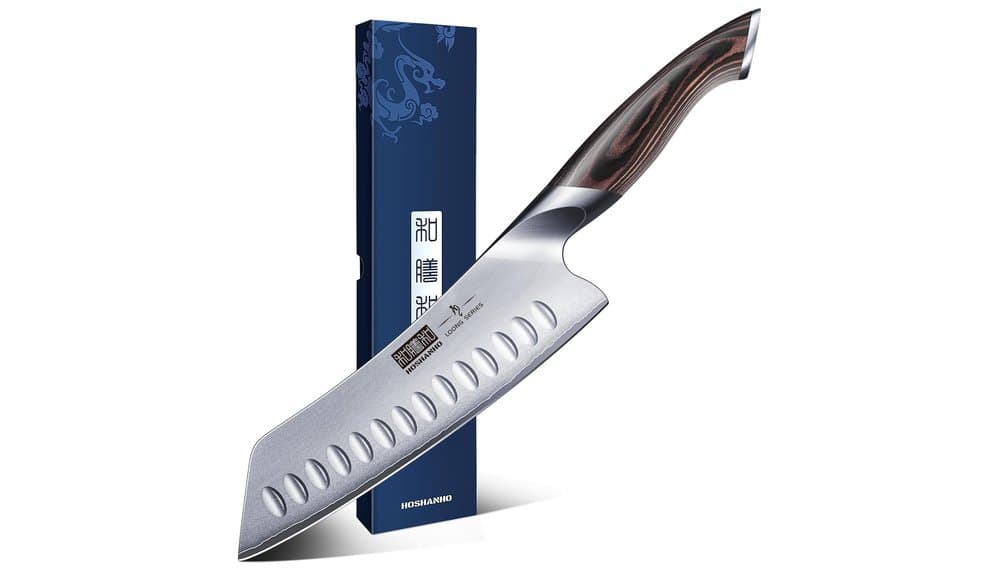
The HOSHANHO clearly bets on material technology to stand out. Its main argument is its Japanese 10Cr15CoMoV steel with an advertised hardness of 62 HRC, which is significantly higher than the other two models. On paper, this promises superior edge retention, meaning it should keep its sharpness longer between sharpenings. Its blade also features a brushed finish (frosted) and anti-adhesion grooves.
Analysis of reviews shows that users are indeed impressed by its aggressive and durable cutting performance. Many describe a feeling of solidity and quality construction. The African Pakkawood handle is also praised for its ergonomic and comfortable grip, even during prolonged cooking sessions. Its versatility for all types of food is a recurring point in positive feedback.
The limitations, according to the community, are inherent to its technical choices. Harder steel (62 HRC) can be slightly more fragile to shocks (like hitting a bone) and, above all, it will be more difficult to sharpen for an amateur without the proper tools (a quality sharpening stone is highly recommended). Like the AIRENA, it should not go in the dishwasher. Finally, its slightly heavier weight (around 318g) is noted; it offers a more powerful cutting feel but can be perceived as less maneuverable by some.
The Wa or Western Handle: A Matter of Balance and Grip
Here, we're not just talking about aesthetics. The handle defines the soul of the tool, its balance point, and how it will communicate with your hand during hours of work. It's a profound sensory difference. You don't hold a knife, you embrace a lever. Choosing between a traditional Japanese (Wa) handle and a Western handle is choosing between two philosophies of movement.
The Wa Handle: Light, Direct, and Natural
Imagine an octagonal or round piece of wood, slightly rounded. That's the Wa handle. It is generally lighter and fixed to the blade by a tang that goes through and is inserted into the wood (a construction called "hidden full tang"). The big advantage? It moves the center of gravity forward, right behind the blade. In hand, you literally feel the tip of the knife. This provides intuitive control for precise cuts and the pulling motions typical of Japanese cuisine.
The octagonal shape, in particular, is an ergonomic marvel. It naturally guides your fingers into the same grip every time, preventing wrist torsion. The wood (like oiled magnolia, cherry wood, or ebony) provides pleasant warmth and grip, even with wet hands. However, it requires a little care: avoid soaking it, dry it after washing so it doesn't crack. For me, this is the closest sensation to an authentic best Japanese santoku knife.
The Western Handle: Familiar, Robust, and Balanced
This is the style you probably already know: two scales (in pakkawood, micarta resin, or sometimes wood) riveted on either side of a full tang that runs the entire length of the handle. The balance is completely different. It is often more neutral, located at the bolster, where your index finger positions itself. The knife "sits" more in your palm.
It's reassuring, especially if you're used to European knives. The so-called "pinch grip" (thumb and index finger pinching the blade right before the handle) is very natural with this configuration. These handles are often more resistant to shocks and repeated washings, which is reassuring for longevity. For many, it's the choice of ease and robustness. But frankly, if you're looking for lightness and the feel of a unique tool, this is not where you'll find it.
See priceThe Wrist's Verdict: How to Choose?
Don't rely on pictures. The only way to know is to hold it.
- For a Wa handle: Pick it up. If you feel the knife seems to "point" where you're looking, with a natural agility, that's a good sign. Check the wood finish, the absence of rough spots.
- For a Western handle: Check the junction between the blade and the handle. It should be perfectly smooth, without the slightest gap where moisture could seep in. The profile should comfortably fill your palm.
Don't listen to those who say one type is objectively superior to the other. It's a story of marriage between the tool and your hand. Poor balance, even on a technically perfect knife, will tire you out and spoil the pleasure.
Deciphering Price Ranges and Value-for-Performance Ratio
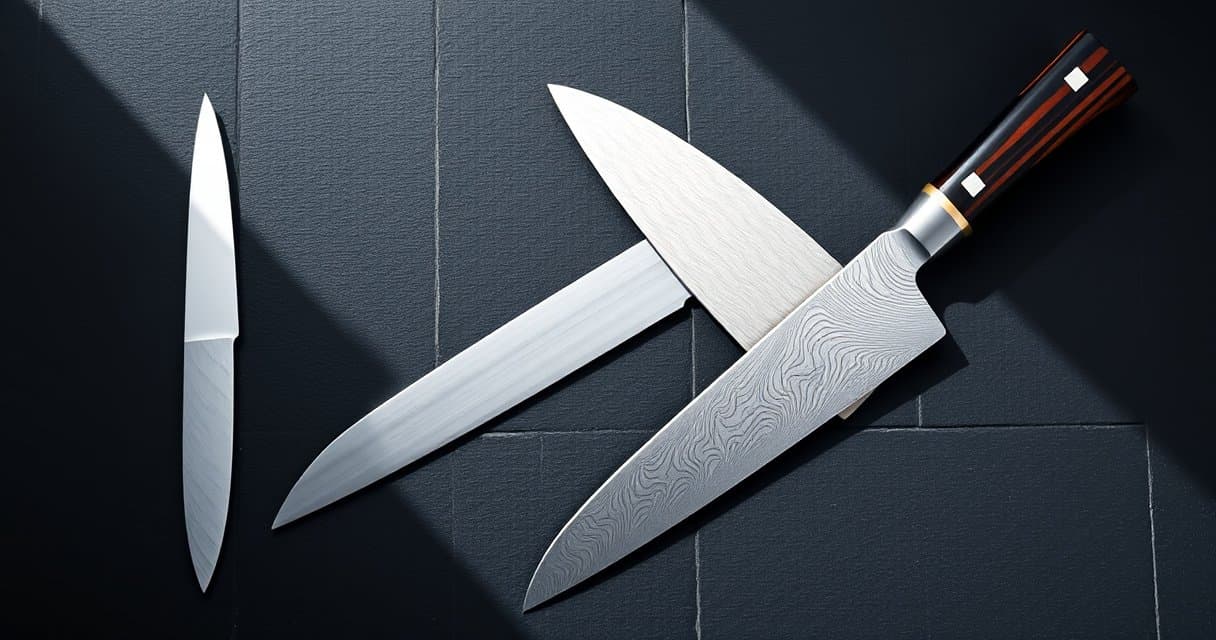
The price of a santoku is not a random number. It is the direct translation of manufacturing choices, hours of work, and the level of finish. Frankly, at 40€, you will never get the same item as at 200€. But that doesn't mean you have to empty your wallet for a performant tool. It's about knowing where your money goes, and from what point you are paying for refinements that only a trained eye will perceive.
The Entry-Level Segment (50 - 90 €): The Gateway
In this range, you find knives often mass-produced, with basic steels (such as stainless steel AUS-8 or X50CrMoV15). The Rockwell hardness (HRC) generally hovers around 56-58, which is acceptable but not exceptional. The edge will be pleasant at first, but will dull more quickly, requiring more frequent sharpening.
The finish is the main compromise. The junction between the blade and the handle may have slight irregularities, the blade polish is standard, and the handle will be made of simple materials (plastic, non-stabilized wood). It's a good choice to test the santoku shape without commitment, or for a second knife. But don't expect a revelation.
The Core Market and Best Value-for-Money (100 - 200 €): The Sweet Spot
This, in my opinion, is where you find the best Japanese santoku knife for the vast majority of passionate cooks. Your money buys a real technical difference.
You enter the realm of performant Japanese steels like VG-10, powdered metallurgy SG2/R2, or AUS-10. Their hardness climbs (HRC 60-63), ensuring remarkable edge retention: you'll go weeks, even months, before feeling the need to go back to the sharpening stone. The blade geometry is more refined, with thinning (grind) behind the edge that facilitates cutting. The handle is well-fitted, made of durable materials like pakkawood or G10. This is the investment that truly transforms your cooking experience.
The High-End and Artisanal (250 € and above): The Exceptional Object
Here, you are paying for craftsmanship, rare materials, and marginal performance gains. We're talking about complex steels like ZDP-189 (HRC can reach 67), purely aesthetic but beautiful multi-layer Damascus constructions, or traditional carbon steels (Shirogami, Aogami) hand-forged.
The shaping is often manual or semi-manual. Every detail is pushed: the blade polish is mirror-like, the handle is made of precious wood and perfectly ergonomic, and the balance is calculated to the gram. The difference in edge sharpness compared to a 150€ santoku will be perceptible, but subtle. This is the purchase of emotion, of owning a unique tool. For intensive daily use? Not necessarily. For the pleasure of the senses and supporting a craft? Absolutely.
Essential Maintenance Habits to Preserve Your Investment
Having the best Japanese santoku knife in your hands is a pleasure. But it's also a responsibility. A knife of this fineness should not be treated like a canteen utensil. Its maintenance is not a chore; it's a short ritual that guarantees years of impeccable service. Frankly, neglecting it is like buying a sports car and never changing the oil.
Washing and Drying: The Immediate Act
Forget the dishwasher, definitively. The combination of aggressive detergents, thermal shock, and high-pressure water jets is a death sentence for the edge, the handle, and, for carbon steels, a direct ticket to rust. Wash by hand, with warm water and a soft sponge. One crucial little point: avoid letting the blade soak in soapy water, especially if the handle is wooden. Always dry it immediately and meticulously with a cloth, paying special attention to the area of the tang (the part of the blade inside the handle), where moisture loves to hide. It's simple, but it's the number one golden rule.
Storage: Avoiding Impacts and Scratches
The cutlery drawer is a battlefield for a fine blade. Impacts against other utensils dull the microscopic edge of the blade with every contact. The solution? Dedicated storage. Several options are available to you. A magnetic wall strip is excellent: it holds the blade in the air, without contact, and prevents it from hitting anything. Wooden block slots are good, provided the slots are clean and spacious enough not to scratch the blade upon insertion. For transport or ultra-protected storage, a rigid case or a wooden sheath are ideal. The goal is simple: protect the cutting edge from any solid contact.
Regular Sharpening: Not an Option, a Necessity
Contrary to popular belief, you don't sharpen a knife only when it no longer cuts. At that stage, it's already too late and the task will be long. Regular sharpening is preventive maintenance. For a santoku made of hard steel (HRC 60+), a pass on a fine-grit sharpening stone (for example, 3000 grit) every 4 to 6 weeks of regular use is enough to realign the edge and maintain that razor sharpness.
Avoid pull-through sharpening gadgets with wheels like the plague. They remove too much metal and destroy the precise geometry of your blade. Take five minutes, put water on your stone, and slide the blade while respecting its angle (around 15 degrees per side for a santoku). It's a form of meditation. And if the idea intimidates you, start with a less expensive knife to get the hang of it – but your santoku deserves this attention.
The Cutting Board: The Invisible Surface That Wears Your Blade
This is often the forgotten element. Cutting on a glass, ceramic, or granite board is the worst thing you can do. These surfaces are harder than your steel and will grind it down with every pass. Always favor softwood boards (like beech), bamboo (quality, well-glued), or polyethylene boards. They are soft enough to receive the edge without damaging it. A good cutting board is the indispensable partner of your good knife.
Conclusion
So, there you have it. Choosing your Japanese santoku is not just about selecting a tool. It's about choosing a kitchen partner for the years to come.
Take the time to feel the balance in your hand. Listen to what the steel and the geometry promise you. And above all, commit to taking care of it.
Because the true pleasure begins when this knife becomes the natural extension of your movement. Happy discovering, and happy slicing.
Frequently Asked Questions
What makes a good Japanese santoku knife?
A good Japanese santoku knife is defined by its quality steel (like VG-10 or blue steel), a fine blade geometry sharpened at a low angle, and a perfect balance between the blade and handle that offers intuitive control.
Which steel to choose for a santoku knife, stainless or carbon?
For easy maintenance and good rust resistance, choose a Japanese stainless steel like VG-10. For superior sharpness and ease of sharpening, opt for carbon steel (like Aogami), but it requires immediate drying to avoid oxidation.
What is the purpose of the hollows (holes) on a santoku knife?
These hollows, called a "kullenschliff" or "granton" effect, create air pockets that reduce food adhesion to the blade, making it easier to cut sticky products like cheese or potatoes.
Should you prefer a Wa handle or a Western handle for a santoku?
The traditional Wa handle, often an octagonal wooden one, offers a forward balance for precise control, while a Western handle provides a more familiar and robust grip with a more neutral balance at the bolster.
What is the price of a good Japanese santoku knife?
A santoku offering excellent value for money is generally priced between 100 and 200 euros, featuring high-performance steels like VG-10 or SG2, high hardness (HRC 60-63), and careful finishing.