Best Professional Sharpener Guide
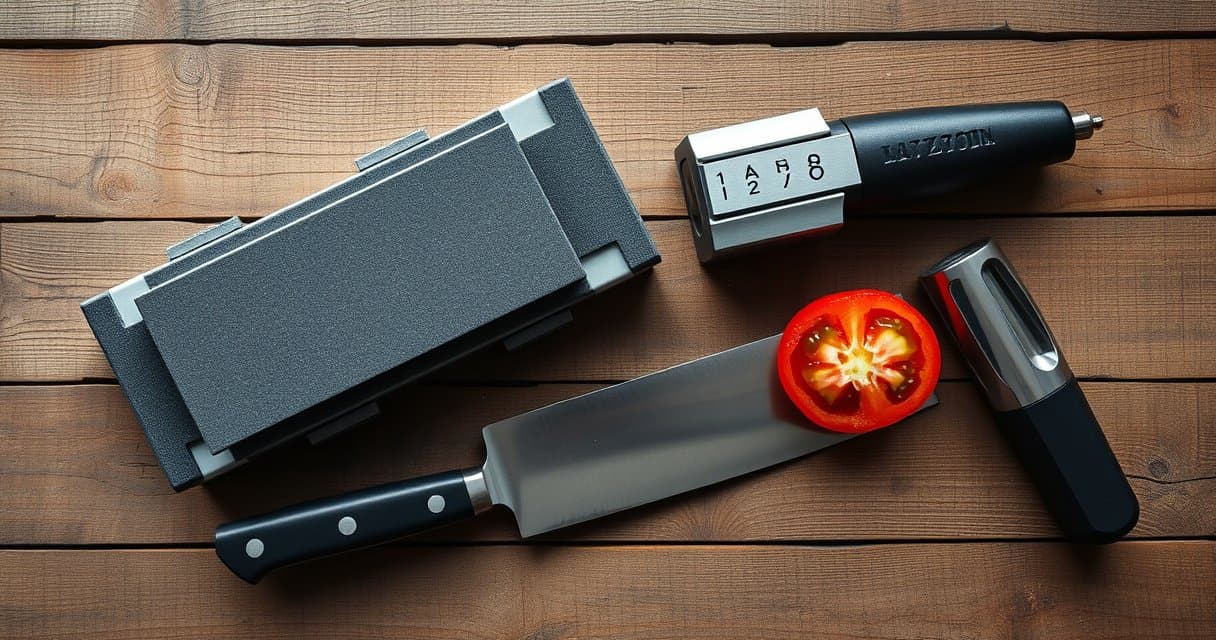
Do you feel like your best knife now drags through vegetables instead of slicing them? A professional sharpener isn't an accessory; it's the essential condition for breathing new life into your blades, and above all, for respecting the knife maker's craft and the quality of your steels. It's the only tool that guarantees your investment in a fine blade will last a lifetime. Let's review how to choose the tool that truly matches your practice.
Key Points to Remember
- The choice of sharpener depends on your practice: stones for mastery, guided systems for precision, or high-end machines for efficiency.
- The abrasive must match your steel: diamond for reprofiling, ceramic for polishing, and water stones for exceptional finishing.
- Angle adjustment is crucial and must respect the specific geometry of each blade to avoid damaging it.
- A quality professional sharpener is recognized by its robust, stable construction with no mechanical play.
- Prioritize a modular and versatile system to grow with your evolving knife collection.
Understanding the Three Main Families of Professional Sharpeners
You have a knife that deserves the best. The first, and most decisive, choice boils down to this question: how do you want to interact with your blade? The method defines the result, and, above all, the relationship you will have with your tools. Frankly, entrusting a blade of white steel #2 or VG-10 to a poor system is almost a crime. So, let's break down the three possible paths.
Water (or Oil) Stones: Absolute Mastery
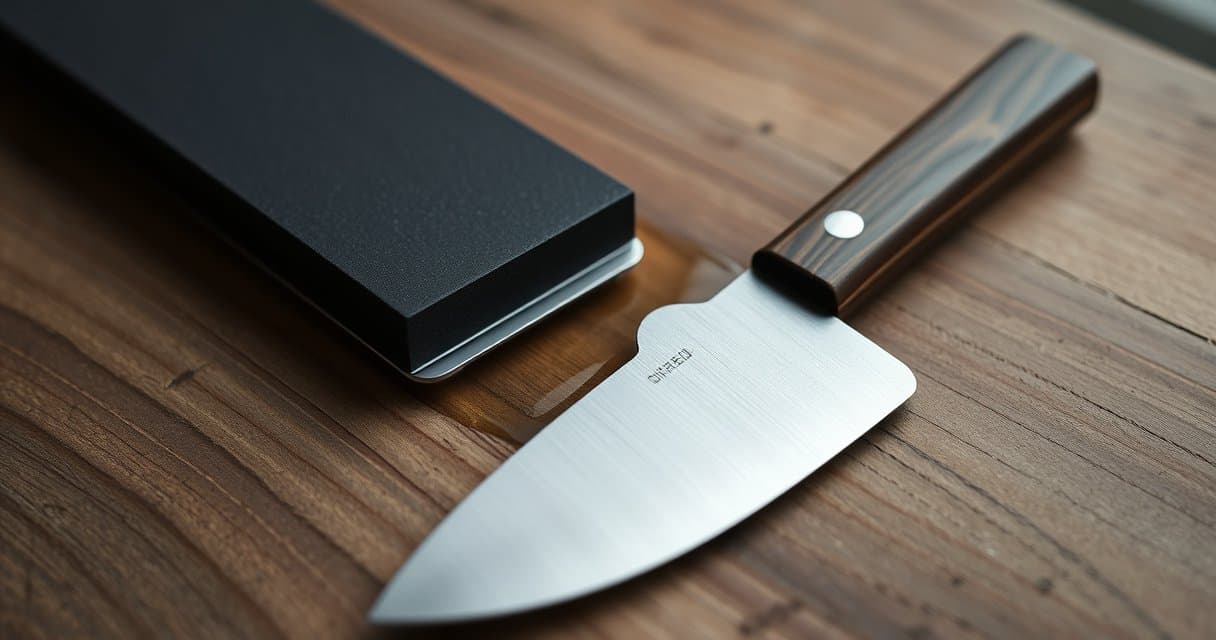
This is the ancestral method, the most respectful, and the one that offers the highest level of finish. We're talking about an abrasive block that you moisten, on which you guide the blade by hand, with no other guide than your eye and feel. The ultimate for a razor edge on hard steels (beyond 60 HRC). The advantage? Total control. You can perfectly manage pressure, angle, and movement to adapt to each type of blade – a Japanese single bevel does not get sharpened like a Western chef's knife. The disadvantage? A learning curve. It takes practice to maintain a constant angle. But once the technique is mastered, it's incomparable freedom. You will need several grits: a 1000 to reshape the edge, a 3000 or 6000 to refine and polish it.
Manual Guided Systems: Ingenious Precision
Do you want the result of a stone without the learning curve? That's where these systems come in. Imagine a holder that secures the stone, and a guide that holds your knife at a fixed, perfectly repeatable angle – often between 15° and 20°, sometimes adjustable to the degree. It's a revolution for the demanding enthusiast. You get a perfectly regular sharpening, ideal for the double bevels of Western knives. It's objectively simpler and less intimidating than freehand stones. The trick? Check compatibility with your blade types. A purely 20° system won't work wonders on a santoku that requires 15°. For optimal versatility, aim for a model offering several pre-defined angles.
High-End Electric Sharpeners: Motorized Efficiency
Forget the noisy little appliances with carbide slots. Here, we're talking about serious machines with quality abrasive wheels (often diamond or ceramic) and a motorized guidance system for the blade. Their strength? Speed and consistency for the regular maintenance of a full kitchen battery. It's the tool of the pro who has ten knives to sharpen in five minutes. But be careful: not all are created equal. A best professional knife sharpener in this category must absolutely offer adjustable angles and progressive wheels (from rough grinding to polishing). The risk with a low-end machine is removing too much metal, too brutally, and "cooking" the steel from heat buildup. For intensive domestic use, it's a valid option, but for an exceptional blade, I remain a proponent of manual contact.
The Science of Abrasives: Choosing the Right Grit for Your Steel
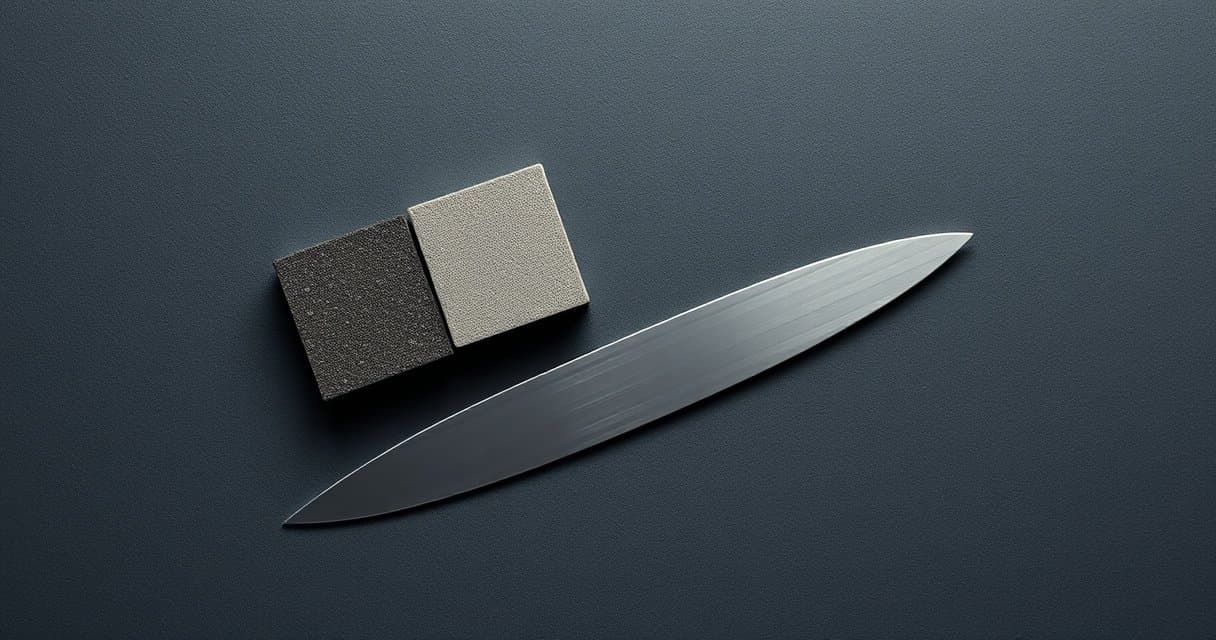
Your knife is solid: steel at 61 HRC, super-fine grain. But if you run it over a coarse and brutal abrasive, you'll ruin everything. The key is to match the abrasive's bite to the hardness and structure of your metal. It's a real dialogue. An unsuitable abrasive doesn't create an edge; it tears it, leaving a jagged edge that dulls in an instant.
Diamond: The Roughing Tool
This is the most aggressive and durable abrasive. An electroplated diamond plate on a metal backing. Its great strength? It bites into everything, and fast. It is particularly effective for reshaping a heavily damaged edge or for very hard so-called "super" steels, like powder metallurgy steels. For a versatile best professional knife sharpener, a diamond stage is often present for the initial reshaping. But beware: it removes a lot of material and leaves deep scratches. The result is sharp, but rough. This is why it must always be followed by a pass on a finer abrasive to polish and refine the edge.
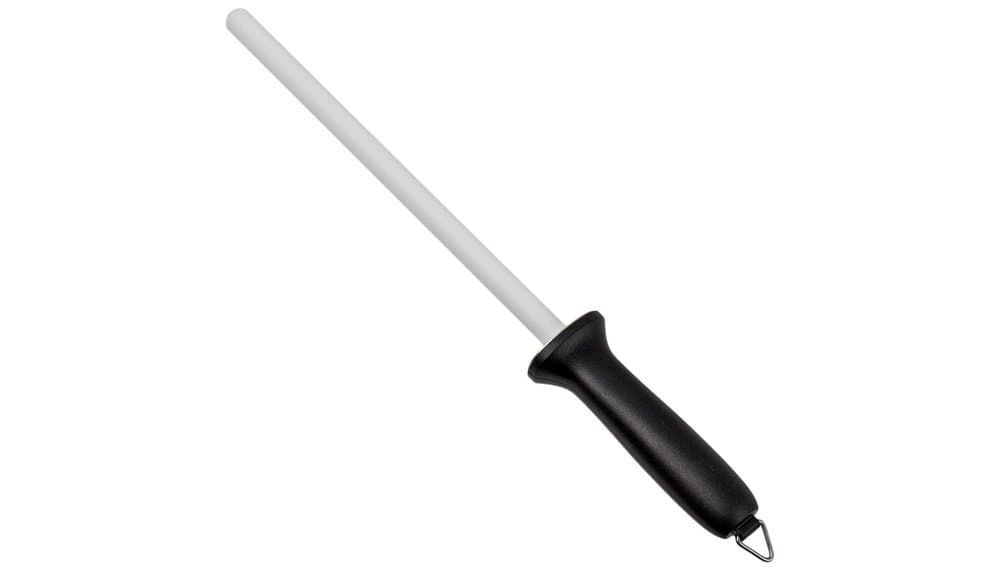
Ceramic: Finesse and Polish
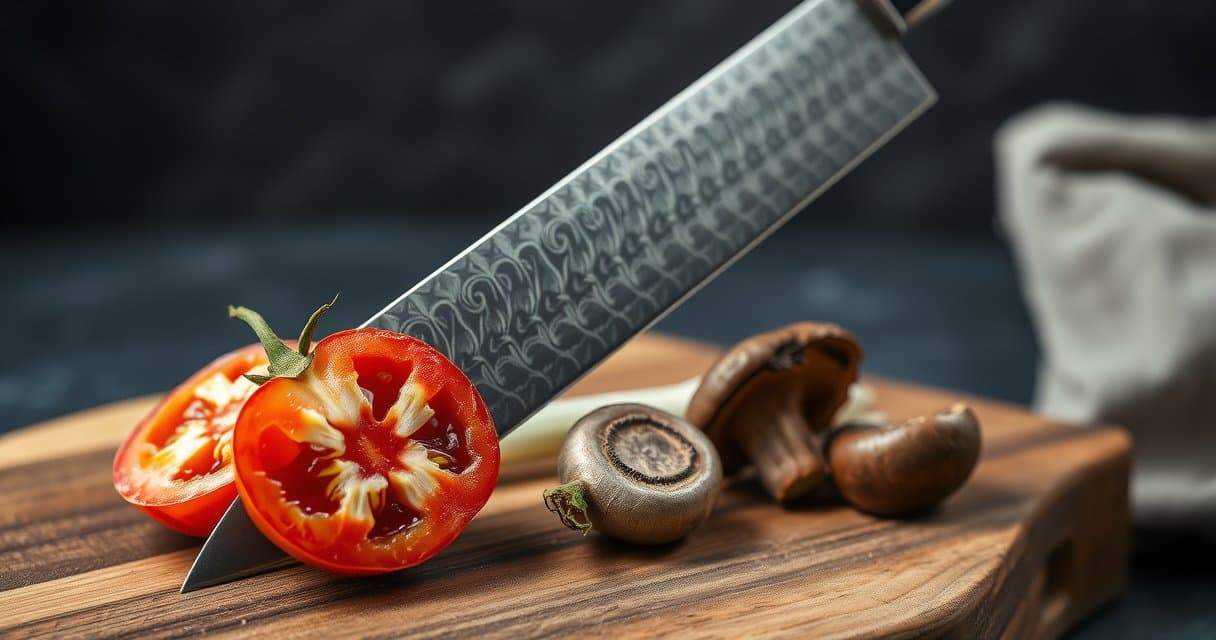
Contrary to a common misconception, ceramic (often zirconium oxide) is not soft. It is very hard and brittle, which allows it to renew itself slightly during use. It produces extremely fine abrasive particles. Its action is less aggressive than diamond, but it excels in finishing sharpening and polishing. It's the step that transforms a "sharp" edge into a "gliding" edge that slices through a tomato without crushing it. For most modern stainless or carbon steels, a ceramic stage after diamond is the secret to a durable and perfect edge.
Synthetic Water Stones: The Smart Compromise
This is where things get exciting. These stones, often made of corundum (aluminum oxide) bound with magnesia or resin, offer an almost infinite range of grits, from 120 (very coarse) to over 8000 (mirror). Their particularity? They wear down by releasing new abrasive particles and need to be soaked in water. This abrasive slurry that forms on the surface is precisely what allows for progressive sharpening and exceptional polishing. For a Japanese knife in blue #2 steel, this is often the royal road. You start with a 1000 grit to reshape the edge, then move on to a 3000 or 6000 to polish it. The final result is of unmatched finesse.
So, how to choose? A simple rule: the harder and finer-grained your steel is, the more you can and should aim for fine grits. Running an R2/SG2 knife (63 HRC) directly on a coarse abrasive is nonsense. Conversely, trying to restore a sharp edge to a dull old knife with a 5000 grit stone, you'll still be at it tomorrow. The true professional will always have several grits in their workshop.
Our Selection
Knife sharpening is often the great forgotten task in the kitchen, until you find yourself with a knife that mashes a tomato instead of slicing it. To avoid this scenario, manual "pull-through" sharpeners (where you pull the blade through a slot) are a popular solution for their simplicity. We have analyzed three popular models to help you see things more clearly. Which one best fits your needs and your type of knives?
| Product | Principle & Stages | Compatibility | Construction & Stability | Key Strengths (based on reviews) |
|---|---|---|---|---|
| Smart Sharp (Lantana) | 3 stages (Diamond, Tungsten Carbide, Ceramic) | Western knives (~20° angle). Excludes Japanese knives, ceramic, scissors. | Ergonomic handle, heavy non-slip base (185g), metal finish. | Results highly praised, clear instructions, quality feel. |
| Dealswin Professional | 2 adjustable V-shaped arms (Tungsten Carbide) | Advertised as universal (standard, serrated, Japanese, cleavers...). | Heavy (400g), stainless steel structure, no fixed base. | Maximum versatility, direct hands-on control of the knife, robust. |
| PORTENTUM | 3 stages (similar to Smart Sharp) | Identical to Smart Sharp (Western knives, wide teeth). | Very similar design (185g), ergonomic handle, non-slip base. | Good perceived value for money, simplicity, stable design. |
Smart Sharp (Lantana)
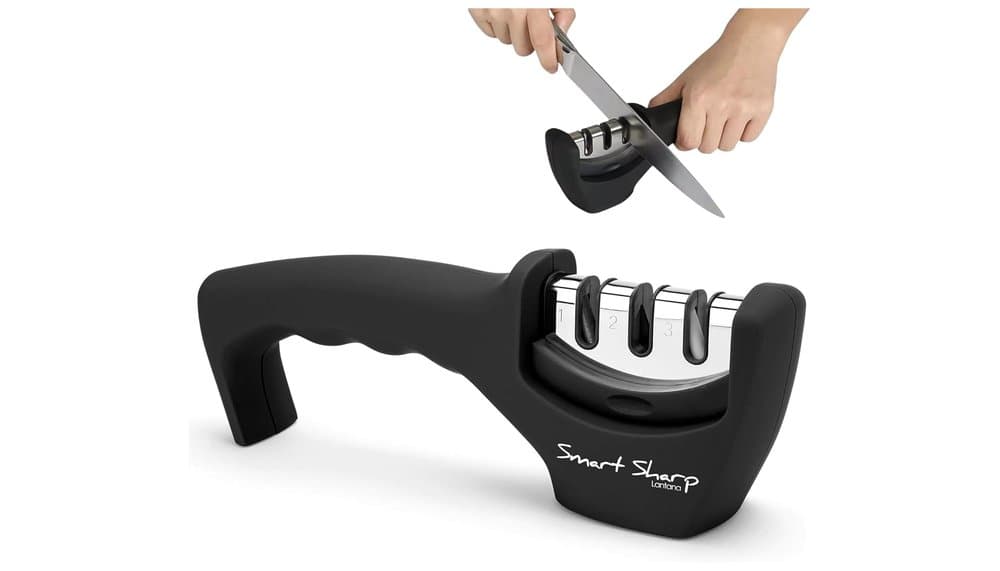
On paper, the Smart Sharp positions itself as the premium solution in our selection. Its three distinct stage system (diamond for prepping, tungsten carbide for sharpening, ceramic for polishing) promises a more comprehensive approach than single-stage sharpeners. The community notes that this progression allows for a fine and long-lasting edge, close to a professional result, without the learning curve of a sharpening stone.
Its ergonomics are also praised: the comfortable handle and, especially, the heavy non-slip rubber base ensure excellent stability during use. Users appreciate not having to hold it with one hand while pulling the knife with the other, a significant comfort point. The manufacturer, Lantana, highlights responsive customer service and a 5-year parts warranty, which, according to feedback, inspires confidence in the product's durability.
However, this performance has its clearly defined limits. The Smart Sharp is designed for a fixed 20-degree angle, typical of Western knives. It is therefore explicitly not recommended for Japanese knives (which have a much lower angle), ceramic knives, or scissors. Some reviews also note that for heavily damaged knives or those previously sharpened at a different angle on a stone, the results can be disappointing. It's a specialized tool for a standard knife collection.
Dealswin Professional Knife Sharpener
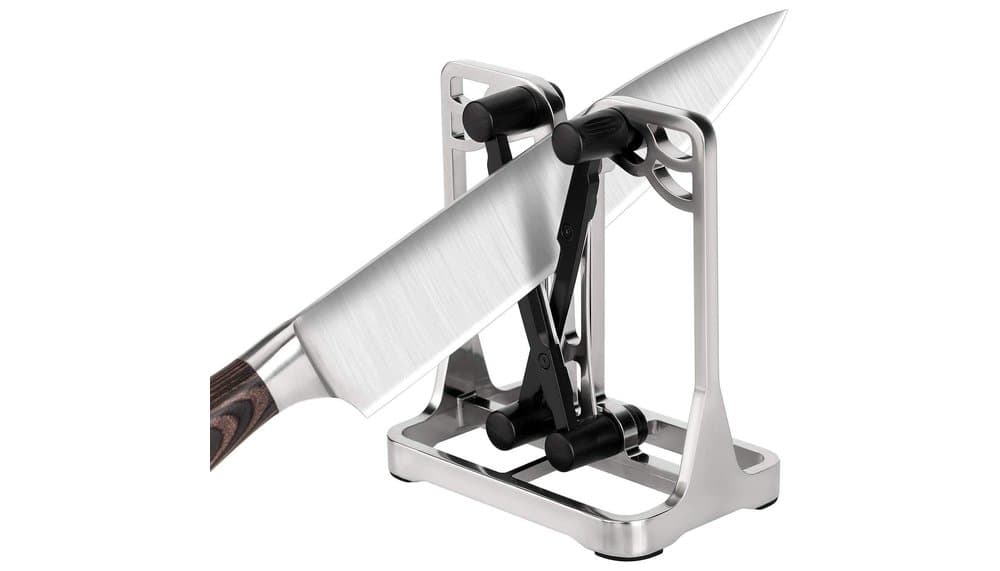
The Dealswin Professional takes a radically different approach. It is a manual "angle-guide" sharpener with two spring-mounted tungsten carbide arms. Its main promise is near-universal compatibility. According to its description, it can handle all types of blades, from Western chef's knives to Japanese knives, and even cleavers.
The main advantage, according to users, lies in this versatility and the manual control it offers. By adjusting the knife's angle against the arms, one can theoretically adapt to the bevel of any blade. Its stainless steel construction and substantial weight (400g) give it a feeling of robustness and solidity. It is also compact and easy to store.
Community feedback, however, highlights significant challenges. First, it requires some technique and a steady hand to maintain a constant angle when passing the blade, which can intimidate beginners. Unlike models with a fixed base, you must hold the device with one hand while maneuvering the knife with the other, which can feel less secure. Furthermore, although universality is advertised, some reviews indicate that results on very hard knives or those with complex geometry can be uneven, and the system may seem more abrasive than a three-stage sharpening process.
PORTENTUM Professional Manual Knife Sharpener
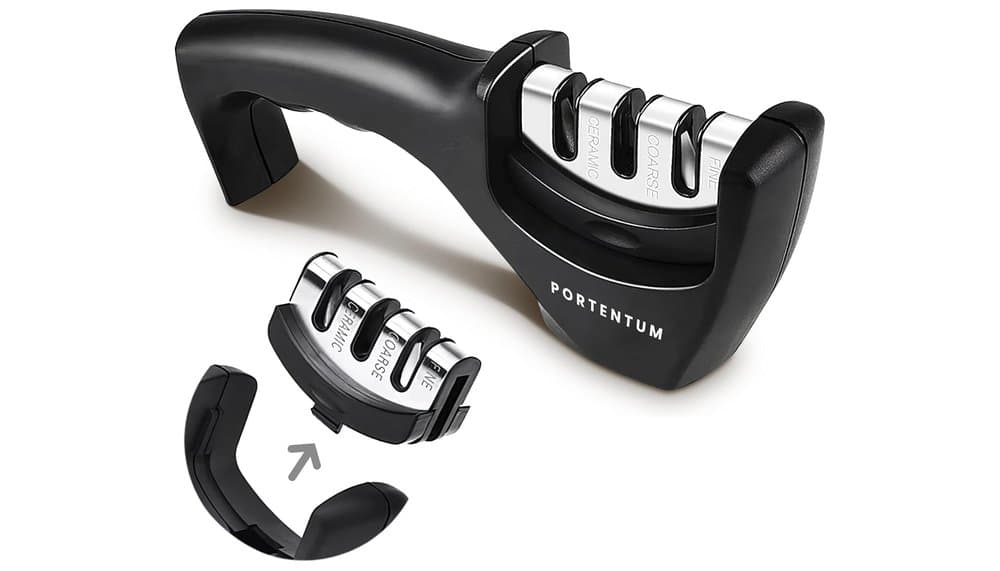
The PORTENTUM appears as a direct challenger to the Smart Sharp, with a very similar formula: a three-stage manual system and an ergonomic design with an almost identical handle and non-slip base. Its technical specifications (weight, dimensions, compatibility) are indeed very close. On paper, it targets the same audience: owners of standard Western kitchen knives looking for simplified and effective sharpening.
The user community often perceives it as a cost-effective alternative offering comparable performance. Reviews highlight its ease of immediate use, good stability thanks to its rubber base, and satisfactory results for regular home use. The presence of European customer support is also noted positively.
However, the feedback echoes the same limitations as its counterpart. It is just as unsuitable for Japanese or ceramic knives. Its angle is fixed. Delving into the reviews, one notes that while overall satisfaction is high, some comments mention a finish or materials that might seem slightly less premium over time compared to the Smart Sharp, although this remains subjective. The 3-year parts warranty, while very decent, is less than the Smart Sharp's 5 years.
Angle Setting: The Key to Respecting Each Blade's Geometry
Here is the number one mistake, the one that ruins a blade faster than anything else. Running your beautiful Japanese gyuto on a fixed-angle sharpener designed for Western butcher knives is a guaranteed disaster. The angle is everything. One degree too much, and you lose the edge's finesse. One degree too little, and the edge becomes too fragile.
Think of the angle as the pillar of a house. A wide angle, say 20 to 22 degrees per side, is a robust pillar. Perfect for a Western chef knife in X50CrMoV15 that will chop chicken bones or slice through pumpkin. The edge is strong, but less sharp in the long run. Conversely, an angle of 10 to 15 degrees, as on most Japanese carbon steel knives, is a fine, slender pillar. The edge is razor-sharp, ideal for precise slicing of fish or vegetables, but it requires more delicate handling. Frankly, trying to sharpen all your knives at the same angle with a universal gadget is a surefire way to ruin them slowly.
This is where choosing a best professional knife sharpener makes all the difference. A serious tool gives you total control over this parameter.
See priceWhy a Fixed "Universal" Angle is Rarely a Good Idea
Many entry-level sharpeners promise a "universal" angle, often around 20°. The problem? It doesn't exist. It's a compromise that suits no one. Too wide for a Japanese knife, it will dull its performance. Too narrow for a Western one, it will make the edge fragile. You might get a knife that cuts, but never one that glides through food. It's guaranteed to negate the work of the blade smith who chose that specific angle for a precise reason.
Adjustable Angle Systems: Regaining Precision
The real solution is adjustability. The best systems, whether manual with guides or electric with pivoting arms, allow you to select the angle to the precise degree. Here is a quick pocket guide:
- Single-bevel Japanese knives (usuba, yanagiba): You only sharpen the beveled side, at a very low angle, often between 5° and 10°. The flat side remains perfectly flat. A classic sharpener can't handle this.
- Double-bevel Japanese knives (gyuto, santoku): Aim for a total angle of 30° to 40°, so 15° to 20° per side. This is the precision zone.
- Western kitchen knives: More robust, they work well with a total angle of 40°, or 20° per side. Perfect for tougher tasks.
- Pocket or hunting knives: Go even higher, to 40° to 50° total for maximum durability.
The advantage? You can adapt the sharpening to the use. Perhaps you want a slightly wider angle on the tip of your chef knife for heavy-duty work, and a narrower one near the heel for delicate slicing. With a good system, it's possible. It requires a bit more time and understanding, but it's the price to pay for maintaining a valuable tool, not just grinding it down.
Signs of a Build Designed to Last
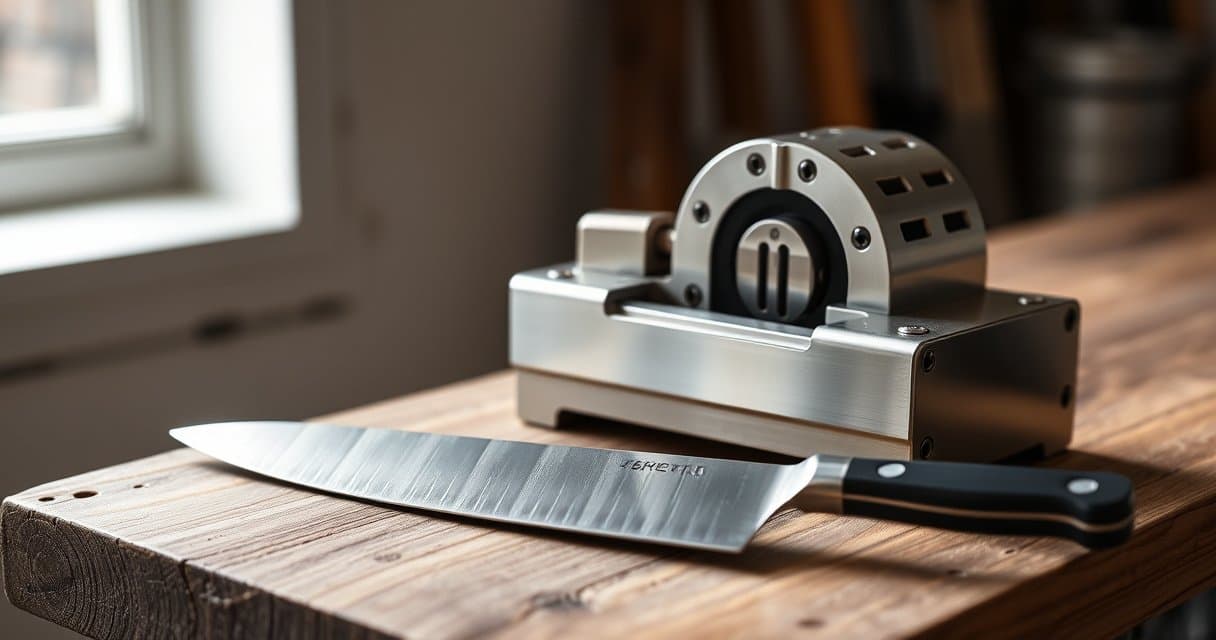
A professional tool is judged by its longevity, not its appearance out of the box. A sharpener that wobbles on the first pass of the blade is a guaranteed failure. Robustness is measured by three things: stability, the precision of the mechanisms, and materials that don't fail.
Let's start with the base. Literally. A lightweight plastic plate with small rubber feet? Forget it. You will apply pressure, sometimes significant pressure. The base must be heavy, substantial, and equipped with powerful suction cups or a clamping system to secure it firmly to the work surface. Some high-end models weigh several kilos; this is a deliberate choice. "Play" is the enemy of good sharpening. If the unit moves, your angle is compromised and the result will always be poor. This is the first distinguishing point between a toy and a real tool.
Next, look at the contact and adjustment points. For a guided system, the columns or arms holding the stone or the blade must be made of machined metal, not molded plastic. Thin plastic will warp with heat or stress, and your carefully chosen angle setting will be worthless by the tenth pass. Similarly, the clamping knobs should inspire confidence, turning smoothly but locking without play. Mechanical play is a deal-breaker. It is synonymous with imprecision and premature wear.
Let's talk about hidden materials. A blade guide made of anodized aluminum alloy will hold up much better than a painted guide that will scratch and leave marks on your blades. The inserts or jaws that hold the knife should be made of a material softer than steel, like nylon or brass, to avoid marking the spine of the blade. This is a detail that speaks volumes about the design. Frankly, a sharpener that damages the spine of your knife by holding it is total nonsense.
The Vibration and Noise Test
A good, often overlooked indicator is performance in action. A professional electric sharpener should operate with a deep, regular hum, without excessive vibration that would make the knife "dance" on the guide. A high-pitched noise or jerky operation often betrays a low-quality motor or an imbalance in the grinding wheels. For a manual sharpener, run your hand over the fixed parts while you simulate the sharpening motion. Do you feel vibrations or flexing? If yes, the structure lacks rigidity. A meilleur aiguiseur couteau professionnel conveys a feeling of solidity with every movement.
Finish, Revealer of Intent
Observe the edges, welds, finishes. Sharp edges, dripping paint, exposed low-quality screws... these are signs of careless assembly. Conversely, well-sanded stops, smooth surfaces, clean and robust fastenings show that the manufacturer has thought about the long-term user experience. This tool will live in your workshop or kitchen, be handled, perhaps get slightly splashed. It must be designed for that. Choosing a model with these build qualities is a way to avoid repeated frustration and make a purchase for the next ten years, at a minimum.
Anticipating the Evolution of Your Collection: Towards a Versatile System
Buying a sharpener solely for the knife you own today is a classic mistake. Passion evolves. You may start with a chef's knife in X50CrMoV15, but in six months, you might succumb to a nakiri in blue #2 steel at 63 HRC, or a paring knife in VG-10. Your sharpener must be able to follow this trajectory without becoming obsolete. The true best professional knife sharpener for you is therefore one that will grow with your practice, not one that will limit it.
Obsolescence comes quickly with closed systems. Imagine a basic electric sharpener with predefined wheels in generic "ceramic." It might suffice for your European knives, but it will be completely unsuitable, even destructive, for a harder and more fragile Japanese carbon steel knife. You would then be stuck: either you damage your new acquisition, or you buy a second sharpener. That's double trouble.
The solution? Prioritize modularity. Look for systems where key components are interchangeable or adjustable over a wide range.
Modularity in Practice: Parts and Adjustments
Concretely, this can translate into several characteristics. For a waterstone system, opt for a universal guide that accepts stones from different brands and standard widths (such as the 150mm or 200mm length formats). This allows you to buy specialized grits later – a 220 grit stone for repairing a large chip, or a finishing stone at 8000 grit for a mirror polish.
For a rigid guide system, check the angle range offered. A system that only adjusts from 15° to 20° is designed for Japan. A system that covers from 10° to 25° with fine increments will allow you to sharpen both a very precise single bevel knife (around 10-12°) and a robust butcher's knife. It's this amplitude of adjustment that makes the difference in the long run.
Some high-end systems even offer conversion kits or different clamping jaws to adapt to extremely thick blades (like a kitchen axe) or, conversely, razor blades. This is the next level of versatility.
Avoiding the Trap of "False Versatility"
Beware of empty marketing claims. A slot sharpener that promises to "sharpen everything, from knives to scissors" is often the worst choice for a demanding collection. These V-slots, typically made of carbide and ceramic, wear down the blade in a brutal and uniform manner, with no respect for its original angle or steel type. It is the antithesis of real versatility. True versatility is the ability to adapt the method and tool to the blade, not to impose a single, destructive method on it.
Thinking about the future also means thinking about abrasive maintenance. A system that allows for easy replacement of a worn abrasive belt, a diamond wheel, or "dressing" a waterstone is a system designed to last. You won't have to throw away the entire device when a single component reaches the end of its life. This design philosophy is, in my opinion, what definitively separates serious equipment from temporary gadgets. Investing in such a system is giving yourself the freedom to buy the knife you truly desire tomorrow, without fearing you won't be able to maintain it properly.
Conclusion
A good professional knife sharpener is not an expense. It is a guarantee.
It protects your knives, your investment, and transforms every motion into a pleasure.
Take the time to choose. Do it for your blades, for today and for those to come. An impeccable edge is something earned. And something maintained.
Frequently Asked Questions
What is the best sharpener for Japanese knives?
Water stones or manual guided systems offering fine angles (10°-15° per side) are best suited, as they respect the delicate geometry and hard steels of Japanese blades.
How do I choose the stone grit for my steel?
Choose the grit according to the condition of the blade: a 1000 grit to reshape the edge, then a 3000-6000 grit to refine it; very hard steels require fine grits to avoid damaging them.
Does an electric sharpener damage knives?
A high-end electric sharpener with adjustable angles and progressive grinding wheels is effective, but a low-end model risks removing too much metal and overheating the steel, damaging it.
What sharpening angle for a Western chef's knife?
A total angle of 40°, approximately 20° per side, is ideal for a Western chef's knife, offering a good balance between sharpness and robustness for various tasks.
How to recognize a quality professional sharpener?
A quality professional sharpener is recognized by its heavy and stable base, its precise adjustment mechanisms with no play, and its robust materials like machined metal for critical parts.
Can you use the same sharpener for all types of knives?
Yes, provided you use a versatile and modular system offering a wide range of adjustable angles and abrasives suitable for each type of steel and blade geometry.