Buying Guide: Japanese Whetstone
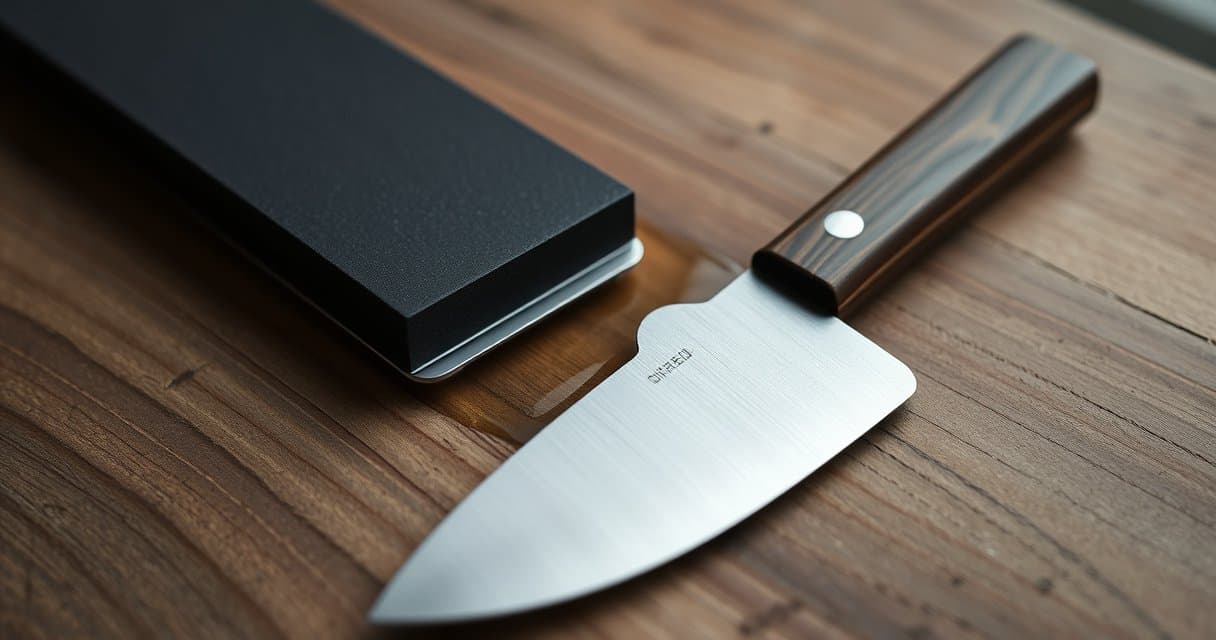
Nothing is more frustrating than a knife that slips on a tomato or crushes a fresh herb. You have invested in a beautiful Japanese blade, but without a suitable Japanese sharpening stone, that precision inexorably dulls. Choosing the right stone is not just a matter of grit; it is understanding a subtle dialogue between the steel of your knife and the abrasive, to restore, each time, that razor sharpness that changes everything in the kitchen.
Key Points to Remember
- For beginners, prioritize a synthetic #1000 grit stone, easier to master and perfectly suited for regular maintenance.
- The stone should be longer than your largest knife (minimum 21 cm) and stable to ensure precise and comfortable sharpening.
- First master a medium grit (#1000) perfectly before investing in fine grits or natural stones for finishing.
- Maintain your stone rigorously: regular flattening and air drying are essential for its longevity.
- The stone's "feedback" (sensation and sound) is an essential guide for sharpening correctly; choose a binder (magnesia, resin) that suits you.
Natural or Synthetic Stone: The Heart of the Technical Choice
This is where everything is decided. Your first choice is not the grit, but the base material. It determines everything: the feel under your fingers, the sound on the steel, and above all, the final result on your blade. Frankly, if you're a beginner, the answer is simple. But if you're already hooked, the dilemma becomes exciting.
Synthetic Stones: Constant Precision
They make up the vast majority of what's available, and for good reasons. Made by bonding abrasive particles (aluminum oxide, silicon carbide) in a matrix (often magnesia or resin), they offer perfect consistency. Every square centimeter of the stone has the same abrasive power. For the systematic and reproducible sharpening of your knives, this is a huge advantage.
Their cutting speed is often excellent, especially on modern, hard steels like VG-10 or SG2. A Shapton Pro 1000, for example, will restore a functional edge in just a few minutes. The other major advantage? Their soft or hard binder is chosen for a precise use. A softer binder breaks down faster, exposing new abrasives and preventing loading – ideal for carbon steels that "load" the stone. A hard binder, as on some vitrified stones, offers a firmer feel and extremely slow wear, perfect for complex stainless steels.
My opinion? For 90% of passionate cooks, a good Japanese synthetic stone is the best Japanese sharpening stone to start and progress with. The performance/control ratio is unbeatable.
Natural Stones: The Art of Ultimate Polishing
Here, we enter another world. A natural stone, or Toishi, is a block of slate or sandstone extracted from a quarry, often in Japan. Its magic? Its complexity. It contains a natural mixture of abrasive particles of different sizes, allowing it to bite the steel and polish it simultaneously. The result isn't just a sharp edge; it's an edge of exceptional fineness and smoothness, often described as "buttery."
But beware, this is an expert's tool. Every stone is unique in terms of hardness, speed, and feel. A famous Nakayama or an Ohira can cost several hundred, even thousands of euros. Its use is almost exclusively reserved for finishing, after sharpening on a synthetic stone. You'll use it on an equivalent grit of #8000 and beyond, to polish the edge and the back (urasuki) of a yanagiba knife, for example.
Frankly, unless you're ready to dive into a very technical and expensive hobby, avoid them for now. An excellent synthetic finishing stone (Naniwa Super Stone 8000 or Shapton Glass 16000) will give you 95% of the result for a fraction of the price and zero hassle.
Summary Table: Synthetic vs Natural
| Criterion | Synthetic Stone | Natural Stone |
|---|---|---|
| Consistency | Uniform and predictable. | Variable, unique to each block. |
| Main Use | Regular sharpening, repair, finishing. | Polishing and ultimate finishing. |
| Speed | Generally fast and controllable. | Slow to very slow, depending on the stone. |
| Learning Curve | Relatively simple and straightforward. | Requires experience and "reading" the stone. |
| Cost (for a pro result) | From 50€ to 200€ for a quality stone. | From 150€ to... unlimited, for a unique result. |
| Maintenance | Requires regular flattening. | Delicate, often with plain water, minimal flattening. |
So, which one to choose? Start with a solid foundation in synthetic. Master the angles, pressure, burr formation. When you feel your blade is sharp but you're looking for something else, a particular cutting smoothness, then you'll be ready to explore the world of natural stones. It's a journey, not an impulse purchase.
Decoding Grits for a Progression Adapted to Your Blades
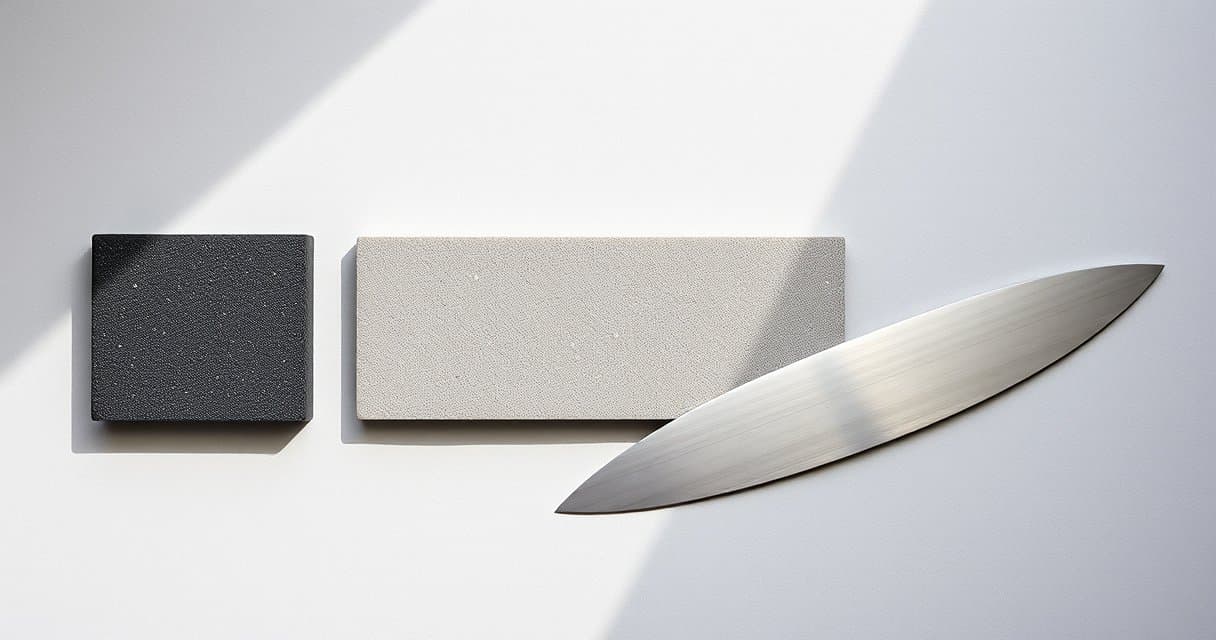
The number on the stone – #1000, #5000 – is not a quality rating. It's a language. It tells you what task that stone can accomplish on your knife's steel. A grit too coarse on a thin blade will unnecessarily plane it down. A grit too fine on a damaged edge will be a total waste of time. Understanding this progression is the key to working efficiently.
Coarse Grits (#120 to #500): Deep Repair
You don't take these stones out every day. They are the surgeon's tool for neglected blades. Imagine a knife whose edge has visible chips, or whose cutting edge is completely rounded. A #300 stone will remove metal quickly to reshape the bevel.
Be careful, this is an aggressive stage. On very hard steel (HRC 62+), you must proceed with caution and a constant angle to avoid creating uneven thickness. A golden rule: don't spend more time than necessary on this grit. As soon as the burr is uniform along the entire length, stop. Personally, I consider a stone around #320 a wise investment if you have more than three or four knives to maintain – it will save the day one day.
Medium Grit (#800 to #2000): The Heart of Sharpening
Here is your basic worker, your go-to stone. It does 80% of the work for a perfectly functional edge. For a daily chef's knife, whether in carbon steel or modern stainless steel, a #1000 stone is often the best Japanese sharpening stone to start with and can be sufficient on its own.
It erases the scratches from the coarse grit and establishes a regular, aggressive edge, perfect for slicing vegetables, meat, fish. If your knife is just a little dull, start directly here. The result? An edge that bites cleanly into tomato skin. Many enthusiasts stop here for their work knives, and that's perfectly fine.
Fine Grits (#3000 to #8000): The Art of Polishing
Here, we are no longer really talking about sharpening, but about finishing. The goal is no longer to remove metal to create an angle, but to refine that edge, to polish it to reduce the "tooth" left by the medium grit and obtain a smoother, more durable edge.
A pass on a #5000 will give a "razor" edge, ideal for fine, precise cuts – think sashimi, chiffonade of herbs. For a single-bevel knife (usuba, yanagiba), this step is crucial. But honestly, for a double-bevel knife like a gyuto, a pass on #3000 is largely sufficient for the majority of kitchen tasks. The "mirror" effect on the bevel is aesthetic, but what matters is the cutting feel.
The Logical Progression: Building Your Kit
You don't need all the stones. Everything depends on the starting condition of your blade and the desired result.
- For regular maintenance: A single #1000 stone works wonders. If you want to go further, the #1000/#3000 duo is perfect and versatile.
- For repair + maintenance: A trio of #320 (or #500), #1000, #5000 covers all scenarios, from the worst to the best.
- For perfection on Japanese knives: A four-step progression like #500 -> #2000 -> #5000 -> #8000 (or a natural stone) will give you an absolutely formidable edge.
My advice? Don't rush for the high grits. First master the #1000 perfectly. An edge perfectly formed at this grit will cut better than an edge poorly finished at #8000. The quality of the sharpening always takes precedence over the fineness of the sandpaper, so to speak.
Our Selection
Whether you are a cooking enthusiast or simply concerned with maintaining your knives, choosing the right sharpening stone is essential. In this selection, we analyze three popular kits based on their technical specifications and the numerous reviews from the community, to help you better understand the different ranges of grits, accessories, and designs.
| Product | Grit Range | Main Material | Included Accessories | Weight / Size |
|---|---|---|---|---|
| KEENBEST Whetstone Set | 400 / 1000 / 3000 / 8000 | Novaculite, Corundum | Bamboo stand, flattening stone, angle guide | 1.7 kg - 17.8 x 5.6 cm |
| SHAN ZU 2-in-1 | 1000 / 6000 | White Corundum | Bamboo stand, angle guide, non-slip strips | 998 g - 19 x 6 cm |
| MITSUMOTO SAKARI | 1000 / 3000 | White Corundum | Acacia wood base, TPR non-slip mat | 730 g - 22 x 10.4 cm |
KEENBEST Whetstone Set
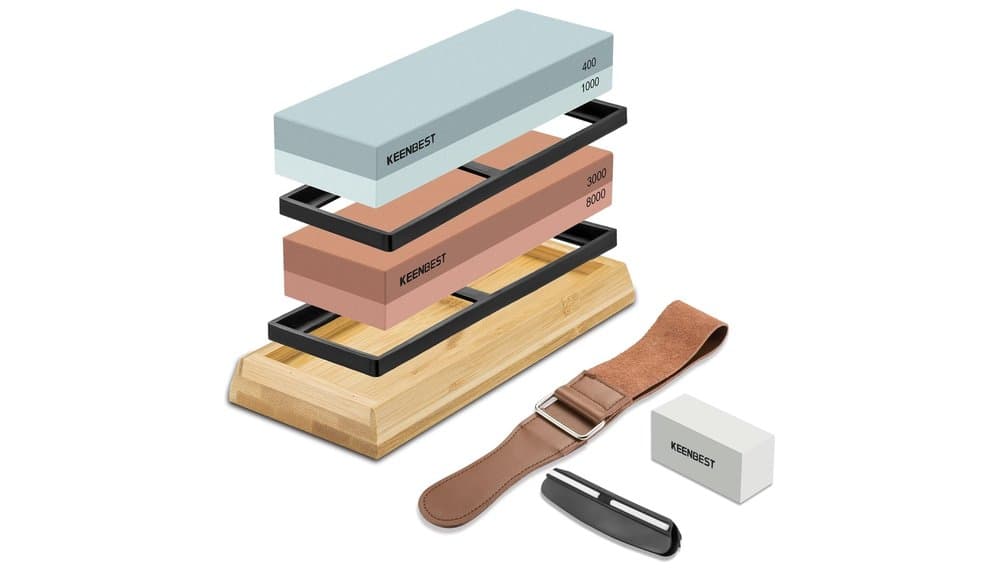
The KEENBEST kit positions itself as a comprehensive and versatile solution thanks to its wide grit range on two stones (400/1000 and 3000/8000). On paper, this progression allows handling the entire sharpening chain, from repairing a badly damaged edge with the 400 grit to an ultra-fine polishing with the 8000 grit. User reviews confirm that this versatility is appreciated for very dull kitchen knives, but also for garden or DIY tools like axes or wood chisels.
According to the reviews, the major plus of this kit lies in its included accessories. The presence of a flattening stone is frequently highlighted as a major advantage for maintaining the flatness of the sharpening stones over time. The angle guide is also noted as a valuable aid for beginners learning to maintain a consistent angle. The community does note some limitations: the significant weight (1.7 kg) and the bulk of the bamboo stand can make it less practical for quick storage. Furthermore, some experienced users feel that the abrasion quality and long-term durability, while very decent, do not rival high-end Japanese stones. In summary, this kit seems ideal for someone looking for a complete and fixed sharpening station, ready to use with all accessories, and who accepts a certain footprint.
SHAN ZU 2-in-1 Sharpening Stone
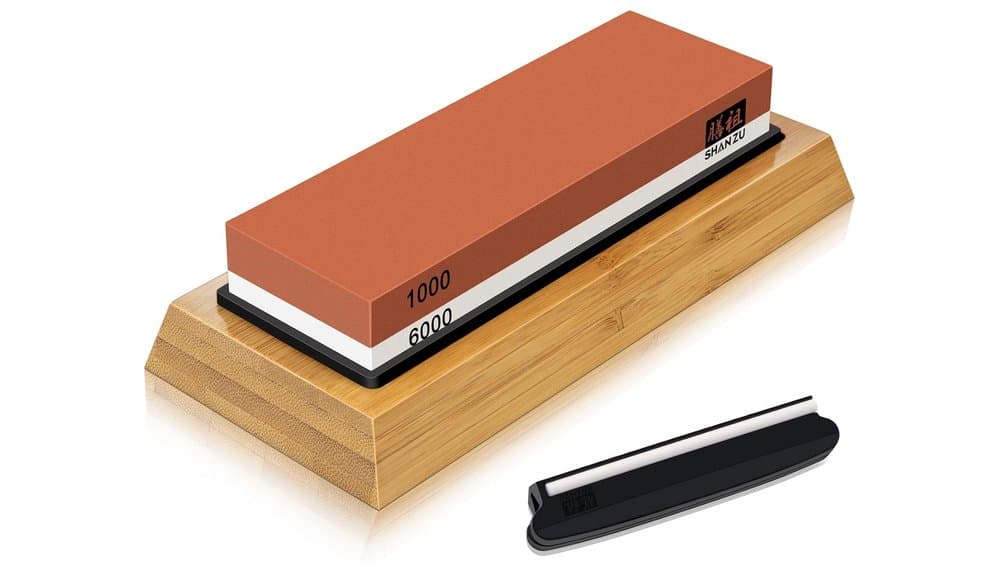
The SHAN ZU is a bestseller with a very high volume of reviews, giving us a clear view of its strengths. Its 1000/6000 configuration is described by the community as the sweet spot for regular maintenance of kitchen knives. The 1000 grit allows effective sharpening to restore bite, while the 6000 provides a polished, razor-sharp finish sufficient for most culinary uses. The reviews emphasize the consistent quality of the stone, made of white corundum, which bites well into the steel without damaging it.
The main advantage highlighted in the reviews is its ease of use and stability. The bamboo stand, coupled with silicone anti-slip strips, is consistently described as effective in preventing any unwanted movement during sharpening. The stone itself seems to have a good abrasion speed and slow wear, according to testimonials. Points of caution mainly concern very high expectations: it is not a "repair" kit for a heavily damaged blade (lacking a coarse grit like 400). Also, a flattening stone is not included, an accessory that will need to be purchased separately for long-term maintenance. Analyzing the data, the SHAN ZU appears to be the obvious and reassuring choice for regular culinary use. Its success with a large community of users, combined with relevant specs, makes it a safe bet for those seeking an effective stone without excess.
MITSUMOTO SAKARI Japanese Knife Sharpener
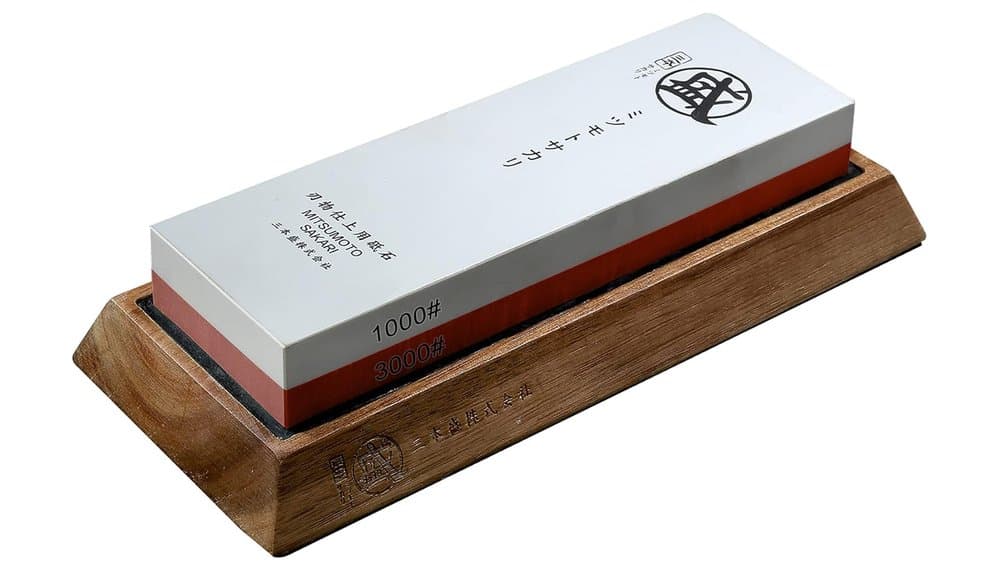
The MITSUMOTO SAKARI adopts a different approach with a 1000/3000 grit range and a more compact and lightweight design. According to the specifications, it is the lightest product in our selection (730g) and its acacia wood base with integrated TPR mat gives it a distinct profile. The user community often presents it as a good compromise for occasional to regular use, where the emphasis is on simplicity and space saving.
The reviews point out that this stone is particularly appreciated for routine maintenance of knives already in good condition. The 3000 grit provides a very decent finish for everyday cooking. Its reduced footprint and design are often cited as assets for kitchens with limited storage space. However, the reviews also highlight its natural limitations. The less extensive grit range makes it less suitable for heavy repairs (no coarse grit) or for perfectionists seeking a mirror polish (no grit beyond 3000). A few comments also note that an angle guide is not included, leaving the user alone to master the technique. Our analysis shows that the MITSUMOTO SAKARI is the ideal candidate for those who prioritize simplicity and a compact design. It meets a need for effective, no-frills sharpening to maintain functional knives, without aiming to restore heavily damaged tools.
Shape, Size, and Ergonomics: A Stone Made for Your Hand
Much is said about grit and material, but holding a stone that is too small or unstable for ten minutes is a guarantee of poor results and a sore back. Ergonomics is not a mere comfort detail; it is a prerequisite for precise and reproducible sharpening. If you have to fight your tool, you will lose control of the angle. Period.
Length: The Golden Rule
Here is the simplest and most important criterion: your stone must be longer than the longest blade you plan to sharpen. Why? To be able to perform a complete back-and-forth stroke, from heel to tip, in one fluid motion.
- For chef's knives (gyuto) 18 to 21 cm : A 21 cm stone (approx. 8.25 inches) is the absolute minimum. It is the most common standard size and fits everywhere.
- For longer knives (sujihiki, bread knife) or for true comfort : Aim for 25 cm (approx. 10 inches). The difference is colossal. You no longer struggle to keep the knife on the stone; sharpening becomes natural, almost meditative.
- 15 cm stones? Forget them for real kitchen knives. They are made for pocket knives or small tools. Using one on a 20 cm knife is an exercise in pure frustration.
Thickness: An Investment in Durability
Look at the stone's profile. A thin stone, 15 mm thick, will wear down to its base in a few years of regular use. A 25 mm, or even 30 mm thick stone is a purchase for a decade or more, even with regular flattening.
This is especially true for coarse grits (#300-#800) which wear faster. Here, thickness is a guarantee of longevity. Frankly, at equal price between two models, always take the thicker one. You will save money in the long run.
See priceStability: The Secret to a Constant Angle
A stone that moves, wobbles, or creaks on the work surface... is the enemy. The solution is twofold:
- A dedicated, heavy base. A piece of wood, a wet board, that's not serious. Invest in a base made of dense rubber, or better yet, wood with non-slip pads. It should grip the work surface. Some bases have a tray to catch water; it's ideal.
- The width of the stone. A standard width of 7 to 7.5 cm suits the majority of blades. A very narrow stone (5 cm) can be unstable and is only suitable for very specific single-bevel knives. For general use, stick with standard.
The Feel in Hand: The Forgotten Feedback
Beyond the numbers, there is the hand. A good stone feels like part of your movement. It doesn't vibrate or emit an unpleasant screech. The binder (which we'll discuss later) plays a huge role in this. A stone that is too soft will "eat" the metal without giving you any feel; a stone that is too hard can skid.
The best Japanese sharpening stone for you is the one that, once placed on its stable base, disappears from your consciousness. It requires no stabilization effort. All your attention can then focus on the blade's angle and the sound of the metal yielding – that light, regular scraping sound that tells you you're doing it right. Never underestimate this: if the tool is pleasant to use, you will use it more often, and your knives will be all the better for it.
The Binder, Feedback, and the Sharpening Experience
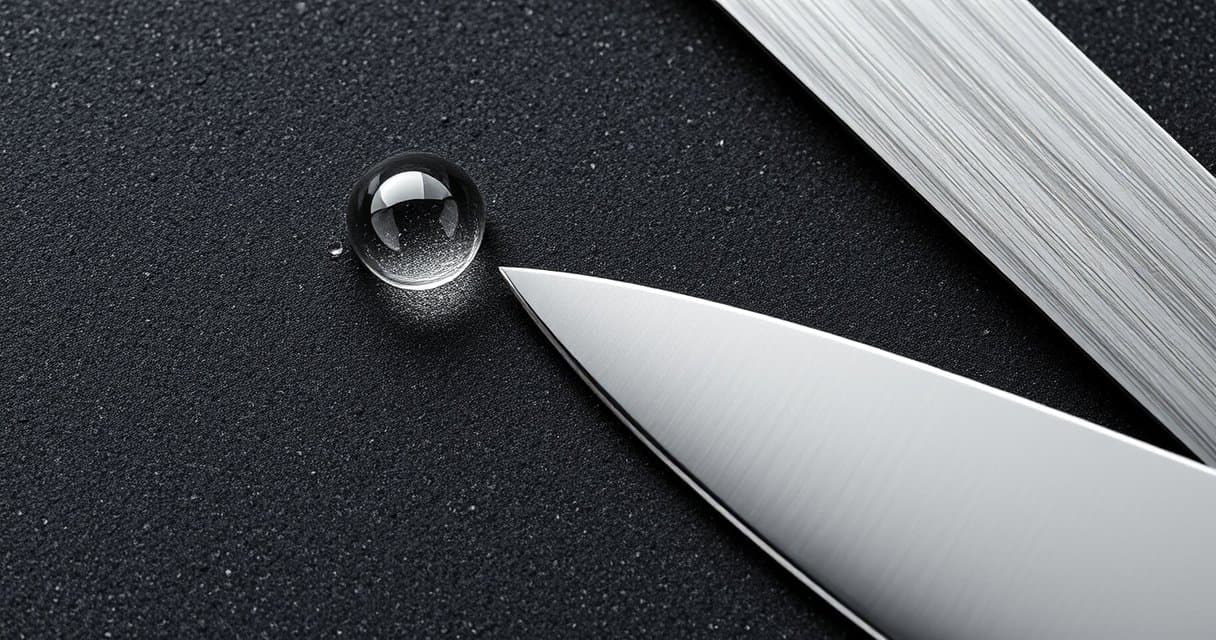
You have the right size, the right grit. Yet, one stone may feel "muted" to you while another literally speaks to you during sharpening. This dialogue is the feedback. And it is almost entirely dictated by an invisible element: the binder. It's the "glue" that holds the abrasive particles together. Its formulation makes all the difference between a functional tool and a sensory experience that makes you better.
Magnesite, Resin, Ceramic: The Character of Your Stone
The binder determines the hardness, the cutting speed, and how the stone reacts to water and pressure. There are mainly three philosophies:
- Magnesite binders (or classic "waterstones") : These are the most common in the mid-range. They require a longer soak (15-20 min). Their texture is often a bit softer. The advantage? They create a true abrasive mud (the slurry) that actively participates in sharpening and slightly polishes the edge. The feedback is soft, almost caressing. Perfect for learning, as they forgive a slightly too steep angle without biting too much into the steel. But they wear and dish a bit faster.
- Resinous binders (often "splash-and-go") : A revolution for the impatient. A simple splash of water is enough. The binder is harder, the stone wears very slowly and stays flat. The sensation is firmer, more direct. You feel every micro-contact between the steel and the abrasive. It's the choice of purists who want absolute control, especially on very hard steels (HRC 63+). Their cutting speed is often impressive.
- Ceramic (vitrified) binders : The high-end of precision. Extremely hard and porous, they absorb water like a sponge in a few minutes. Their wear is minimal. Sharpening is clean, fast, with feedback of crystalline clarity. They require, however, more assured technique – there is no forgiveness. It's the tool for the demanding.
Reading the Sensations: What Your Hand Must Listen To
Feedback is not mysticism. It's a series of physical clues you must learn to decode.
- The sound : A regular, granular scratching on a #1000 grit means you are removing metal. A softer sound, almost a hissing on a #5000 grit, indicates you are polishing. A high-pitched screeching? Your angle is probably too shallow, you are just rubbing the back of the bevel.
- The resistance : Feeling the stone "bite" the steel and then glide fluidly is the right sensation. If it grabs too much, like velcro, your angle is too steep or the stone is clogged. If it slips without any grip, the angle is too shallow or the stone is too hard for the steel.
- The appearance of the slurry : Its color and texture are revealing. A homogeneous gray slurry on stainless steel? All is well. A slurry with small shiny, metallic chips? You are "biting" too aggressively, perhaps with a grit too coarse for the intended finishing work.
For me, the sign of a better Japanese sharpening stone is not that it is universal, but that it communicates clearly. It tells you when you are right, and gently corrects you when you stray. It's this silent conversation that transforms a maintenance chore into an almost meditative moment of connection with your tool. Don't ignore it: it's your most direct teacher.
Dressing, Drying, and Longevity: The Keys to Essential Maintenance
An ill-maintained stone is a stone that betrays you. It promises a straight edge and delivers a warped one, a blade with a ruined profile. The real difference between a disposable tool and a lifelong companion is decided here, after sharpening. It's not glamorous, but it's the best-kept secret of the pros.
Dressing Your Stone: Why, When, How
Dressing is the action of making the surface of your stone perfectly flat and clean again. Without it, you are sharpening on a hill: the center of the blade will never touch the stone, creating a belly and ruining the geometry of your beautiful Japanese knives.
When to do it? Not after every use, no. Do the marker test. Draw a grid on the knife's edge, make two light passes on the stone. If the ink disappears only in the center, your stone is hollowed. For weekly use, a monthly check is a good rhythm. For intense daily use, it can be weekly.
The equipment is simple but crucial. A thick glass plate with silicon carbide sandpaper (grit #220 for flattening, #600 for smoothing) works very well. For the better-equipped, a dedicated diamond stone (with 325 grit for example) is an investment that lasts a lifetime. The method is always the same: wet the abrasive surface, place the stone to be dressed on it, and make small circles or figure-eights over the entire surface until it is uniformly matte.
Drying: The Silent Killer of Good Stones
Honestly, 90% of people get this wrong. A stone stored damp in its plastic box is an invitation to mold and, worse, internal cracking. The binder absorbs water unevenly, creates tension, and one day, crack, it splits in two. It's infuriating.
The golden rule: let it breathe. Take it out of its holder, wipe off excess water with your hand, and place it on a drying rack or on its side, in a place away from direct sunlight and sudden temperature changes (not on the radiator!). Air-drying for 24 to 48 hours is ideal. Many quality synthetic stones are designed to dry without warping. If you're worried about dust, a simple open cardboard box will do.
Maximizing Lifespan: The Small Rituals That Matter
A well-treated stone will accompany you for years, even decades. A few habits make a huge difference.
Before sharpening, soaking must be appropriate. A magnesia-bonded stone needs 15-20 minutes to become saturated. A "splash-and-go" just needs a spray. A saturated stone wears evenly and doesn't grab the steel.
After sharpening, don't throw away the abrasive slurry right away. Use it! Gently rub your fingers on it to clean out the stone's pores. Then rinse thoroughly with clean water. This simple step prevents clogging by metal particles, which would make the stone smooth and ineffective.
For me, the true test of a best Japanese sharpening stone is not just its performance when new, but its ability to recover it, month after month, after proper dressing. A stone that allows itself to be maintained is a stone that respects your investment. This is where the quality of its construction is revealed.
Conclusion
Choosing your Japanese sharpening stone is much more than a purchase. It is forging a partnership for the decades to come.
Consider the material, grit, and shape. Give paramount importance to maintenance. Your stone then becomes the natural extension of your gesture.
It is the key to revealing and preserving the soul of your blades. Invest time in this choice. Your knife, and every ingredient you slice, will thank you.
It is the final, essential, link in precision cooking. Make this silent companion a pillar of your workshop.
Frequently Asked Questions
What is the best Japanese sharpening stone for beginners?
For a beginner, a medium-grit #1000 synthetic stone is the best choice, as it provides consistent and reproducible sharpening for the majority of knives. Brands like Shapton Pro or Naniwa offer excellent "splash-and-go" models to start simply.
Natural or synthetic stone: which one to choose?
Choose a synthetic stone for regular sharpening and reliability, as it is easier to master and less expensive. Reserve natural stones, which are more costly and complex, for experts for ultimate finishing and polishing after basic sharpening.
What size sharpening stone should I choose?
The stone must absolutely be longer than the longest blade to be sharpened, with 21 cm as the minimum for a standard chef's knife. For optimal comfort and a fluid motion, a 25 cm stone is highly recommended.
What grit progression should I use to sharpen a knife?
For regular maintenance, a single #1000 stone is sufficient, while a trio of #320 (or #500), #1000, and #5000 covers all scenarios from repair to finishing. Mastering a medium grit like #1000 is much more important than owning very fine grits.
How do I maintain a Japanese sharpening stone?
It is crucial to flatten it regularly to keep its surface perfectly flat using a diamond plate or sandpaper on glass. After use, the stone must air dry for 24 to 48 hours and never be stored wet in its box to avoid cracking and mold.
What is a "splash-and-go" stone?
A "splash-and-go" stone has a hard binder (resin or ceramic) that only requires a simple splash of water before use, unlike stones with a magnesite binder that require a 15-20 minute soak. This type of stone typically offers firmer feedback and very slow wear.