Tefal Virtuoso Wok Frying Pan Test and Review
Introduction
On a site dedicated to durable and high-performance kitchen tools, we usually scrutinize carbon steel, cast iron, and the forged steels of Japanese knives. The Tefal Virtuoso Wok Frying Pan therefore arrives with a different proposition: an uncoated stainless steel wok with a 10-year guarantee. It is neither a traditional carbon steel wok nor a classic non-stick frying pan. We will analyze it through the demanding lens of "buy-it-for-life": its construction, its long-term potential, and its relevance for a serious cook who values performance above all.
Strengths
Based on technical specifications and user feedback, several qualities clearly stand out for this wok.
- Versatility and Total Compatibility: Its compatibility with all stovetops, including induction, and its oven resistance up to 250°C make it an extremely versatile tool. Users employ it for Asian stir-fries as well as for sauces, roasts, and even eggs.
- Healthy and Durable Surface: The absence of a synthetic non-stick coating eliminates concerns about wear and chemicals. The stainless steel surface is inert, transfers no taste, and allows the use of metal utensils without risk.
- Advertised Construction Robustness: The weight of 940g for a 28cm diameter indicates a solid structure. The ten-year guarantee and the reinforced rivets described by the manufacturer are strong arguments in favor of a long mechanical lifespan.
- Simplified Maintenance: Unlike a carbon steel wok which requires meticulous seasoning, this one is presented as easy to clean, even being dishwasher safe. This is a major practical argument for daily use.
Weaknesses
The analysis of feedback and the technical context also reveals inherent limits to its concept.
- A Learning Curve: Coming from a non-stick pan requires relearning. The water droplet technique (checking the temperature) is essential to prevent food from sticking. This requires practice and patience.
- Middling Thermal Performance: Although equipped with a thick "Thermo-Fusion" base for even heat distribution, stainless steel is a poorer heat conductor than aluminum or copper. Its heat-up time can be longer and its heat retention inferior to that of cast iron, which can impact the sought-after "wok hei" (the breath of the wok).
- A "Westernized" Wok: Its shape, closer to a deep sauté pan than a traditional round-bottomed Chinese wok, and its higher weight limit the possibility of manipulating it with one hand for the characteristic "tossing" (stir-frying).
- Durability Conditioned by Use: While the material is intrinsically durable, its natural non-stick performance depends entirely on mastering temperature and using fat. Incorrect use will consistently lead to sticking and burnt-on residue that is difficult to remove.
Detailed Analysis
Materials and Construction: Stainless steel, but which kind?
Here, no carbon steel or cast iron. Tefal relies on "premium" stainless steel, unspecified (often 18/10 in this segment). The key question for us is: is it a fully stainless steel construction, or a sandwich with a conductive layer (aluminum) encapsulated? The specs mention a thick, bonded "Thermo-Fusion" base. This terminology strongly suggests a multi-layer bottom – likely stainless steel encapsulating an aluminum core to improve conduction – rather than a solid stainless steel block. This is good for heat distribution, but distances the product from the purity of a carbon steel or cast iron wok. The 10-year guarantee is a mark of confidence in the durability of the welds and structure.
See priceCulinary Performance: Between Searing and Control
The "Perfect Seizure" argument is central. On paper, a correctly heated and oiled uncoated stainless steel surface allows for excellent Maillard reaction and effective deglazing for rich sauces. Experienced testers and users confirm this point: once the temperature is mastered (often around 7/9 on induction), meat sears well without sticking. However, cooking experts emphasize that stainless steel cannot match the heat retention capacity of cast iron or the extreme responsiveness of a carbon steel wok on a powerful burner. It is therefore an excellent versatile tool for Western cooking and moderate stir-frying, but not the ultimate tool for professional-style high-heat wok cooking.
Ergonomics and Handling
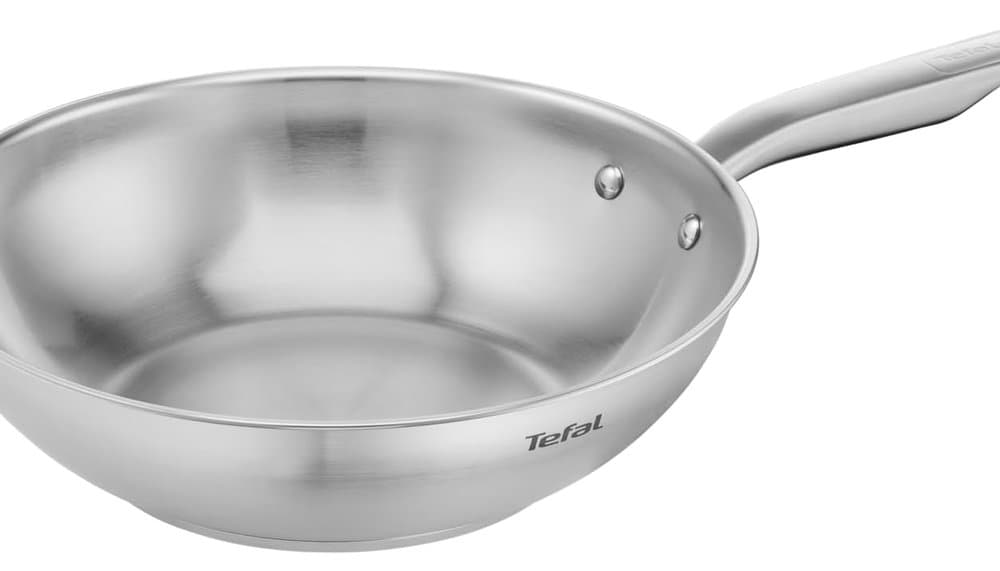
With a fixed stainless steel handle, the product weighs 940g. This is heavy for true wok work (where it is constantly lifted), but relatively light compared to a cast iron Dutch oven. Reviews note that the grip is solid and the handle stays cool for a fair amount of time. The brushed design is aesthetic. The critical point is the shape: its perfectly flat bottom is ideal for induction and ceramic cooktops, but it loses the concentrated heat point of a traditional round wok over a flame.
"Buy-It-For-Life" Potential: A Realistic Bet?
This is the fundamental question. A well-maintained carbon steel wok lasts several lifetimes. The Tefal Virtuoso bets on durability through the indestructibility of the material. There is no coating to flake off, no seasoning to religiously preserve. Theoretically, it can last decades. The reality, based on feedback, is that its "non-stick" culinary performance depends on perfectly mastered technique. A negligent or rushed user will find it "sticks" and might abandon it. Its "for life" potential is therefore conditioned on the user's commitment to learn and respect its cooking principles. It won't age physically, but could be set aside out of frustration.
Technical Specifications
| Characteristic | Detail |
|---|---|
| Product Name | Tefal Virtuoso Wok Frying Pan |
| Diameter | 28 cm |
| Capacity | 1.5 liters |
| Weight | 940 g |
| Main Material | Premium stainless steel (brushed finish) |
| Cooking Surface | Uncoated stainless steel |
| Base Construction | Thick "Thermo-Fusion" bottom (likely multi-layer) |
| Stovetop Compatibility | All stovetops (induction, gas, electric, ceramic) |
| Oven Safe | Yes, up to 250°C |
| Dishwasher Safe | Yes |
| Handle Type | Fixed stainless steel handle, riveted |
| Guarantee | 10 years |
What Users and Experts Say
A synthesis of nearly 1500 customer reviews (with an average rating of 4.3/5) and online expert analyses paints a nuanced consensus.
The recurring praises focus on:
- The perceived robustness and quality finish.
- The extreme versatility: many use it as their only frying pan/sauté pan/wok.
- The safety and health: the absence of a chemical coating is a major argument.
- The ease of cleaning once the cooking technique is mastered.
- The excellent sear on foods when the temperature is correctly controlled.
The frequent criticisms and warnings concern:
- The need to learn the "water droplet" method and to properly preheat the pan before adding oil and food. This is the number one friction point for beginners.
- Food sticking in case of incorrect temperature handling or using too little fat.
- The shape: some wok purists regret it is not as suited to traditional Asian techniques as a carbon steel model.
- Isolated comments about quality defects or stains appearing over time (normal on stainless steel).
Web experts, for their part, emphasize that this type of product occupies a middle ground. It is far more durable than a coated non-stick pan (whose short lifespan they often criticize), but it requires more know-how. They see it as an excellent practical and healthy compromise for everyday cooking, without reaching the status of a specialized professional tool like a carbon steel wok or a cast iron pan.
Conclusion
The Tefal Virtuoso Wok Frying Pan is a well-built and intelligently designed product for the demanding mainstream market. It is not a tool for the wok purist, nor an heirloom for future generations like a patiently seasoned piece of cast iron or carbon steel can be.
It is rather the ideal transition wok-pan for the serious home cook who wants to break free from dependence on ephemeral and potentially questionable non-stick coatings. It offers a gateway to the world of cooking "by feel," where mastering temperature becomes a key element of the result. Its versatility, apparent ease of maintenance, and decade-long guarantee make it a sensible investment.
Its long-term success in your kitchen will not depend on its mechanical solidity (which seems assured), but on your willingness to accept its learning curve. If you are ready to understand and apply the principles of cooking on stainless steel, you will get a healthy, high-performing, and likely very durable tool. If you seek the absolute simplicity of "absolutely no sticking" without effort, you may be disappointed. For our community oriented towards durable tools, this product deserves consideration as a practical and resilient foundational piece, provided you understand and accept its nature.