Ultimate Carbon Steel Wok Guide
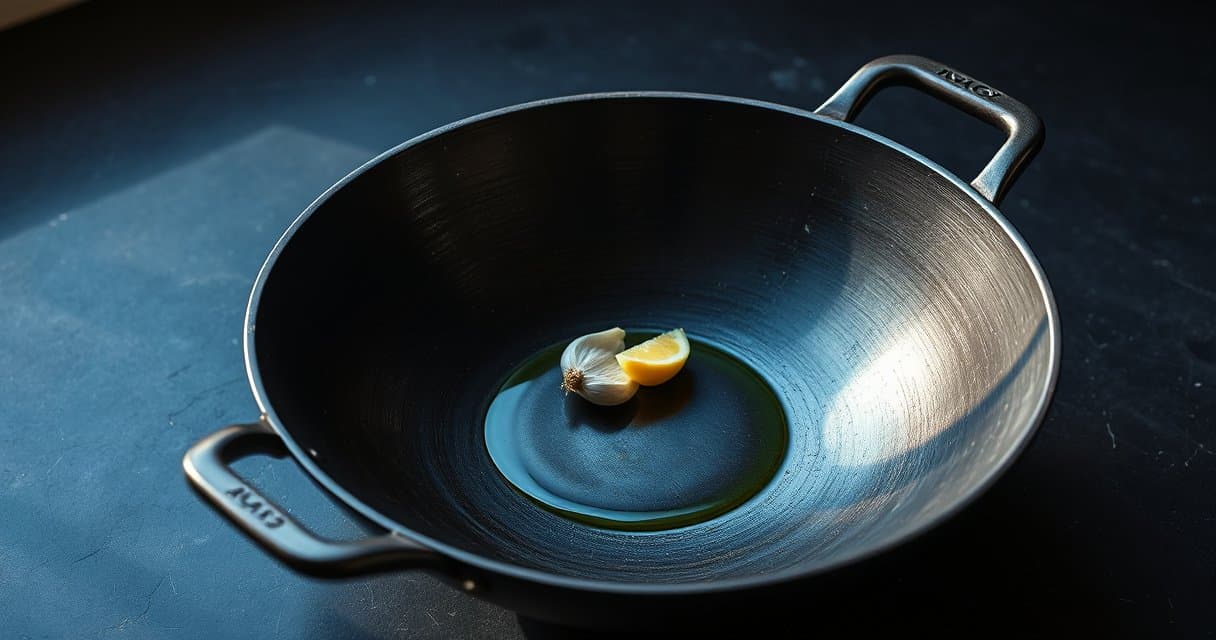
There is a secret behind wok hei, that smoky and striking flavor of great stir-fried dishes: it's carbon steel. Light, reactive, it literally becomes an extension of your hand over the fire. Properly seasoned, it offers a natural non-stick quality that makes cooking a breeze. To benefit from it, you just need to understand its soul and accept it for what it is: a traveling companion that evolves with you.
Key Points to Remember
- A carbon steel wok is a living tool to season yourself; its natural, non-stick patina improves with use instead of wearing out.
- The crucial choice is geometry: flat bottom for induction cooktops, round bottom for a gas flame, with an ideal steel thickness of 1.8 to 2.2 mm.
- Maintenance relies on three simple steps: cleaning with hot water, immediate drying over the fire, and occasional application of a very thin film of oil before storage.
- Its culinary performance is unique thanks to exceptional thermal reactivity, essential for quickly searing food and achieving true "wok hei."
Carbon Steel in Your Kitchen: The Reasons for a Radical Choice
Forget everything you think you know about a classic non-stick pan. A carbon steel wok is the exact opposite: it is not a coating you use until it flakes, it is a living material that you cultivate. It is the radical choice of the cook who prefers mastery over ease, long-term performance over limited-use gadgetry.
Why such a commitment? It's all about culinary physics.
Unmatched Thermal Conductivity and Responsiveness
Carbon steel is an excellent heat conductor. Compare it to cast iron, for example. Thick cast iron retains heat wonderfully, but it takes time to heat up and cool down. Carbon steel, however, is lively. On a good gas flame, you feel changes in temperature almost instantly when you add food or move the wok. This responsiveness is crucial for the "wok hei" technique, that ultra-fast searing which caramelizes juices without overcooking the interior. Frankly, on an induction cooktop with a suitable flat bottom, this quality remains valuable for precise control.
The Patina: Your Personal and Evolving Non-Stick Layer
This is the heart of the matter. A new carbon steel wok is metallic gray and rustic. The first time you cook an egg in it, everything sticks. The process of seasoning (which we will detail later) creates a polymerization of oils into a dark, solid, naturally non-stick layer. This patina is not applied in a factory; it is the result of your use. It thickens, improves, and adapts to what you cook. A Teflon pan loses its properties; a good carbon steel wok gains them over time. It is this relationship that makes it, for many, the best carbon steel wok possible: a tool that becomes unique.
Absolute Durability and Monastic Simplicity
No internal rivets to trap food, no toxic coating to fear, no plastic handle to melt. It's a piece of metal, often a single piece, with riveted or welded handles. You can heat it until white-hot, use it with metal spatulas, scrape it without mercy. Its lifespan is measured in decades, even generations, if basic maintenance is followed. It's a purchase for life, literally. Next to it, even high-end utensils seem fragile and temporary.
So yes, it requires a bit of learning. But the gain in control, sensation, and results is so colossal that, once you've made the leap, you almost never go back. That is the radical choice.
Choosing the Right Shape for Your Stove and Wrist

The shape of your wok is not just a matter of style; it's a crucial technical adjustment variable. It dictates how heat circulates, how you handle the utensil, and ultimately, the result on your plate. Excellent carbon steel that doesn't suit your setup becomes a nightmare to use. The key is honesty about your installation and your habits.
Traditional Round Bottom vs. Flat Bottom: A Choice Dictated by Your Stove
This is the most important decision. Don't fool yourself.
The round bottom is the authentic shape, designed to concentrate the heat from a gas or wood flame into a central "hot spot." This allows you to push food to the cooler sides to keep it warm without overcooking, then bring it back to the center to finish searing. For the characteristic wrist movement of wok cooking, it's unbeatable. But on an electric coil, glass-ceramic, or induction cooktop? It's a disaster of instability. You'll need to use a wok ring, which further reduces thermal contact and makes the experience laborious. In my opinion, if you don't have gas, forget the round bottom, unless you have an absolute passion for authenticity despite the constraints.
The flat bottom is the pragmatic adaptation for modern kitchens. It offers perfect stability and maximum contact surface on electric coil and induction cooktops. You lose a bit of the "slope" for moving food around, but you gain thermal efficiency and ease of use. A bottom diameter of at least 12 to 14 cm is ideal for good heat diffusion. It's often the real best carbon steel wok for most home cooks today.
Diameter and Depth: A Question of Family and Style
A 28 cm wok is charming but quickly too small. You overload it, the temperature drops, and you end up steaming the food instead of searing it. For 2 to 4 people, aim for a diameter of 32 to 34 cm. This gives enough room for ingredients to dance in the hot oil. For larger families or batch cooking enthusiasts, 36 cm is a welcome luxury. The classic depth (around 10-12 cm) is perfect for stir-frying; a shallower version ("paella-style") exists but strays from the original spirit.
Metal Gauge (Thickness): The Compromise Between Thermal Mass and Lightness
This is where the feel in your hand comes into play. Metal that is too thin (below 1.5 mm) heats up extremely quickly but also tends to create hot spots and warps more easily. Very thick metal (over 2.5 mm) behaves almost like cast iron, losing the responsiveness that is the charm of carbon steel. The ideal, in my view, lies in a medium gauge of 1.8 to 2.2 mm. It provides even heat distribution, enough mass to avoid warping, while remaining light enough to be handled with one hand when necessary. Hefting a wok in the store gives a good indication: it should have a presence, without being dead weight.
Handles: Safety and Ergonomics Above All
Two configurations dominate. The classic "one long handle + one short helper handle" offers maximum control for lifting and tossing. Ensure the long handle is made of solid wood or steel-sheathed to avoid burns and that it is securely riveted. Models with two short handles ("Canton style") are more stable for carrying but less practical for the tossing motion. Avoid plastic or resin handles like the plague, as they won't withstand the heat of a wok left on the fire. It's a small detail, until the day you burn your fingers.
Our Selection
Choosing a wok can be more complex than it seems, especially when wanting to combine the authenticity of Asian-style cooking with the constraints of our modern kitchens. In this selection, we review three popular models in carbon steel, a material prized by purists for its exceptional heat conductivity and durability. They are all aimed at high-heat cooking enthusiasts, but their specifications and design meet very distinct needs. Here is a comparative analysis based on their technical characteristics and user community feedback.
| Product | Diameter & Weight | Bottom Type | Stove Compatibility | Key Features & Strengths |
|---|---|---|---|---|
| Craft Wok 731W316 | 14" (35.6 cm) / 2.09 kg | Flat bottom (not 100% smooth) | Induction, Electric, Gas | Robustness (1.8mm steel), double handle, pro chefs' choice |
| BEKA Wok Nomad | 31 cm / 1.35 kg | Likely flat bottom | Induction, Electric, Gas | Lightweight, wooden athermic handle, oven compatible |
| Craft Wok Traditionnel | 14" (35.6 cm) / 2.1 kg | Round bottom | Gas only | Authentic shape for "wok hei", double handle, established reputation |
Craft Wok 731W316 (Flat Bottom)

This model positions itself as a technical compromise between tradition and modernity. On paper, its specs announce a robust tool with a steel thickness of 1.8mm (gauge 15) and a weight of over 2 kg, which is a guarantee of stability and heat retention. Its major strength, according to the specifications, is its universal compatibility, including with induction hobs, thanks to its flat bottom. This is a decisive argument for kitchens equipped with this type of stove.
Community feedback confirms this impression of solidity and performance on induction or ceramic hobs. Many users appreciate that it is a hand-forged wok, with a hammered finish which, according to reviews, reduces the risk of food sticking. However, the manufacturer and customer reviews warn of an important point: the bottom is not perfectly flat. It has "flat bulges" due to the hammering process. For most, this does not affect cooking, but it can create a slight imbalance on some perfectly smooth surfaces. Another point raised: its maintenance. Like all carbon steel, it requires careful seasoning before first use and immediate drying after washing to prevent rust. It is a time investment that discourages some beginners, but which is rewarded, according to testimonials, by natural anti-stick properties that improve over time.
BEKA Wok Nomad
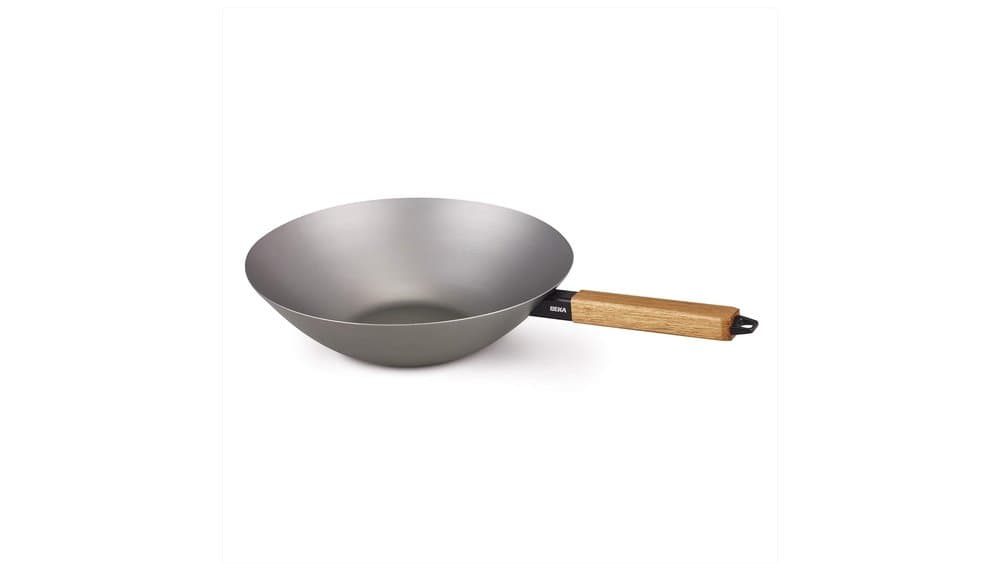
The BEKA Nomad immediately stands out for its featherweight of 1.35 kg and its slightly smaller diameter (31 cm). This lightness is its main asset, highlighted by many reviews, especially for people who like to be able to seize and toss food one-handed without fatigue. Unlike the two Craft Woks, it only has a single wooden athermic handle, an ergonomic choice for easier handling, but which can be less practical for carrying a heavily loaded wok.
On paper, it is also compatible with all stoves, including induction, and has a unique advantage: it is oven compatible. This opens up possibilities for finishing dishes in the oven, which the other models may not allow due to their mixed handles. The specifications indicate it is made of carbon steel, promising the same benefits of natural patina. However, the product sheet is less detailed about the steel thickness. User feedback is generally positive regarding its quick handling and versatility. The mentioned limitations often revolve around its perceived durability: some feel its lighter construction makes it less "professional" or less able to withstand shocks compared to more massive woks. Like the others, it requires initial seasoning and rigorous maintenance.
Craft Wok Traditionnel (Round Bottom)

This is the most traditional and authentic model in the selection. With its round bottom and hand-forged design, it is clearly intended for use on a gas flame or a dedicated wok burner. On paper, its specs are very close to its flat-bottomed cousin (same thickness, same weight), but it's the shape that makes all the difference. The community of passionate cooks agrees that the round bottom allows for better heat distribution and facilitates the tossing motion essential for capturing the famous "wok hei", that slightly smoky, seared flavor.
Reviews are glowing about its performance on a powerful gas flame, describing it as a pro tool. Its double handle (wood and steel) is considered very practical for two-handed manipulation when it is heavy. However, its limitation is just as clear: it is incompatible with flat electric hobs, induction, or ceramic hobs. Its round bottom makes it unstable on these surfaces. It is therefore a purchase reserved for gas-equipped kitchens. Like the other Craft Wok, it requires meticulous seasoning and constant maintenance to develop its patina and prevent corrosion. It is a demanding product, but which, according to feedback, delivers results closest to an Asian restaurant kitchen when used under the right conditions.
Understanding Steel: From Carbon Content to Surface Treatment
Let's now get to the heart of the matter: the metal itself. Not all carbon steels are created equal, and these nuances explain the differences in price, feel in use, and ease of seasoning. This is where a large part of a wok's intrinsic quality lies.
The Carbon Percentage: The Key to Reactivity
"Carbon steel" is actually low-carbon steel, typically with a carbon content between 0.08% and 0.25%. This is what distinguishes it from stainless steel (alloyed with chromium) and tool steels (very high carbon content). For a wok, we often aim for the mid-range, around 0.2%. Why? A percentage that is too low makes the steel very soft and more prone to warping. A percentage that is too high would make it excessively hard and difficult for the manufacturer to work with, without any real benefit for cooking. This balance creates a perfectly suited material: rigid enough to hold its shape, but with excellent thermal conductivity that allows for lightning-fast heat-up and even distribution.
The Surface Finish: Raw, Blued, or Pre-Seasoned?
This is where the options diverge radically based on the condition in which you receive your wok. Each has its implications.
-
The Raw Wok (with Mill Scale): Straight from the factory, the steel is covered with a greyish or blackish layer, the "mill scale." This is iron oxide formed during hot rolling. This layer must be completely removed before the first seasoning, as it prevents oil from adhering to the bare steel. It requires a bit of work (sanding, scouring), but it gives you a virgin surface, perfect for creating your own patina. It's the purist's choice.
-
The Fire-Blued Wok: An increasingly common finish. The manufacturer heats the wok to a very high temperature in a special oven. This creates a layer of magnetite iron oxide (Fe₃O₄), blue-black in color, which immediately protects the steel from rust. This is a huge advantage. This layer is porous and accepts oil seasoning wonderfully. Frankly, for a beginner, it's ideal: you skip the tedious step of stripping the scale and go directly to seasoning. The bluish color is also a distinctive sign of quality.
-
The Industrially "Pre-Seasoned" Wok: Here, the manufacturer has applied one or more layers of polymerized oil. The wok arrives black and claimed "ready to use." Be cautious. The quality of this coating varies enormously. It can be too thick, fragile, or made with poor-quality oil. Personally, I often recommend considering it simply as rust protection during shipping, and proceeding with a good "homemade" seasoning on top to start from a healthy foundation. You'll have total control.
What to Check Before Buying
Your eyes and fingers are your best tools. Examine the interior surface. It should be as smooth and uniform as possible. Avoid models with a finish that feels rough to the touch, like coarse sandpaper: food will tend to stick, and the patina will be uneven. Turn the wok in the light and look for obvious defects: deep dents, crude welds on the handles. A good carbon steel wok has an obvious simplicity and integrity. The best carbon steel wok for you is the one whose composition and finish you understand, because you'll know exactly how to treat it from day one.
The First Seasoning: A Ritual of Transformation and Shared Expertise

So, you're holding your new wok. It's cold, gray (or blue-black), and terribly vulnerable to rust. In the next hour, you will give it a soul. Don't stress. Seasoning is not an exact science, it's a rite of passage. The goal is simple: to use heat to create a thin, solid, polymerized layer of oil that adheres to the steel and will become your non-stick cooking surface. This is called the patina.
See pricePreparation: The Big Clean (If Necessary)
It all depends on the finish you've chosen. If your wok is blued, skip to the next step. If it's raw with mill scale, you need to remove it. Do this outside if possible. Scrub the inside vigorously with hot white vinegar and a metal brush or steel wool. Rinse, dry immediately over heat to prevent flash rusting. You should get a uniform metallic surface, a silvery gray. If your wok is industrially "pre-seasoned", a simple wash with hot water and mild dish soap is enough. You're just removing factory residues.
The Ritual of Fire and Oil
Here we go. You will need: a powerful heat source (gas preferably), paper towels, tongs, and an oil with a high smoke point. Forget extra virgin olive oil. Opt for duck fat, grapeseed oil, peanut oil, or even classic sunflower oil.
- Heat Until Smoking Hot: Place the empty wok over maximum heat. Let it heat up. Really. You will see the steel change color, turning yellow, purple, blue (especially on a raw wok), and finally to a matte gray. This is normal. It burns off impurities and opens the pores of the metal. The first time, it's impressive.
- The First Layer, the Most Crucial: Reduce the heat to medium. With your tongs, take a ball of paper towel soaked in a tiny bit of oil. This is where it all happens: you need a microscopic layer. Quickly rub the inside of the wok. The oil should smoke and spread into an almost invisible film. If you see drops or puddles, it's too much! Wipe it off immediately. A layer that's too thick will become sticky and gummy.
- Repeat, Patiently: Remove the wok from the heat, let it cool for a few minutes. Start again. Heat to medium, apply a micro-layer of oil, let it smoke, cool. Three to five cycles are enough for a solid base. You will see the color change from gray to golden brown, then to dark brown. The transformation is magical.
My Blunt Opinion on "Old Wives' Tale" Methods
You'll find tutorials recommending frying ginger skins and green onions. It's a nice tradition, but scientifically, it doesn't do much for polymerization. Oil and heat are enough. The ginger and onion lightly flavor the first oil layer, that's all. Don't complicate things the first time. Focus on the precise gesture of applying the oil. My method? After the last cycle, I immediately stir-fry some sliced onion that I then discard. It cleans the last residues and officially launches the wok's life. From this moment on, it's use that will refine and strengthen this patina, layer after layer. A better carbon steel wok is above all a wok you have transformed yourself. That story begins right here.
Daily Maintenance: Best Practices for Evolving the Patina
Now that your wok is seasoned, forget the idea of a fragile utensil. It's the complete opposite. The true beauty of carbon steel is that every use improves it. Your mission is no longer to protect the patina, but to make it work so it becomes stronger, darker, more performant. This is where the manufactured object truly becomes yours.
Cleaning: A Matter of Speed and Heat
The golden rule is simple: always clean while the wok is still hot. Once the food is served, pour a cup of hot tap water into the wok still on the heat. It will sizzle. With a stiff-bristled brush (bamboo or nylon), scrub vigorously. The heat and water lift 95% of residue effortlessly. For stubborn bits, a little coarse salt as a natural abrasive works miracles. Frankly, it's ten seconds of work. Rinse with clean water.
And soap? Here's my strong opinion: a little mild dish soap, occasionally, will not kill a well-polymerized patina. If you've cooked fish or a very greasy sauce, use a drop. The idea is not to strip down to bare metal, but to clean. On the other hand, steel wool or abrasive sponges are a no. You would scrape away years of perfection.
Drying: The Non-Negotiable Step that Prevents Disaster
This is THE critical moment. Rust awaits any trace of moisture. After rinsing, immediately put the wok back on medium heat. Let it heat until all water has evaporated and the surface is completely dry to the touch. You'll see slight wisps of steam/smoke escaping. That's a good sign. This takes 60 to 90 seconds. This heat finishes sterilizing the surface and even consolidates the existing patina. Never skip this step thinking a towel is enough. A towel leaves micro-droplets.
The Final Touch: The Finishing Oil Film (Or Not)
Once dry and still warm, this is where opinions differ. For a wok used daily, you can absolutely put it away as is. Its patina is active and protective. If you plan not to use it for several days, or in a humid environment, apply a minuscule film of oil. Half a teaspoon on a paper towel, spread over the entire interior surface, then wiped off as if you regretted putting it on. The goal is molecular protection, not a greasy layer.
Observe the color evolution. After stir-fried noodles, it may look lighter. After a fatty beef stir-fry, it darkens. That's normal. One day you'll cook an acidic tomato sauce and a small area might look "bare". Don't panic. Wash, dry, heat the empty wok, apply a micro-layer of oil to the affected area, let it polymerize for a minute. The patina repairs itself. It's this dynamic relationship, this ability to regenerate with use, that makes the superiority of a best carbon steel wok. You don't have a utensil, you have a culinary ecosystem in constant evolution.
The Signs of a Wok That Stands the Test of Time

The true quality of a carbon steel wok is not judged upon unboxing. It reveals itself over the years, through thousands of stir-fries. A good model will be your companion for twenty years. An excellent one you will pass down. To recognize a future heirloom, you must look at what others overlook: the design and finishing details that speak of an intent to last.
Handle Assembly: Hidden Strength, Evident Comfort
This is the number one breaking point on a cheap wok. Do you pull on the handles to rip them off? Surely not. But heat, thermal shock, and the weight of food do. Observe the attachment. On a wok designed to last, handles are secured with solid steel rivets, not screws that can loosen over time. These rivets should be well flattened inside the wok, without sharp edges that would trap food. A steel washer between the rivet and a wooden handle (if present) is a sign of seriousness: it distributes pressure and prevents the wood from splitting.
Comfort is just as crucial. A long main handle should fit the curve of your hand. If you have to force your wrist to maintain the stir-frying position, you will use it less and it will be an ergonomic failure. The second handle, often a small helper handle, must be far enough from the wok's body that you can grab it without burning yourself, even with gloves.
The Harmony of Weight and Thickness: The "Cold Return" Test
Steel thickness is a number, but its homogeneity is a promise. A better carbon steel wok is not just thick everywhere. Its profile is often engineered: slightly thicker at the bottom for optimal heat retention, and thinner on the sides to remain light and responsive. You can feel it. Take the wok in both hands and gently tap it with a fingernail in different areas. The sound should be clear and uniform, not dull and varying in places, which would indicate questionable inconsistencies.
Here is a simple but telling test, the "cold return" test. Heat the empty wok over high heat for 90 seconds. Then, under a thin stream of cold tap water, rinse it quickly over the entire inner surface. The sound should be a light, uniform sizzle. If it produces localized creaks or cracks, it is often a sign of internal stresses in the metal, a weakness that can lead to warping or cracking in the very long term. Well-rolled and heat-treated steel withstands this shock without flinching.
Edge Finishing and Shape Memory
Look at the wok's rim, at the very top. Is it neatly hemmed or left sharp? A border folded over onto itself, smooth to the touch, is a sign of careful finishing. It's not just about safety. This "rib" gives rigidity to the whole, preventing the wok from warping like an old aluminum pot.
Finally, shape memory. After years of use, a quality wok retains its beautiful curve. A low-end model, under the effect of repeated thermal shocks, may begin to flatten slightly at the bottom or bulge. You would see this by spinning it on a flat surface: it would wobble. This structural integrity is the ultimate signature of an object designed to be your partner for life, not a consumable. A good wok doesn't get tired. It matures.
Conclusion
There you have it, you know the essentials. A carbon steel wok is not just a simple utensil. It's a project.
It requires an initial commitment, a bit of know-how. But in return, it offers you incomparable cooking freedom and a bond that grows with each use. Every meal becomes an opportunity to perfect its patina, to refine your technique.
Choose it well, treat it with respect, and it will become the most reliable pillar of your kitchen. A partner for life. Happy cooking
Frequently Asked Questions
What is the best carbon steel wok?
The best carbon steel wok is a tool you cultivate yourself, offering natural non-stick properties through seasoning and extreme durability. It is chosen based on its geometry (flat bottom for induction, round bottom for gas) and a steel thickness of approximately 1.8 to 2.2 mm.
How to properly season a carbon steel wok?
The key is to apply microscopic layers of high-smoke-point oil to a very hot wok, repeating the process 3 to 5 times. It is imperative to start by removing the mill scale if the wok is raw, or simply washing it if it is pre-blued.
Carbon steel or cast iron for a wok?
Carbon steel is lighter and much more thermally reactive, which is crucial for the "wok hei" technique, unlike cast iron which retains heat well but heats and cools slowly. Carbon steel allows for precise control and ultra-fast searing of food.
How to clean and maintain a carbon steel wok?
Clean it with hot water and a brush immediately after cooking, then dry it immediately over heat to prevent rust. You can occasionally use a little mild soap, but absolutely avoid abrasive sponges which would damage the patina.
Why is my carbon steel wok rusting?
Rust appears if the wok is left wet, as bare carbon steel is very sensitive to oxidation. To prevent it, you must systematically dry the wok over heat after each wash and possibly apply a minimal film of oil before storing it.
Can a carbon steel wok be used on an induction cooktop?
Yes, provided you choose a specific model with a flat bottom and thick enough to ensure good contact and even heat distribution. A round-bottomed wok is unstable and inefficient on this type of cooktop.