KAI Wasabi Black Yanagiba 21 cm Sushi Knife Review
Introduction
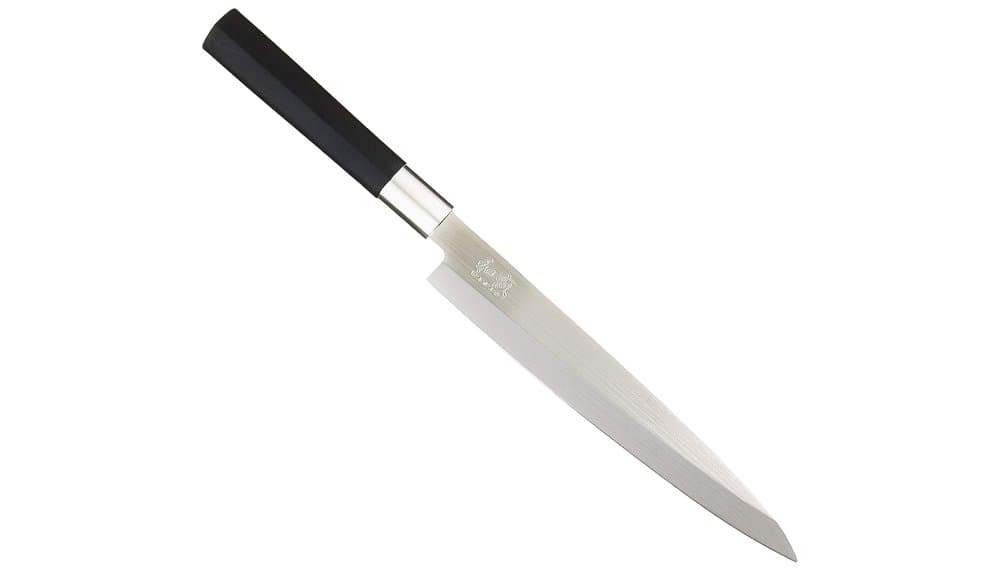
The KAI Wasabi Black Yanagiba 21 cm represents a fascinating and accessible entry point into the demanding world of authentic Japanese sushi knives. On a site dedicated to durable kitchen tools, this product interests us particularly as it embodies a compromise between the "buy it for life" tradition and the reality of modern production adapted to an international market. It is not a hand-forged knife from an artisan's workshop, but a professional tool from a major Japanese brand, designed to offer serious performance. Our analysis aims to determine if this yanagiba can satisfy a demanding amateur cook, eager for a professional tool they can use and cherish for decades, by breaking down its materials, construction, and feedback from those who use it.
Key Strengths
- Exceptional sharpness out of the box: The overwhelming majority of feedback highlights that the knife arrives extremely sharp, capable of classic test cuts like cleanly slicing a sheet of paper or a ripe tomato without crushing it.
- Remarkable value for money: For a Japanese single-bevel blade made in Japan, the community agrees the positioning is very competitive. It offers an introduction to yanagiba cutting without the investment of a high-end carbon steel model.
- Intelligent adaptation for the international user: KAI has made technical choices, such as the use of stainless steel and a moderate Rockwell hardness, which reduce the learning curve for maintenance compared to a traditional carbon steel yanagiba, which is more temperamental.
- Robust and hygienic construction: The handle made of polypropylene injected with bamboo powder is fully molded around the nakago (tang), creating a seamless joint where dirt cannot infiltrate. It is advertised as water-resistant and easy to clean.
- Ideal blade length for home use: At 21 cm (approx. 8.3 inches), the blade is considered more manageable and suited to small and medium cutting boards than a professional 27 cm or longer blade, while still being long enough for beautiful slices of fish.
Key Weaknesses
- Handle potentially too thin for large hands: This is the most recurrent negative feedback. Several users, particularly male, note that the handle diameter is quite thin, which can affect comfort during prolonged use or for those with large palms.
- Wider factory edge (ito-ba) finish: As pointed out by an expert user in reviews, the factory micro-bevel (ito-ba or habaki) is wider than on a traditional Japanese yanagiba. This makes it more forgiving and easier for a beginner to re-sharpen, but some purists feel it does not immediately deliver the ultimate cutting finesse of a hand-sharpened edge (honbazuke).
- Single-bevel learning curve: This is not a product flaw, but an inherent characteristic. Cooks used to double-bevel Western knives must relearn their technique. The knife is designed for right-handed users and incorrect use (angle, lateral pressure) can damage the blade.
- Very specific usage limits: This is a specialized tool. Experts and technical sheets are clear: it is designed for slicing fish and tender cooked meats by pulling the blade. It should not be used for chopping, cutting through bones, or on hard surfaces.
- Impossibility to customize or replace the handle: The molded, one-piece construction means the handle is fixed for life. If it breaks, repair is nearly impossible. However, this construction also guarantees its durability and watertightness.
Detailed Analysis
The Blade: "1K6" Stainless Steel at 58 HRC, the Choice of Practicality
The heart of our "buy it for life" analysis lies here. The KAI Wasabi Black Yanagiba uses a stainless steel designated 6A/1K6. This is a steel from Daido Steel, roughly equivalent to AUS-8 or VG-5 in terms of composition (moderate carbon, chromium for stainlessness, vanadium). Its Rockwell hardness is 58 (±1) HRC.
This choice is crucial for the knife's positioning:
- Ease of sharpening: A hardness of 58 HRC is considered medium-high in the knife world. It's an excellent compromise. The blade will hold its edge much longer than a low-end knife, but will remain relatively easy to re-sharpen on a standard whetstone, even for a motivated amateur. This is much simpler than a "super steel" at 62+ HRC.
- Resilience and corrosion resistance: Unlike traditional carbon steel yanagiba (like White Steel #2), this stainless steel will not rust if left wet for a few minutes. This is the "safety" and "peace of mind" factor for the home user, especially in a humid environment. It more easily forgives small maintenance mistakes.
- Cutting performance: On paper, a harder carbon steel (61-64 HRC) could offer a sharper edge and slightly superior edge retention. However, according to user feedback, the finesse of the single bevel and the factory sharpening allow this 1K6 to deliver absolutely professional cutting performance, sufficient for slicing sashimi with surgical precision. The community notes that the edge is "formidable" and "does not forgive".
Ergonomics and Construction: Industrial Robustness
The handle is a point of discussion. Made from polypropylene reinforced with bamboo powder, it aims to offer a warmer, more organic feel than raw plastic. Opinions on its comfort are mixed, but a trend emerges: people with medium or small hands find it pleasant and precise, mentioning a "pencil-like" grip. Conversely, for large hands, the thinness can become uncomfortable over time. The "buy it for life" argument works in its favor through its construction: the handle molded around the tang and the metal bolster (kuchiwa) at the junction create an almost indestructible and perfectly hygienic assembly, with no seam for bacteria to lodge in. It is built to last and withstand demanding kitchen environments.
The overall build quality, like the perfect alignment of blade and handle often mentioned, reinforces the idea of a Made in Japan product that adheres to high control standards, even on a production line.
Comparison with the "Buy It For Life" Ideal
For a serious home cook, this knife presents an interesting profile:
- Material durability: Excellent. The stainless steel resists corrosion, the synthetic handle does not rot, and the construction is solid.
- Potential for "seasoning" / Patina: None. Unlike a carbon steel blade, it will not develop a patina. Its appearance will remain unchanged.
- Ease of maintenance: Good to very good. Its hardness and steel make it easier to maintain than a high-end artisan knife, while still requiring regular sharpening on a Japanese waterstone to perpetuate its performance. Testers emphasize this is a necessity, not an option.
- Specialization: This is both its strength and a limitation in a "one-tool" perspective. It is not a universal chef's knife. It is a first-rate specialized tool for a precise task. For someone who regularly prepares sushi or raw fish, it's a logical investment. For someone seeking a versatile knife, it is a poor choice.
Technical Specifications
| Characteristic | Detail |
|---|---|
| Product Name | KAI Wasabi Black Yanagiba 21 cm |
| Blade Type | Yanagiba (sushi knife), single-bevel, for right-handed users |
| Blade Length | 21 cm (approx. 8.3 inches) |
| Blade Material | Daido 1K6 (6A) stainless steel |
| Rockwell Hardness (HRC) | 58 (±1) |
| Blade Finish | Polished ("kurouchi" on the non-cutting back) |
| Handle Material | Polypropylene with bamboo powder addition, molded |
| Construction | Handle molded around the tang (nakago) with metal bolster (kuchiwa) |
| Weight | Approximately 202 grams |
| Manufacturing Origin | Japan (Seki) |
| Recommended Maintenance | Hand wash, immediate drying, regular sharpening on a waterstone |
What Users Say
A synthesis of 743 global reviews (average rating of 4.4/5) and expert analyses reveals a strong consensus around a few key ideas.
Recurring praise revolves around cutting performance. Terms like "extremely sharp," "exceptional sharpness," "clean and precise cut," and "perfect for sashimi" come up like a leitmotif. Many users, including former professionals, attest that it is one of the sharpest knives they have received. The fact that it is made in Japan is also highly valued and contributes to the perception of good value for money. Beginners appreciate its accessibility, while more experienced users praise its effectiveness for a tool at this price point.
Criticisms and remarks focus on two main aspects:
- Handle ergonomics: The most frequent complaint concerns its thinness, considered uncomfortable for people with large hands. This is the main ergonomic adjustment point.
- Need for proper sharpening: Several comments, including from experts, indicate that to reach its full potential, sharpening on a Japanese stone may be necessary, even if the knife is very sharp out of the box. The factory micro-bevel is intentionally more robust.
- Specialization: Some buyers realize after the fact how specific the tool is and that it requires a different technique than their Western knives.
A long, detailed review from an Italian user with experience in Japan perfectly summarizes this positioning: they see this KAI Wasabi Black as an "international" yanagiba, intelligently designed to offer the Japanese cutting experience while mitigating the maintenance constraints of a pure traditional tool, making it perfectly suited for serious but occasional home use.
Conclusion
The KAI Wasabi Black Yanagiba 21 cm is much more than a simple entry-level sushi knife. It is a professional tool made in Japan, intelligently adapted to meet the needs and constraints of the demanding amateur cook. Its bet is successful: it offers the authenticity of a single-bevel cut and performance worthy of a restaurant in a corrosion-resistant package that is relatively easy to maintain thanks to its 1K6 steel at 58 HRC.
Its main compromise for a "buy it for life" philosophy lies in its extreme specialization and the thin handle that will not suit all hand sizes. It is not the universal, hand-forged tool to be passed down through generations, but it is the specialized, robust, and reliable tool that you can use with pleasure and efficiency for many, many years, provided you respect its purpose and learn the basics of sharpening it. For the home enthusiast of Japanese cuisine who wants to step up to a professional level of slicing, it is a solid and highly recommended choice.