KRODEAIR Cast Iron Wok Review with Lid
Introduction
In the world of durable kitchenware, the wok holds a special place. It is the ultimate versatile tool, capable of searing, frying, simmering, and steaming. For serious cooks looking for lifelong equipment, the choice of material is crucial. The KRODEAIR Cast Iron Wok with Lid presents itself as a robust, cast iron option for recreating authentic cooking. But how does it perform under the demands of intensive use and in comparison to other materials like carbon steel? We will dissect this product from a "buy-it-for-life" perspective, examining its construction, heat behavior, ergonomics, and long-term potential.
Strengths and Weaknesses
Before diving into the detailed analysis, here is an overview of the strengths and challenges associated with this wok, as reported by users and testers.
Strengths:
- Extremely robust construction in cast iron, promising exceptional longevity.
- Excellent heat retention and distribution, ideal for even cooking and perfect searing.
- Enhanced versatility thanks to the inclusion of a wooden lid, allowing for stewing and braising.
- Flat bottom ensuring optimal stability on domestic cooktops (induction, glass-ceramic, gas).
- Surface without chemical coating, healthy and improvable through seasoning.
Weaknesses:
- Very high weight, characteristic of cast iron, which hampers maneuverability and makes the "toss" technique difficult.
- Potentially too short fixed handle according to feedback, increasing the risk of proximity to heat.
- Slower thermal reactivity than carbon steel, less suited to the rapid temperature adjustments typical of stir-frying.
- Demanding maintenance: requires immediate and thorough drying to prevent rust, and regular seasoning to maintain its performance.
Detailed Analysis of the KRODEAIR Cast Iron Wok
Material & Construction: The DNA of Durability
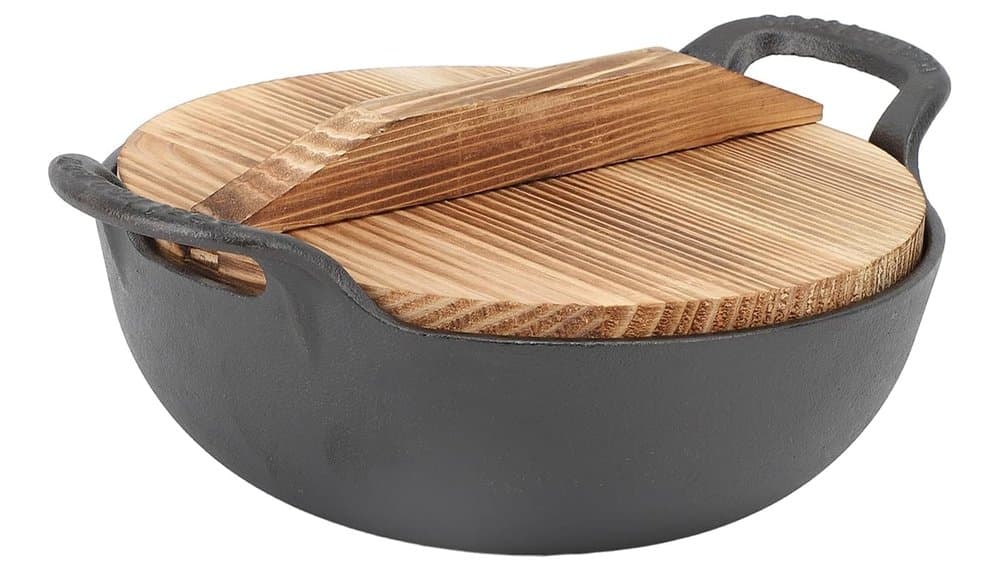
The KRODEAIR is made from raw cast iron. This is neither lightweight carbon steel nor enameled cast iron. It is the traditional, heavy, and massive material. On paper, this means a virtually indestructible one-piece construction, safe from warping and capable of withstanding decades of intensive use. It is the archetype of an object designed to last a lifetime, provided its maintenance is mastered. The presence of a solid wooden lid is a real plus, not only for its functional utility (braising, limiting splatter) but also because it avoids the problem of a cast iron lid becoming scalding hot and further weighing down the set.
Culinary Performance: Heat and Versatility
Cast iron excels in two areas: heat retention and its even distribution. Once hot, the KRODEAIR wok acts as a stable thermal mass. This is excellent for deep frying (constant temperature), stir-fries where a homogeneous sear is desired, or dishes that require switching from high heat to simmering. The flat bottom is a crucial asset for modern induction or electric stoves, guaranteeing maximum contact.
However, this is where the comparison with carbon steel becomes instructive. Testers emphasize that this high thermal inertia is also a drawback for the most authentic "Chinese-style" stir-fry. A carbon steel wok is reactive: turn up the flame, it heats almost instantly; remove it from the heat, it stops cooking. The cast iron of the KRODEAIR, on the other hand, takes time to heat up and, once hot, takes time to cool down. This makes it a tool less suited to the ultra-fast adjustments required by certain professional techniques.
See priceErgonomics and Handling: The Weight of Performance
Ergonomics is the main point of friction for this product. The considerable weight of cast iron is an unavoidable physical fact. Based on community feedback, this makes the wok difficult to handle with one hand, especially for flipping or tossing food. The fixed handle is often described as too short. On a deep cooktop, the user has to get closer to the flame, which can be uncomfortable. Unlike traditional woks with handles, it is impossible to lift it with both hands for better weight distribution. This configuration requires a certain physical strength and may limit its use for some.
Maintenance & Long-Term Durability
The mechanical durability of this cast iron is not in question. The real challenge lies in maintaining the surface. Like any bare cast iron cookware, the KRODEAIR requires an initial seasoning and regular upkeep. This process, which involves creating a polymerized layer of oil, is what will develop its natural non-stick properties over time. Experts agree: avoid the dishwasher and harsh detergents, favor cleaning with hot water and immediate, thorough drying to prevent rust. It is a small ritual that, once integrated, ensures this wok will become not only a tool for life but also one that improves with age.
Technical Specifications
| Characteristic | Detail |
|---|---|
| Product | KRODEAIR Cast Iron Wok with Lid |
| Main Material | Raw cast iron |
| Lid Material | Solid wood |
| Coating | None (bare surface to be seasoned) |
| Bottom | Flat |
| Handle Type | Single fixed handle |
| Cooktop Compatibility | Compatible with all cooktops (induction, gas, glass-ceramic, electric) |
| Maintenance | Hand wash, immediate drying, oiling/seasoning recommended |
What Users and Testers Say
A synthesis of community feedback and available expert analysis paints a nuanced but consistent picture of the product.
Recurring positive points revolve around its perceived sturdiness and thermal performance. Users appreciate the feeling of quality, the stability on the heat, and the ability to sear food well. The wooden lid is consistently mentioned as a useful and well-thought-out accessory. Many also note that, when properly seasoned, the surface becomes increasingly non-stick, validating the "buy-it-for-life" approach based on maintenance.
Criticisms focus primarily on two ergonomic aspects. The weight is the number one complaint, with many comments about the difficulty of handling it, especially when full. The handle length comes second, with many finding it too short for safe and comfortable use on standard cooktops, forcing an uncomfortable proximity to the heat. Finally, some more experienced cooks or those wanting to replicate restaurant techniques fault its lack of reactivity compared to a lighter carbon steel wok.
Conclusion
The KRODEAIR Cast Iron Wok with Lid is a serious piece of cookware, built to last. Its raw cast iron construction, its clever wooden lid, and its ability to accumulate and distribute heat make it a versatile and durable tool, ideal for cooking where thermal stability is paramount. It is an excellent choice for roasting, frying, braising, and more "measured" stir-fries.
However, it is not a consensus choice as a "professional" tool for quick stir-frying. Its weight and thermal inertia place it in a different category from the carbon steel wok, the lightweight and reactive tool of Asian kitchens. The choice between the two boils down to a philosophy of use. If you are looking for a thermal bastion, stable, versatile, and virtually eternal, and you are willing to accept its weight and demanding maintenance, the cast iron KRODEAIR is a solid investment. If your priority is agility, reactivity, and the technique of high-heat cooking with movement, a traditional carbon steel wok will likely be a more suitable companion. For the serious cook, this cast iron wok is less an instrument of virtuosity than a reliable and durable pillar of the kitchen arsenal.