Skerper Basic SH003 Ceramic Sharpener Review
Introduction
On a site dedicated to sustainable and high-performance kitchen tools, sharpening is approached with a certain rigor. Between Japanese water stones for precision and steel sharpening rods for honing, where does a tool like the Skerper Basic SH003 Ceramic Sharpening Gun fit? This article analyzes this product from a "buy-it-for-life" perspective, breaking down its materials, real-world use, and relevance for serious cooks. We have not tested it hands-on; our analysis is based on technical specifications, user community feedback, and expert reviews available online.
Strengths
The strengths of the Skerper Basic SH003, according to available data, are clear and match its positioning.
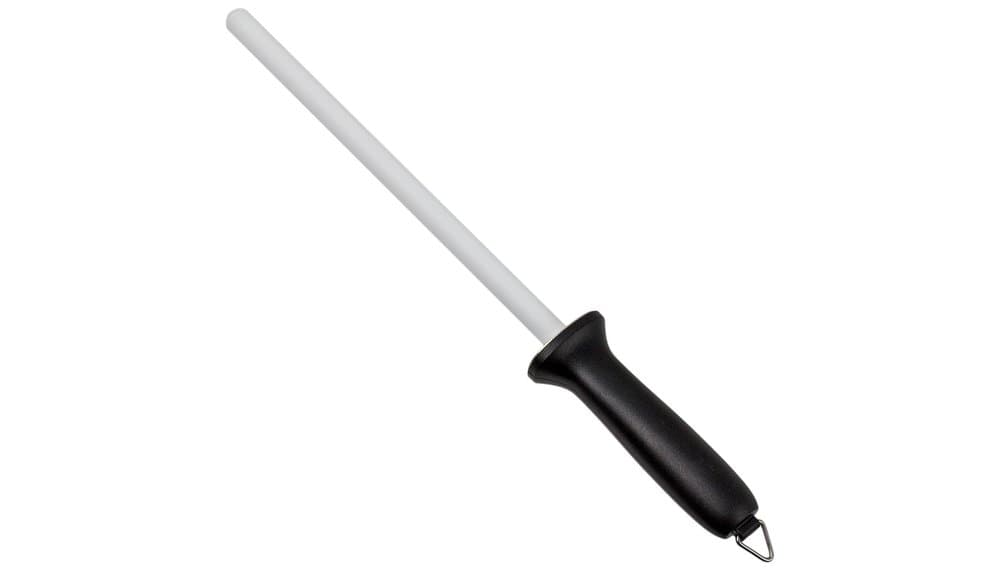
Effective abrasive material: The rod is made of fine ceramic, with an estimated grit size around 1200. According to testers, this material is excellent for maintenance and fine honing of an existing edge. It allows for realigning the cutting edge (the "straightening" or honing process) and removing micro-imperfections, quickly restoring a razor-sharp edge to a knife slightly dulled by daily use.
Accessibility and ease of use: The brand targets it at both beginners and experienced users. Its classic rod design is intuitive and does not require complex setup. It's a tool for quick "daily maintenance," easier to master in a pinch than a water stone.
Lightweight and maneuverability: Weighing only 212 grams and with a handle shaped for grip, user feedback highlights comfort of use even during prolonged sessions on multiple knives. Its total length of 36.5 cm (with an active rod length of about 24.5 cm) offers good range for most kitchen blades.
Value for money and warranty: Positioned in Skerper's "Basic" range, it is presented as a product with good value for money. The brand supports its durability promise with a 25-year material warranty mentioned in expert contexts, a notable point for a "buy-it-for-life" analysis.
Weaknesses
The product's limitations are equally clear and are mainly linked to its nature and materials.
Structural fragility: The main drawback noted by the community is the inherent fragility of ceramic. Unlike a forged steel or diamond rod, the ceramic rod is sensitive to shocks and can break if dropped on a hard floor. It is not a tool to be treated roughly.
Functional limits: There should be no mistake: this is not a sharpening tool. Its function is strictly maintenance and honing. For a dull, chipped, or blade needing a new bevel, a sharpening stone (ceramic, water, or diamond) remains essential. Experts are unanimous: it is a complement, not a standalone solution.
Finish and perception: As an entry-level product, compromises are made. The plastic handle, although ergonomic, does not convey the same sense of quality and long-term durability as a stabilized wood or solid metal handle. For a "pro" tool enthusiast, the aesthetics and feel may seem basic.
Specific maintenance: Ceramic tends to clog with metal microparticles. It therefore requires regular cleaning (with an abrasive eraser or brush) to maintain its abrasive effectiveness, a constraint not present with smooth steel rods.
Detailed Analysis
Materials and construction: conditional durability
The heart of the product is its alumina ceramic rod. This material is very hard and allows for fine work. Its abrasive longevity is excellent, but its resistance to physical shocks is the Achilles' heel of the "for life" concept. Its durability therefore depends entirely on careful handling and storage by the user. The plastic handle is the least premium point of the construction. There are no noble materials here like VG-10 or white steel found in our knives, but a tool whose durability relies on correct usage.
See pricePerformance on different steels: suitable for the majority, but with discernment
The fine ceramic of the SH003 is suitable for a wide range of steels. For hard steels like Japanese steels (HRC 58-63+), it is perfect for frequent honing, allowing to significantly extend the interval between full sharpenings on a stone. For softer steels (HRC 55-58), it will also be effective, but the "straightening" effect on the edge will be more pronounced and needed more often. The key, emphasized by experts, is to use a constant and light angle (around 15-20 degrees depending on the knife) to avoid unnecessarily aggressing the blade.
Ergonomics and grip: comfort in service of regularity
User feedback converges: the tool is light and well-balanced. The handle, although simple, seems designed for a good grip, which is crucial for maintaining a stable angle during repeated passes. This ease of use encourages regular use, which is exactly the goal of a daily maintenance tool. For prolonged sessions on an entire set of knives, fatigue seems limited.
Positioning in the sharpening ecosystem
The Skerper Basic SH003 does not compete with a Naniwa Chosera or Shapton Glass water stone. It positions itself more as the ceramic equivalent of the traditional steel sharpening rod, but finer. It is more versatile and less risky (for the edge) than a pull-through sharpener with wheels, but less powerful and precise than a guided system. For the serious user, it fits into a routine: water stone to recreate the edge (1-2 times a year), ceramic rod to maintain it (every week or after intensive use).
Technical Specifications
| Characteristic | Detail |
|---|---|
| Model | Skerper Basic SH003 Ceramic Sharpening Gun |
| Rod Material | Ceramic |
| Grit Size (Grit) | Fine (estimated ~1200) |
| Total Length | 36.5 cm |
| Useful Length (rod) | ~24.5 cm (estimate based on tests) |
| Weight | 212 grams |
| Handle Material | Plastic |
| Color | Silver |
| Manufacturer Warranty | 25 years (according to expert sources) |
| Intended Use | Daily maintenance and edge honing |
What Users Say
The synthesis of customer reviews and expert feedback online paints a solid consensus around this product.
The recurring praise focuses on its immediate effectiveness. Satisfied users (representing a majority of 5-star ratings) testify that "a few passes" are enough to restore a pleasant and sharp cutting edge, often with a result superior to a basic, poorly used sharpening stone. They appreciate its simplicity, its value for money, and the long warranty. The phrase "does what it's supposed to do, no more, no less" often comes up.
Criticisms and disappointments mainly come from a misunderstanding of its use. The few low ratings (1 star) seem linked to mismatched expectations: users trying to re-sharpen very damaged blades and noting the tool's ineffectiveness for this task. The second tangible point of criticism is the perception of a certain fragility or a "plastic" finish that does not match the image of a professional tool.
The general trend is therefore positive provided one knows and accepts its limits. It is perceived as an excellent complement for anyone who already has a primary sharpening method (stone) and is looking for a simple and quick way to maintain their knives between full sessions.
Conclusion
The Skerper Basic SH003 Ceramic Sharpening Gun is a specialized tool that perfectly fulfills a precise mission: regular maintenance and fine honing of edges. From a "buy-it-for-life" perspective, its analysis is nuanced.
Its material durability is conditional: the ceramic promises exceptional abrasive longevity, but its resistance to accidents is low. Its lifespan will therefore depend on the caution and care provided by its owner. The 25-year warranty is a strong argument from the manufacturer.
For the serious and demanding cook who uses quality knives (Japanese or Western high-hardness steels), this tool has a legitimate place in their drawer. It is not a substitute for a water stone, but a valuable ally for keeping blades at their peak performance daily, extending the intervals between full sharpenings. It represents a modest expense for a tangible gain in ease of use.
However, for someone looking for a single, universal solution to restore very damaged knives, or for the user who prioritizes absolute robustness (a steel rod will be unbreakable), the Skerper SH003 will not be the optimal choice. It is a tool of finesse and regularity, whose value is measured in continuous use, not in solving extreme problems.