Arcos Nitrum 2900 Flexible Filleting Knife Review
Introduction
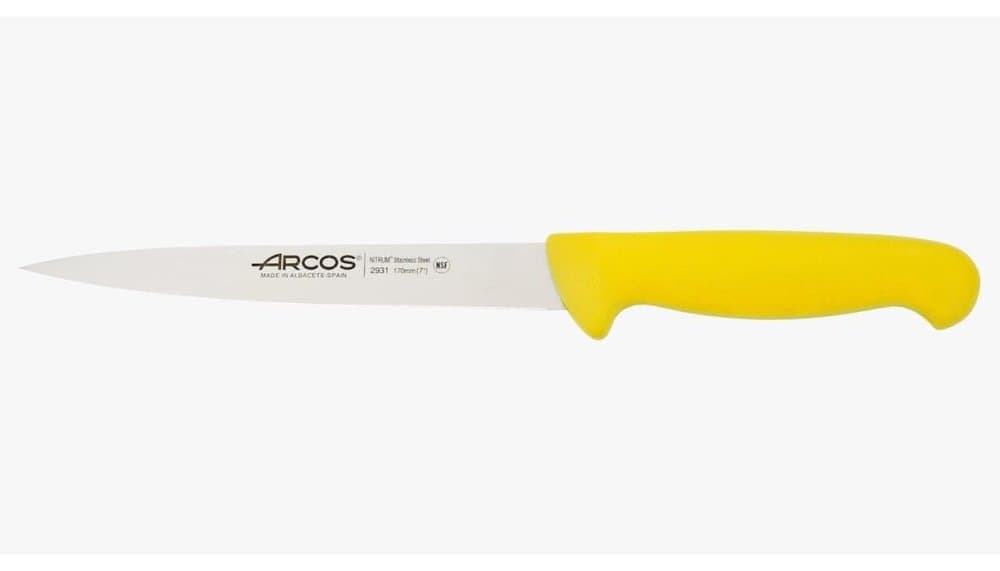
In the world of sustainable culinary tools, the filletting knife occupies a unique place. It is an instrument of precision, whose blade must be an extension of the cook's hand to glide along the bones without wasting precious flesh. The Arcos Nitrum 2900 Series 170 mm Flexible Filleting Knife presents itself as a professional tool born from a Spanish know-how nearly three centuries old. We will analyze it from the demanding perspective of "buy it for life," dissecting its materials, design, and suitability for the needs of a serious cook seeking a long-term investment.
Strengths and Weaknesses: A First Assessment
Before diving into the details, here is what emerges from the analysis of specifications and user feedback.
Strengths
- Nitrum Steel Blade: A proprietary technology promising exceptional hardness and superior edge retention, ideal for a precision tool.
- Mastered Flexibility: The blade's flexibility is unanimously praised as a major asset for perfectly following the structure of fish, particularly flatfish.
- Ergonomic and Hygienic Handle: Designed in POM (polyoxymethylene), a technical polymer, it offers a comfortable grip, resists detergents and extreme temperatures, and is dishwasher safe.
- Featherweight: At only 87 grams, it promises excellent handling and control during prolonged work sessions, reducing fatigue.
- Heritage and Construction: Manufactured by Arcos, a historic house, with a process of permanent injection of the blade into the handle for structural durability.
Weaknesses (or Points to Consider)
- Demanding Maintenance: The hardness of Nitrum steel implies that sharpening must be done carefully, ideally on quality sharpening stones, and may deter beginners.
- Marked Specialization: It is primarily a knife for filleting fish. Its flexibility makes it less suitable for other tasks like deboning harder meats.
- Subjective Flexibility: While an asset for most, some users find the blade too flexible for their taste, limiting its perceived versatility.
Detailed Analysis: At the Heart of Sustainable Performance
See priceThe Blade: Nitrum Steel Under the Microscope
This is where the "buy it for life" character of this knife plays out. Arcos speaks of a patented stainless steel technique, Nitrum. Although the company does not disclose the exact alloy composition or its Rockwell hardness (HRC) on the product sheet, the technical context and expert feedback provide insight.
The name "Nitrum" strongly suggests a treatment or alloy including nitride (often vanadium or chromium). This surface treatment is known to significantly increase steel's hardness, wear resistance, and corrosion resistance without making it brittle.
On paper, and according to community feedback, this technology translates into two things:
- Excellent Edge Retention: The blade stays sharp much longer than that of a standard low-grade stainless steel filleting knife. For a tool where precision is paramount, this is a decisive advantage.
- More Demanding Sharpening: The counterpart of great hardness is often increased difficulty in sharpening. Very hard steels can take longer to work on a stone. Experts emphasize the need to use appropriate grit stones and avoid abrasive electric sharpeners that could overheat and damage the steel's microstructure. This is therefore not a knife you quickly run over a ceramic rod; its maintenance requires know-how.
The 170 mm length is a strategic choice. It is considered by connoisseurs to be the most versatile: long enough to fillet a medium-sized sea bass or salmon, yet manageable enough for smaller fish like trout or sole. Its controlled flexibility is its very essence. It allows you to "feel" the bones through the blade and navigate around them with surgical precision, maximizing flesh yield.
The Handle: Ergonomics and Durability in Use
The POM handle (also called acetal) is an often underestimated strength. This is not simple plastic. It is a high-performance technical polymer, renowned for its wear resistance, dimensional stability, and low friction coefficient. In the kitchen, this translates to:
- A secure grip, even when wet or greasy.
- Resistance to shocks and chemicals (detergents), justifying the "dishwasher safe" indication.
- Longevity superior to many plastics, with no risk of cracking or deforming over time.
The ergonomic shape, with its rounded lines and featherweight, is designed for prolonged professional use. The blade-handle connection via injection (so-called hidden "full-tang" construction) is advertised as permanent and hygienic, eliminating joints where bacteria could proliferate. It is a guarantee of long-term sturdiness.
Comparison and Positioning
The Arcos Nitrum 170 mm positions itself as a specialized professional tool. Compared to a Japanese filleting knife in carbon steel (like white steel), it offers much greater corrosion resistance (no rust), perhaps at the expense of ultimate sharpness fineness and easier sharpening. Compared to a more standard Western filleting knife in stainless steel (like X50CrMoV15), it distinguishes itself with supposedly much better hardness and edge retention, thanks to Nitrum technology.
It is therefore a choice for those who prioritize edge durability and hygiene without compromise, and who are ready to invest time in its maintenance. It is not designed as an "all-purpose" knife and excels in its unique role.
Technical Specifications
| Characteristic | Detail |
|---|---|
| Model | Arcos Nitrum 2900 Series Flexible Filleting Knife |
| Blade Length | 170 mm (6.6 inches) |
| Blade Material | Nitrum Stainless Steel (patented technology) |
| Edge Type | Smooth (plain edge) |
| Construction Type | Forged blade, injection into handle |
| Handle Material | POM (Polyoxymethylene) |
| Handle Color | Yellow (other colors available) |
| Total Weight | 87 grams |
| Maintenance | Dishwasher safe (according to manufacturer) |
| Origin / Manufacturer | Arcos, Albacete, Spain |
What Users and Experts Say
A synthesis of customer reviews and expert analyses reveals clear trends.
Praise is concentrated on pure performance:
- Users confirm the knife is extremely sharp right out of the box. Terms like "sharp," "precise," and "excellent yield" constantly recur.
- The blade's flexibility is its main asset. It is described as perfect for gliding along bones, enabling clean fillets with no waste.
- The comfort and lightness of the handle are appreciated, especially for long tasks. Its secure grip, even with wet hands, is a notable plus.
- The 170 mm length is often cited as the "sweet spot," offering a good balance between control and capacity.
Criticisms or reservations concern use and maintenance:
- The main point of attention is the knife's specialization. Some who bought it for more versatile use (e.g., deboning poultry) find its flexibility excessive and poorly suited.
- As anticipated, sharpening is a topic. Satisfied owners are generally those already accustomed to using sharpening stones. No recurring manufacturing defects are reported, but the necessity for competent maintenance is emphasized.
- A minority of users express mixed opinions, finding the product "decent" but not exceptional, sometimes due to a miscalibrated expectation regarding the level of flexibility.
Testers and the enthusiast community confirm it is a tool for experienced users. It is not designed to be mistreated or sharpened carelessly. For those who master its maintenance, it is a reliable and durable work companion.
Conclusion: Who Is This Filleting Knife For?
The Arcos Nitrum 2900 Series 170 mm Flexible Filleting Knife is a serious tool that honors its manufacturer's reputation. It is not a gimmick, but a work instrument built to last.
It is a wise investment if:
- You are a cooking enthusiast, a regular angler, or a demanding home cook who often prepares fish.
- You seek above all precision and yield in filleting, and you are ready to use a specialized tool for it.
- You are already accustomed to sharpening your knives on a stone and see maintenance as a necessary ritual to preserve a quality tool.
- You value durable materials (hard steel, POM handle) and hygienic, robust construction.
On the other hand, look elsewhere if:
- You are looking for a "multitask" knife to debone both fish and poultry or game. Its flexibility will make it imprecise on harder joints.
- You do not intend to or know how to properly sharpen hard steel. Its performance will degrade without proper maintenance.
- You prefer the charm and sharpening simplicity of a carbon steel knife, despite its greater sensitivity to corrosion.
In summary, this Arcos filleting knife embodies a "buy it for life" philosophy in its field of specialty. It requires an invested user to reveal its full potential, but in return, it offers precision and durability that can last decades with proper care. It is the choice of expertise and longevity over versatility and ease.