BEKA Nomad Wok Review & Expert Test
Introduction
In the market for durable cookware, carbon steel woks and pans hold a prominent place for demanding cooks. These pieces, free from synthetic coatings, promise exceptional longevity and professional performance, provided one accepts a specific learning curve and maintenance routine. The BEKA Nomad Frying Pan positions itself as a gateway into this world, with a 10-year warranty and technical specifications that set the tone: robust and functional. We will dissect this utensil from a "buy-it-for-life" perspective, analyzing its materials, construction, performance, and, above all, what users and testers say after several months or even years of daily use.
Key Strengths
According to expert feedback and the user community, the major strengths of the BEKA Nomad are clear.
Demonstrated Robustness and Durability. The construction from carbon steel sheet is the foundation of its promise. It is a healthy material, free from PTFE or PFOA coatings, which can last for decades with proper care. The manufacturer's ten-year warranty, although conditional, is a confidence-building guarantee that appeals to enthusiasts of durable products. On paper, its thickness (not specified but deemed satisfactory by testers) gives it appreciable thermal mass for searing.
Thermal Performance and Versatility. Carbon steel is renowned for its reactivity and ability to reach high temperatures. Experienced users report excellent results for searing meats or stir-frying vegetables. Its compatibility with all stovetops, including induction, is a considerable advantage in modern kitchens. Testers highlight that its design, with a relatively flat bottom for a wok, offers good heat distribution on electric and induction hobs, unlike traditional, highly curved Asian woks.
A Seasoning That Improves Over Time. This is the heart of the "natural" concept. All enthusiastic reviews insist on this point: once properly seasoned, the utensil develops a natural anti-stick patina that strengthens with each use. This patina gradually blackens, a sign of a utensil that "lives" and improves, which is very rewarding for an enthusiast.
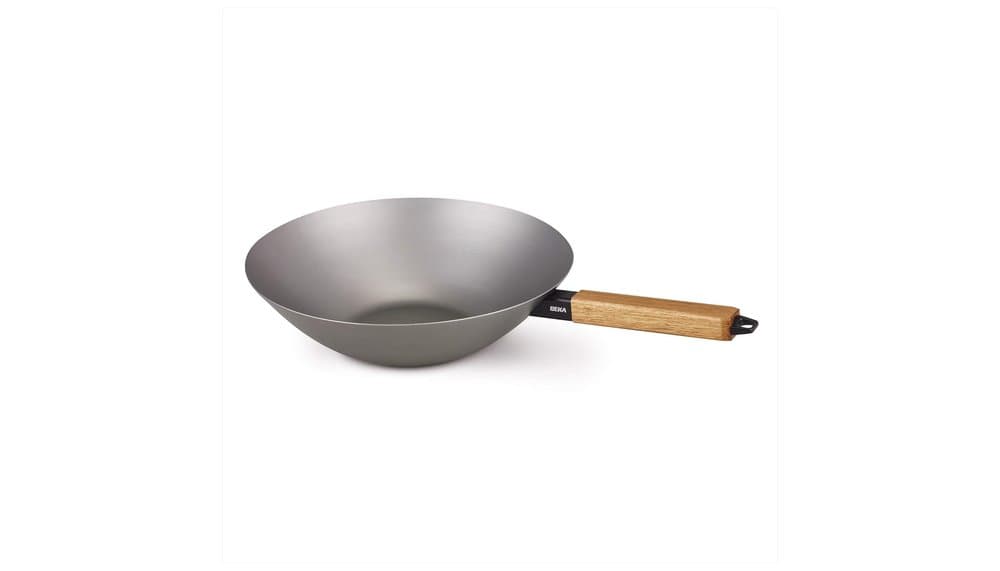
Handling and Relative Lightness. Weighing 1.35 kg for a 31 cm diameter, it is described as relatively light and manageable for a carbon steel utensil of this size. The acacia wood handle is generally appreciated for its comfort and heat-resistant properties, staying cool during cooking, which is an advantage for prolonged handling.
Weak Points
This type of utensil is not for everyone, and negative feedback consistently points to the same demands.
A Steep Learning Curve. The main pitfall is the initial seasoning and maintenance. Disappointed reviews almost always come from users who did not follow the instructions, used soap, or did not dry the pan immediately, leading to rust. This is not a product defect, but an inherent characteristic of unprotected carbon steel. It requires a radical change in habits compared to classic coated pans.
Demanding Maintenance. It is strictly forbidden in the dishwasher. Cleaning is done with hot water, possibly with a mild abrasive like coarse salt, followed by immediate and thorough drying and often a light protective oiling. For some, this ritual is cumbersome.
Usage Limitations. The wooden handle is not designed to go in the oven. Although the wok itself is "ofenfest" (oven-safe), it will need to be disassembled or one must limit cooking to the stovetop. Furthermore, like all carbon steel, it is not recommended for very acidic long-cooked sauces (tomato, wine) which could damage the seasoning.
Actual Cooking Surface Size. Some users note that the advertised diameter (31 cm) is that of the opening, but the flat bottom measures about 13-15 cm in diameter. This is an ideal size for 1 to 2 people, but can be limiting for large quantities.
Detailed Analysis
Construction and Materials
The BEKA Nomad is made from carbon steel sheet. Unlike cast iron which is molded, carbon steel is rolled, allowing for thinner walls, better heat reactivity, and controlled weight. On paper, it is the material of choice for professional woks for its efficient heat conduction and resistance to thermal shock. The handle attachment seems robust; a user with over a year of daily use reports that after initial doubts, the attachment proved to be solid. The acacia handle is fixed with screws, which facilitates potential replacement or allows the handle to be removed for more uniform oven seasoning.
See priceCooking Performance and Seasoning
Feedback converges: once seasoned, performance is excellent. Heat-up is fast and heat retention is sufficient for searing. A German tester using induction emphasizes that this wok, thanks to its thickness, heats much more evenly than a traditional Chinese wok, which would have a very localized hot spot on this type of hob. The anti-stick patina does develop over time. A French user posts a picture after 6 months: the pan is perfectly blackened, uniform, and they claim nothing sticks. The seasoning process, although crucial, is well-documented by the community (many online tutorials). The most effective method seems to be over a gas flame or in the oven, rather than induction, for the initial stage.
Ergonomics and Handling
At 1.35 kg, this wok is considered well-balanced. The weight is sufficient for good thermal mass without being tiring for the quick motions of wok cooking. The wooden handle offers a good grip, even with wet or greasy hands, and does not transfer heat. This is a strong point for long cooking where frequent stirring is required.
Durability and "Buy-it-for-life" Philosophy
This is where the product makes complete sense. Carbon steel is a simple, almost indestructible material if not rusted. It does not warp at normal cooking temperatures (one user notes a slight warping only during seasoning at over 300°C, which resolved upon cooling). Unlike a coated pan, its cooking surface is not a consumable that wears out: it regenerates and improves. If it is scratched or the seasoning deteriorates, one simply needs to clean it, lightly strip it if necessary, and re-season it. It is thus theoretically eternal. The 10-year warranty is a good indicator of the manufacturer's confidence in the integrity of the weld and handle attachment.
Technical Specifications
| Characteristic | Detail |
|---|---|
| Bowl Material | Carbon Steel |
| Diameter | 31 cm (opening) |
| Weight | 1.35 kg |
| Capacity | Approx. 1 liter (information to be taken relatively) |
| Compatible With | All stovetops: gas, electric, induction, ceramic |
| Oven Safe | Yes ("ofenfest") - The wok alone, without the wooden handle |
| Coating | None. Anti-stick through seasoning (natural patina) |
| Handle Type | Acacia wood, fixed with screws (removable) |
| Maintenance | Hand wash only. Immediate drying imperative. Dishwasher prohibited. |
| Warranty | 10 years (on manufacturing defects) |
What Users Say
An analysis of nearly 940 reviews (average rating 4.0/5) reveals a classic polarization for this type of product, clearly separating informed users from unprepared novices.
Positive feedback (majority) celebrates the quality after seasoning. Recurring keywords are: "excellent after seasoning", "doesn't stick at all", "patina that improves", "robust", "good value for money". Satisfied users insist on the importance of following the initial steps correctly (cleaning, perfect drying, oiling and repeated heating) and post-use maintenance (immediate drying, light oiling). Many post photos after several months, showing a perfectly black and glossy pan, proof of their success. An experienced user even explains that the cleaning techniques (hot water, coarse salt) and seasoning make the utensil "more sterile" than a dishwasher cycle, addressing hygiene concerns.
Negative feedback almost all point to rust and food sticking during the first uses. Comments like "rust", "food sticks", "gives a taste" or "bad investment" betray a total lack of understanding of how carbon steel works. These reviews are instructive as they serve as a warning: this product is not "ready to use" like a Teflon pan. It requires an investment in time and know-how.
Some more nuanced reviews (3/5 ratings) highlight practical points: the difficulty of properly seasoning the edges on an induction hob, or the fact that the handle seems a bit light at first (an impression often disproven after prolonged use). An expert tester confirms that induction is not the ideal heat source for initial seasoning, preferring gas or the oven.
Conclusion
The BEKA Nomad Frying Pan is not an ordinary kitchen utensil. It is a tool for enthusiasts, for those who see cooking as a craft and accept developing a relationship with their equipment.
Its evaluation from a buy-it-for-life perspective is overall very positive. Its simple carbon steel construction, functional design, and long warranty make it a product built to last. It excels at high-temperature searing and, once seasoned, offers a natural and healthy anti-stick surface that improves over time.
However, this durability and performance come at a price: user involvement. It is absolutely not suitable for someone looking for the simplicity of a dishwasher-safe disposable pan. On the other hand, it is a serious and healthy alternative to synthetic coatings for the enlightened home cook or home professional, willing to learn the basics of seasoning and maintenance. If you accept these rules, the BEKA Nomad will offer you decades of service and will likely become one of your favorite cooking utensils. Otherwise, its bare steel will rust quickly and the experience will be disappointing. The choice is, ultimately, a question of culinary philosophy.