Bruder Mannesmann 404 Green Sharpening Stone Review
Introduction: A Green Sharpening Stone, but for What Use?
On our site dedicated to sustainable and high-performance culinary tools, we usually evaluate multi-grit Japanese waterstones or diamond plates designed for the hardest steels. The Brüder Mannesmann WETZSTEIN 404 Green Sharpening Stone stands out in this landscape. It is not an accessory designed for Japanese chef's knives in blue steel or VG-10. It is a specialized tool, stemming from a different tradition, and evaluating it according to a buy-it-for-life logic requires understanding its own philosophy. Our analysis will break down its specifications, confront its promises with community feedback, and precisely determine which type of serious user this tool is suited for.
Strong Points
- Monolithic construction and durable material: Cut from a solid block of corundum (aluminum oxide), this stone avoids problems of delamination or breakage under moderate stress (excluding impact). The material is renowned for its longevity and slow wear.
- Generous length: With its 225 mm length, it offers a comfortable sharpening stroke, especially for long tools like scythes, allowing for ample and regular movements.
- Absolute simplicity of use: No mounting, no base, a single grit. It is an elementary tool that requires little preparation: simply wet it.
- Perceived excellent value for money for its specific task, as overwhelmingly noted by buyers.
Weak Points
- Glaring lack of versatility: It is a single-grit (medium-fine) stone, unsuitable for reprofiling, correcting a heavily damaged edge, or the final refinement of a razor. It covers only one very specific step of sharpening.
- Extreme specialization: Designed and optimized for long, thin-edged gardening tools (scythes, sickles, billhooks), its effectiveness on kitchen knives, especially those made of hard steel (HRC 58+), is limited and requires advanced technique.
- Recurring logistics problems: A notable portion of user feedback reports deliveries resulting in a broken stone, pointing to packaging unsuitable for such a fragile item.
- Lack of accessories: No non-slip base, no flattening stone is provided. The user must plan for everything themselves to ensure stable and precise use.
Detailed Analysis: A Specialized Tool Under the Microscope
Material and Design: Corundum, a Robust but Rudimentary Choice
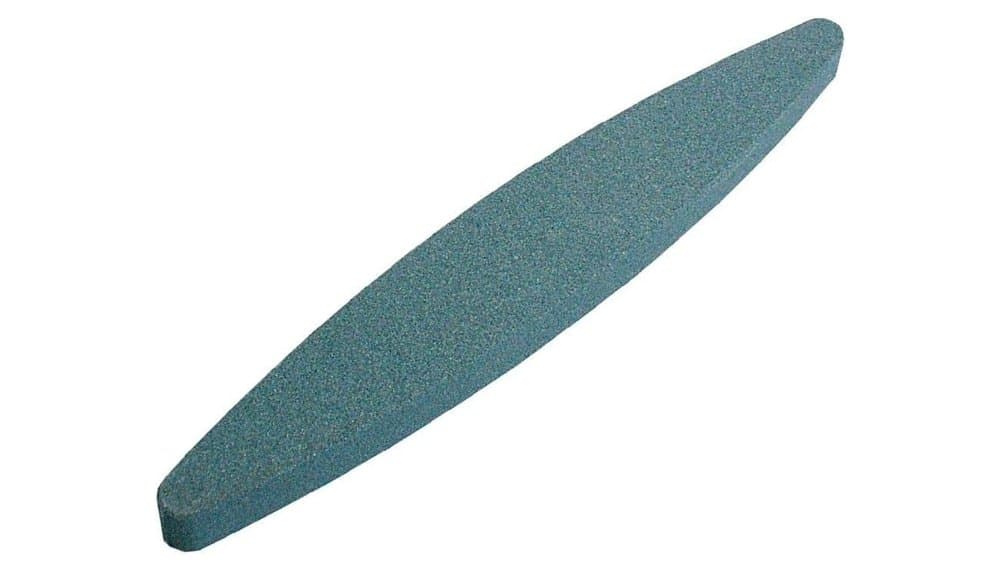
The choice of corundum is significant. It is not the sophisticated resinoid binder of Japanese waterstones, nor ceramic or synthetic diamond. It is a traditional abrasive material, relatively soft compared to modern grits, which breaks down to form an abrasive slurry aiding in polishing. According to the specifications, we have a massive block, easy to handle thanks to its dimensions (227 x 36 x 14 mm) and light weight (150g). The finish is basic, no frills. From a buy-it-for-life perspective, the construction is potentially very durable if it survives delivery and accidental shocks. Its very simplicity limits failure points: there is nothing to unsolder, bend, or unscrew.
See priceGrit and Sharpening Effectiveness: The Gap Between Gardening Practice and the Kitchen
The grit is described as "medium." The web context and expert reviews specify that it is actually oriented towards a medium-fine finish, suited for maintaining and refining the edge of an already shaped scythe. This is the heart of the matter.
- For garden tools (scythes, sickles): The feedback is unanimous. The stone is "simple and effective", "does the job". The edge of these tools, often made of less hard carbon steel and with a very fine geometry, is perfectly maintained by this grit. The stone's length is a major asset for following the curvature of the blade.
- For kitchen knives: The analysis is more nuanced. It can be used to "refresh" a slightly dulled edge on softer Western knives. However, for high-carbon Japanese knives (white steel, blue steel) or stainless steels like VG-10/AUS-10 (typically with a Rockwell hardness between 58 and 62 HRC), this stone alone is insufficient. Its cut is too slow for reprofiling, and not fine enough to obtain a razor edge optimized for cutting food products. As one user notes, it requires "a minimum of technique" and the process is "quite long compared to other methods".
Handling and Ergonomics: Back to Basics (With Its Drawbacks)
The ergonomics are spartan. The stone is held directly in the hand. Some users would have preferred "3 cm more for grip", but most adapt. The real ergonomic issue is stability during sharpening. Testers emphasize that it is imperative to secure it firmly to a work surface, using a wet base or a vise, to avoid imprecise and dangerous maneuvers. This requirement distances it from the object's "supposed" simplicity. For prolonged use, this constraint is a downside.
Durability and Maintenance: Longevity Conditioned by Care
Corundum is a porous material. Like any waterstone, it must be soaked in water before use to prevent its pores from clogging with metal particles. Its maintenance is simple: a rinse after use and air drying, away from frost. No information on a potential need for flattening appears in the data, but for intensive use on long blades, this step would become necessary over time to maintain a perfectly flat surface. The manufacturer's 2-year warranty is a plus, but it covers manufacturing defects, not normal wear.
Technical Specifications
| Characteristic | Detail |
|---|---|
| Product Name | Brüder Mannesmann WETZSTEIN 404 Green Sharpening Stone |
| Abrasive Material | Corundum (Aluminum Oxide) |
| Grit Type | Medium (medium-fine orientation) |
| Dimensions (L x W x H) | 227 mm x 36 mm x 14 mm |
| Weight | 150 g |
| Usage Type | Waterstone (to be wetted) |
| Primary Designated Use | Sharpening scythes, sickles, billhooks, garden tools |
| Manufacturer Warranty | 2 years |
| Format | Single stone, single-grit, no accessories |
What Users Say: Strong Adherence for a Targeted Use
The synthesis of over 3500 global reviews (rating of 4.3/5) and web expert feedback paints a clear consensus.
Recurring positive points:
- Effectiveness for garden use: Mentions like "does what it's supposed to do," "it works," "perfect" dominate among users sharpening scythes, shears, or large scissors.
- Simplicity and reliability: Many praise its "simple and effective" aspect, without complications, reminiscent of traditional tools.
- Value for money: Often described as a "good deal" for those whose need exactly matches its specialty.
Highlighted negative points and limitations:
- Fragility during delivery: This is the major drawback. Many comments like "Broken stone", "Good product but travels very poorly" indicate a recurring problem of unsuitable packaging.
- Technical limits: Users looking for a versatile stone for kitchen knives are disappointed. The web context confirms this: it "is not suitable for repairing a very damaged edge" and its "use is restricted to maintenance."
- Learning curve: For novices in manual sharpening, especially on knives, the experience is "not immediate" and requires "a bit of practice and patience."
Conclusion: A Relevant Purchase Only for a Well-Identified Need
The Brüder Mannesmann WETZSTEIN 404 Green Sharpening Stone is an honest tool, robust in its material design, but with a very marked specialization. It is not a universal sharpening stone, and even less a tool of first choice for the serious home cook's arsenal of Japanese or high-end Western knives.
For whom is this a relevant buy-it-for-life purchase?
- The gardener or farmer who needs to regularly maintain a scythe, sickle, or billhooks.
- The DIY enthusiast needing a finishing stone for woodworking tools (wood chisels, drawknives) that are already profiled.
- As a secondary, backup, or learning stone to understand the basics of water sharpening on undemanding tools.
For whom should it be discouraged?
- The passionate cook looking for a primary stone for their hard steel knives (HRC 58+). They will need a multi-grit set (e.g., 400/1000, 1000/3000).
- The person looking for a versatile and complete solution to restore heavily damaged blades.
- The user who wants a turnkey experience, with a base and detailed instructions.
In summary, this green stone excels in its historical niche. Its for-life potential is real if its use strictly corresponds to its intended purpose, and if it is delivered intact. For the community of performance kitchen knife enthusiasts, it remains a marginal tool, potentially able to complement a collection, but by no means to constitute one.