ECENCE Pro Stainless Steel Knife Sharpening Rod Test
Product Analysis: ECENCE Professional Stainless Steel Knife Sharpening Rod
In the world of durable kitchen utensils, a knife is only truly performant when it is properly sharpened. Maintaining the edge is a discipline in itself, and the choice of sharpening rod is crucial. Today, we examine the ECENCE Professional Stainless Steel Knife Sharpening Rod, a rod that presents itself as a professional and durable tool. Adopting our "buy-it-for-life" perspective, we analyze its specifications, construction, and suitability for the needs of a serious cook, based on technical data and available feedback.
Strengths and Weaknesses
Strengths
- Robust construction with high-hardness steel (65 HRC) promising excellent longevity and superior wear resistance.
- Generous length of 39 cm offering good leverage and suiting the majority of chef's knives.
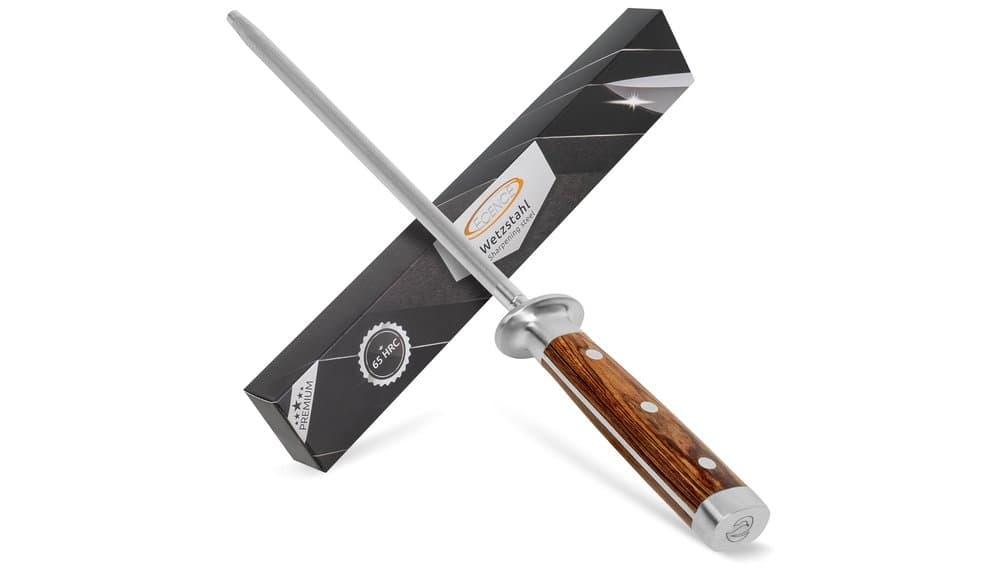
- Ergonomic composite wood handle, appreciated for its comfort and control during use.
- Asserted versatility for the regular maintenance of a wide range of blades, from domestic knives to superior models.
- Perceived as very good value for money by the user community.
Weaknesses
- Limited to maintenance and realignment (honing): Less effective than a diamond-coated rod for restoring a very dull or damaged edge.
- Technique required: Like any smooth rod, its optimal efficiency depends on maintaining a constant angle, which may require learning.
- Lack of abrasive coating: Its action is slower for restoring an edge than models with diamond or ceramic coatings.
- Weight and balance that may feel less "high-end" than some established professional references.
Detailed Analysis: A buy-it-for-life approach
Materials and Construction: The heart of durability
The first element that interests us here is the very substance of the tool. The ECENCE Professional is made of hardened stainless steel. The key figure put forward by the manufacturer is a Rockwell hardness (HRC) of 65. This is a major technical point.
For a sharpening rod, high hardness is a contradictory asset. On one hand, 65 HRC steel is extremely wear-resistant. It will not scratch easily upon contact with the hardest blades and will retain its smooth surface and properties over decades of regular use. This is the main argument in favor of its durability. On paper, this specification places it in a category above many entry-level rods, which often use softer steel.
On the other hand, it is essential to understand its function. This rod is not designed to sharpen (i.e., remove material to create a new edge), but to hone or realign (straighten the blade's edge which bends with use). Its surface is smooth. Its effectiveness relies on being harder than the knife blade it works on. With an HRC of 65, it will be effective on the vast majority of Western kitchen knives (generally between 54 and 58 HRC) and on many Japanese stainless steel knives (like AUS-10, VG-10). In contrast, for knives made of carbon steel (like White Steel #2) or very high-hardness steels (above 63-64 HRC), its action will be more limited, and a whetstone will be necessary for true sharpening.
See priceErgonomics and Handling
The second cornerstone of a durable tool is its comfort of use. The ECENCE relies on an ergonomic composite wood handle. According to user feedback, this is a success. The community notes that the grip is comfortable and secure, which is imperative for maintaining a constant angle and avoiding accidents. The wood blend, according to the manufacturer, reduces the risk of cracking and warping over time, a crucial point for longevity. Its design seems to prevent fatigue during prolonged sharpening sessions, a detail that matters for enthusiasts who maintain an entire collection.
The total length of 39 cm (with a usable rod of about 30 cm) is a practical asset. It allows for comfortably honing 20 to 25 cm chef's knives with a single fluid motion. The guard is sufficiently wide to protect the hand effectively.
Performance and Real-World Use
Testers and the community agree on the primary role of this rod: it is an excellent tool for regular maintenance. For the user who realigns the edge of their knives before or after every major cooking session, the ECENCE Professional fulfills its mission reliably. Customer reviews highlight quick results, with knives regaining a "razor" edge after a few passes.
However, experts from the web context add an important nuance. Compared to a diamond or ceramic-coated rod, its action is less abrasive and slower. Therefore, it is not the ideal tool for restoring an edge to a completely dull or damaged knife. For this task, one will need to turn to a whetstone. This is a fundamental distinction. This rod is the maintenance partner, not the deep repair tool.
Long-Term Durability and Maintenance
The hardened stainless steel construction promises excellent resistance to corrosion and wear. No feedback reports rust or deformation. This is a tool that requires practically no maintenance: a simple occasional cleaning with soapy water and thorough drying is sufficient. No part is likely to loosen or wear out over time under normal use. Its "for life" potential rests entirely on the quality of its steel and handle, two elements which, according to available data, seem well-mastered.
Technical Specifications
| Feature | Detail |
|---|---|
| Model | ECENCE Professional Stainless Steel Knife Sharpening Rod |
| Rod Material | Hardened stainless steel |
| Hardness (HRC) | 65 HRC |
| Total Length | 39 cm |
| Usable Length (est.) | ~30 cm |
| Handle Material | Ergonomic composite wood |
| Weight | 390 grams |
| Primary Use | Honing / Edge Realignment |
| Suitable For | Common kitchen knives, Western knives, Japanese steels like VG-10/AUS-10 |
What Users Say: Summary of Feedback
Customer reviews, with a very high average rating, paint a consistent and positive picture of the product. The following trends clearly emerge:
Recurring positive points:
- Perceived construction quality as excellent: Terms like "solid", "robust", "very good material", and "superior quality" constantly recur. Users are satisfied with the finish and the feeling of durability.
- Immediate effectiveness: Many reviews indicate that knives regain a remarkable edge after the first use. Expressions like "sharpens very well", "super professional", and "my knives are razor blades" confirm its effectiveness for regular maintenance.
- Comfort of use: The wooden handle is consistently praised for its ergonomics and comfort, offering a "good grip".
- Value for money: Even without mentioning price, the feeling that the product offers good value is implied in many comments.
Points of attention or negatives: Negative reviews are rare. The few criticisms generally stem from poorly calibrated expectations (e.g., hoping it could replace a stone for a very damaged knife). The expert web context clearly highlights its functional limit: it is a maintenance tool, not a complete edge restoration tool. No recurring manufacturing defects are reported.
Conclusion: Who is this ECENCE Professional Rod for?
The analysis of the ECENCE Professional Stainless Steel Knife Sharpening Rod reveals a serious and well-designed tool. Its 65 HRC steel construction and ergonomic wood handle make it a credible candidate for lifetime use, provided its precise role is understood.
We recommend it without reservation to the passionate cook or demanding home cook who owns a set of good knives (mainly stainless steel or reasonably hard carbon steel) and is looking for a reliable tool for weekly or daily edge maintenance. It will advantageously replace the low-end small rods often supplied with knife blocks.
On the other hand, this rod is not suitable as a primary tool for someone whose knives are systematically very dull, or who owns a collection of Japanese knives in very hard carbon steel (like Blue/White Steel). In this case, it will be a useful complement, but must be accompanied by a quality whetstone for true edge restoration work.
In summary, the ECENCE Professional is a safe bet for regular maintenance. It embodies the "buy-it-for-life" philosophy through its robust and no-frills construction, doing its essential job well: keeping your blades ready for action, day after day.