Elo 3082826 Enameled Cast Iron Dutch Oven Test
Introduction
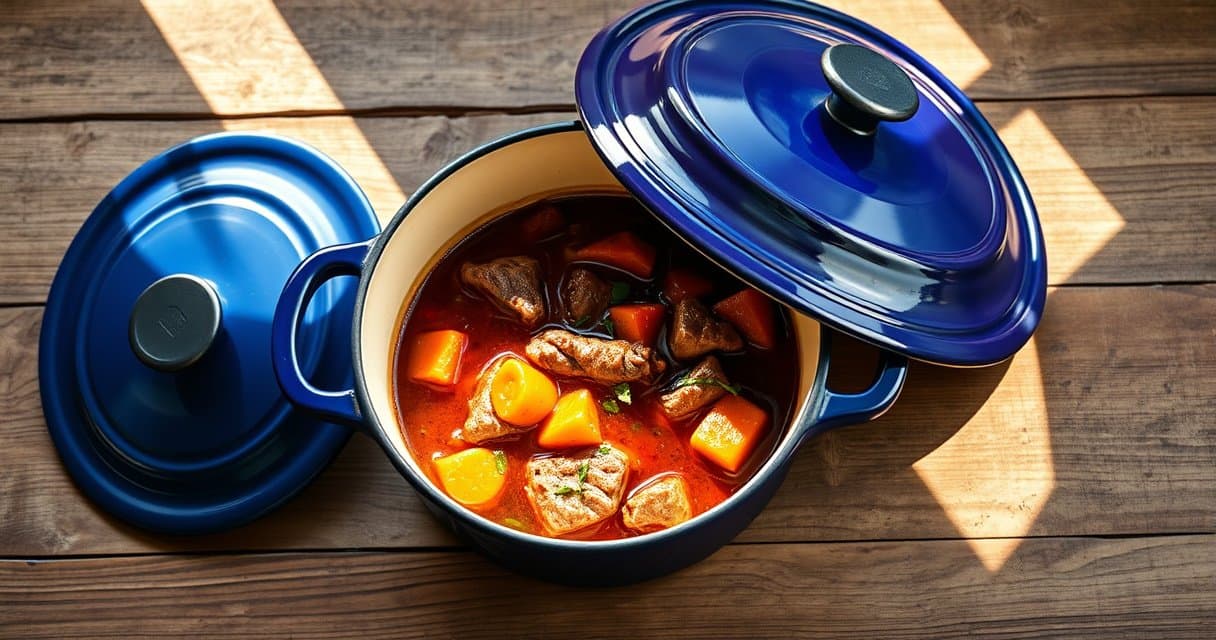
In the world of cookware, enameled cast iron Dutch ovens hold a special place. True heirs to an artisanal tradition, they promise exceptional cooking and near-legendary durability. The Elo 3082826 Enamelled Cast Iron Casserole Pot positions itself in this market with an argument centered on versatility and an accessible price. However, for the demanding cook looking for a tool for life, marketing promises are not enough. What interests us here is to dissect the object: its construction, its real-world performance, and its long-term resilience. By analyzing technical specifications and cross-referencing user feedback with expert observations, we will determine whether this Dutch oven can claim a place in a serious kitchen, or if it remains a compromise with uncertain durability.
Strengths
Based on available data, several qualities consistently stand out for the Elo 3082826.
Total thermal versatility. This is its major asset. The pot is compatible with all types of stovetops, including induction, and can seamlessly go from burner to oven. An essential characteristic for braising, roasting, and baking bread, where smooth transfer from cooktop to oven is required.
Exemplary heat distribution and retention. The base material, cast iron, is the key element here. On paper, it guarantees slow and even heat diffusion, eliminating hot spots and allowing for gentle, constant simmering. Testers emphasize that this fundamental property of cast iron is indeed present, delivering convincing culinary results for stews and roasts.
Functional lid design. The lid is not just a simple lid. It incorporates a system of interior spikes (picots) designed to condense moisture and make it fall back like a fine rain onto the food. This principle, borrowed from major brands, aims to create a self-basting cycle that keeps meats juicy and flavors concentrated.
Simplified maintenance thanks to the enamel. Unlike raw cast iron, the enameled interior surface is described as "non-stick" and does not require long and tedious seasoning. It is also advertised as dishwasher safe, a significant comfort point for such a heavy utensil.
Weaknesses
However, the analysis highlights recurring weaknesses, often linked to manufacturing compromises to achieve a low price.
Questionable enamel durability. This is the critical point raised by both user feedback and expert context. Several buyers report problems with enamel chipping or cracking after a few months of use, sometimes even under careful handling. One user even notes the appearance of rust under the enamel, a sign of a defect in application or quality control. Experts confirm that on entry-level models, the enamel tends to be more fragile and less resistant to thermal or mechanical shocks than on premium references.
Finishes and rust protection. Web experts note that on some budget-friendly pots, the rim of the pot or lid is not enameled. This exposed cast iron is an absolute point of vigilance: if it is not perfectly dried after washing, it will rust. This demands a rigor in maintenance that sometimes contradicts the promise of ease.
Weight and handling. At nearly 4.8 kg empty, this pot is a massive object. While thick cast iron is a guarantee of thermal performance, it becomes a handicap for handling, especially when full. User feedback confirms this heaviness, a factor to consider for regular users.
Real non-stick performance. While the product is sold as "non-stick," some customer reviews temper this enthusiasm, indicating that food sometimes sticks too much. The smooth enamel does not offer the same non-stick properties as a modern dedicated coating; it requires mastery of temperatures and often a base of fat.
Detailed Product Analysis
Materials and Construction: The Heart of the Matter
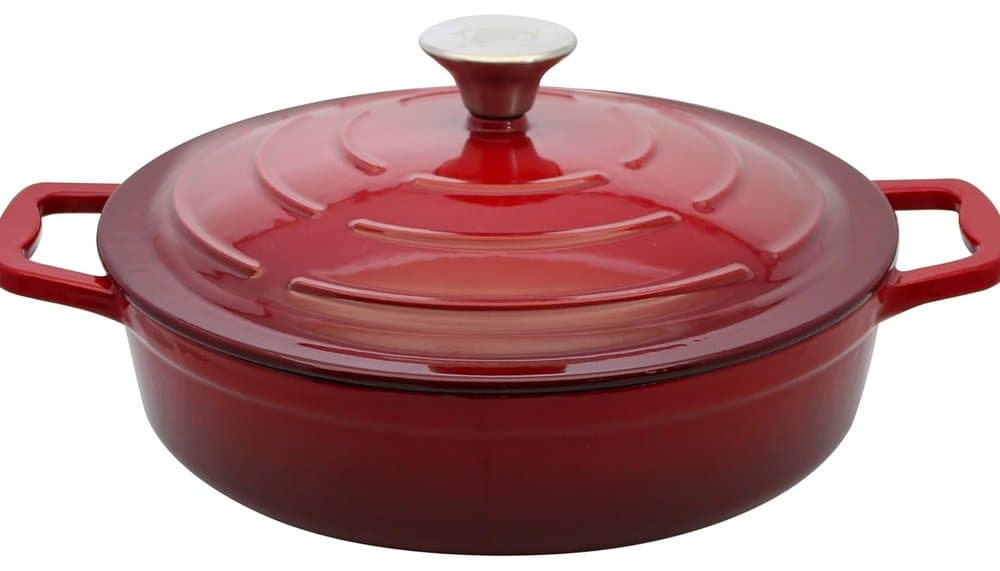
The product is made of enameled cast iron. Cast iron, in itself, is the quintessential buy-it-for-life material. Unwearable, unbreakable, and with unmatched thermal inertia, it constitutes a solid foundation. The real subject is the enamel. It is a vitrified ceramic applied at high temperature. Its quality depends on its composition and the rigor of its application. Feedback suggests that on this model, the enamel could be the weakest link in the chain. The 10-year warranty is a good signal, but it requires keeping proof of purchase and going through customer service in case of a problem. The presence of a silicone ring on the stainless steel handle is a practical and safety detail that effectively insulates from heat.
See priceCooking Performance: Between Theory and Practice
Heat distribution is, according to feedback, effectively even. Cast iron excels at storing heat and releasing it slowly, which eliminates brutal temperature variations and allows precise control of simmering. Heat retention is also excellent, keeping dishes warm long after cooking is finished. This is why satisfied users praise its results on stews, pot-au-feu, and roast chicken. However, this inertia is a double-edged sword: the pot takes time to heat up and cool down. One must anticipate and adapt one's technique.
Ergonomics and Daily Use
Ergonomics are dominated by weight. At 28 cm in diameter and 4.8 kg, it is not easy to maneuver, especially when pouring its contents. The handles, although secured by the silicone ring, are fixed and medium-sized. One must ensure a firm, dry grip. The "all stovetops" and "oven" versatility (up to 240°C) is a true practical asset that justifies its permanent presence on a stove rather than at the back of a cupboard.
Durability and "For Life" Potential
This is the most nuanced section. The cast iron body will survive several generations. That is indisputable. On the other hand, the enamel is the weak link. If it cracks or chips, the underlying cast iron is exposed to moisture and oxidation. A small chip can become an active rust spot that spreads and lifts the surrounding enamel. This does not condemn the utensil (one can continue to use it while monitoring the area), but it seriously compromises its integrity, appearance, and "non-stick" character. For a "buy-it-for-life" philosophy, this uncertainty about the enamel's longevity is a serious caveat, especially when compared to the reputation of indestructibility of enamels from brands like Le Creuset, which justify their price with decades of testing and stringent quality control.
Technical Specifications
| Characteristic | Detail |
|---|---|
| Model | Elo 3082826 Enamelled Cast Iron Casserole Pot |
| Body Material | Enameled cast iron |
| Diameter | 28 cm |
| Capacity | 3 Liters |
| Weight | 4.79 kg |
| Color | Cherry Red (and others) |
| Compatible With | All stovetops (Induction, Gas, Ceramic, Halogen), Oven |
| Max Oven Temperature | 240°C |
| Handles | Stainless steel with silicone insulation |
| Lid | Enameled cast iron with condensation spikes (picots) |
| Maintenance | Dishwasher safe (according to manufacturer) |
| Warranty | 10 years |
What Users Say
The synthesis of 55 customer reviews (average rating 4.2/5) and web expert analyses gives us a realistic overview of the strengths and frustrations encountered in the field.
The praise mainly concerns:
- Culinary performance: Users are unanimous in praising the quality of stewed dishes, heat retention, and even cooking. "Food doesn't stick and the taste is incomparable," notes one user.
- Value for money: Many describe it as a "good alternative" to premium brands, offering similar features (like the spikes in the lid) for a much lower investment. "Perfect price, quality, and use," summarizes one buyer.
- Aesthetics and versatility: Its appearance at the table and its oven-to-table transition are highly appreciated.
The recurring criticisms highlight:
- Enamel fragility: This is the main issue. A detailed review reports the appearance of "numerous rust spots that lift the enamel" after a few months, despite careful maintenance (hand washing and oiling). This quality control problem is corroborated by expert analyses.
- Non-stick performance: Contrary to promises, several users find that "food sticks too much" to the bottom.
- Weight and finish: "A bit heavy but it's sturdy," concedes one user. Another compares directly, noting that "it's definitely not the same quality as Staub."
Experts add a warning about un-enameled rims that can rust, and advise to avoid thermal shocks (do not transfer from a very hot oven to a sink of cold water) and to prioritize hand washing with mild products to preserve the enamel, even if the dishwasher is permitted.
Conclusion
The Elo 3082826 Enamelled Cast Iron Casserole Pot is an ambivalent product. On one hand, it undeniably delivers the essence of what is expected from a cast iron Dutch oven: incomparable heat retention, total versatility, and culinary results that fully satisfy amateur and seasoned cooks alike. Its intelligent design with the spiked lid and its ten-year warranty make it a serious candidate for regular use.
On the other hand, our analysis reveals that it struggles to check all the boxes of a "buy-it-for-life" philosophy without reservation. The uncertainty surrounding the long-term durability of its enamel, supported by concrete negative customer feedback and expert warnings, is its Achilles' heel. It demands more care in its handling and maintenance than a high-end reference.
Our verdict: It is an excellent entry-level or supplementary pot, perfect for discovering the virtues of enameled cast iron without breaking the bank. For the serious cook looking for a professional and heirloom tool, one they can rely on flawlessly for decades, investing in a brand with proven enamel expertise remains probably the most rational choice. The Elo 3082826 brilliantly fulfills its function, but with a conditional longevity that prevents it from unquestionably joining the pantheon of truly indestructible kitchen tools.