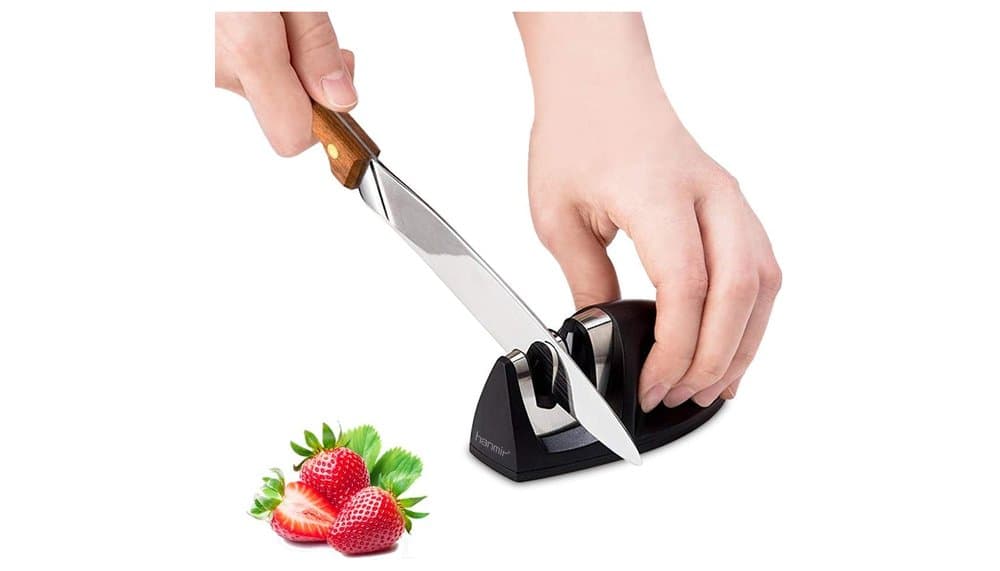
Hanmir Professional 2-in-1 Manual Kitchen Sharpener Review
Introduction
In our quest for durable and high-performance kitchen tools, the question of maintenance is paramount. A knife, even forged from the best VG-10 steel or carbon steel, will eventually lose its sharpness. The sharpening method then becomes a crucial topic for enthusiasts who invest in tools for life. Today, we analyze the Hanmir Professional Kitchen Sharpener 2 in 1 Manual Sharpener. This manual sharpener promises a simple and quick solution, without the skills required by a traditional sharpening stone. But does it meet the requirement of buy-it-for-life maintenance for quality knives? We will dissect its specifications, confront its promises with user feedback, and evaluate its place in the kitchen of a serious enthusiast.
Strengths
- Remarkable ease of use: Clear two-step process (coarse/polishing) accessible to everyone, with no learning curve.
- Execution speed: Allows restoring a functional edge in seconds, ideal for quick maintenance in the kitchen.
- Announced wide compatibility: Claims to work on most steels, including ceramic, and on all common types of kitchen knives.
- Compact and stable design: Small, lightweight format with a non-slip base for safe use on a countertop.
- Accessibility/performance ratio: Offers a tangible result for a very low initial investment compared to electric systems or quality stones.
Weaknesses
- Abrasive and aggressive method: Removes a significant amount of metal, potentially detrimental to the longevity of fine or high-end blades.
- Fixed and limited angle control: The sharpening angle is dictated by the guide, which may not match the original angle of Japanese knives (often 15°-18°) or premium Western knives.
- Questionable construction durability: The ABS plastic structure and wheels mounted on plastic axles raise doubts about long-term durability under intensive use.
- Inconsistent results on hard steels: Effectiveness on high-carbon steels or high Rockwell hardness steels (HRC 60+) is mixed according to feedback.
- Imperfect edge finish: Produces a serrated edge (micro-serrations) rather than the razor-sharp and polished edge obtained with a whetstone, affecting cutting finesse.
Detailed Analysis
Construction and Materials: The Antithesis of "Buy-It-For-Life"?
According to technical specifications, the Hanmir 2-in-1 is primarily constructed from ABS plastic with abrasive wheels. On one side, a tungsten (or diamond-coated) wheel for coarse sharpening; on the other, a ceramic wheel for polishing. On paper, these materials are chosen for their abrasive hardness. However, this is where the gap widens with the philosophy of durable tools.
Unlike a whetstone made of corundum or silicon carbide, which wears slowly but can last for decades, the durability of this product depends on the resilience of its moving plastic parts and the longevity of its abrasive wheels. The user community rarely highlights its robustness over several years. For someone investing in knives designed to last generations, this sharpener represents a weak link in the maintenance chain: a technical consumable rather than an heirloom.
See priceThe Dilemma of Abrasive Sharpening vs. Blade Angle
The fundamental principle of this sharpener, like all preset guide models, is to plane down the blade until a new edge is formed at the angle imposed by the guide. It is this mechanism that poses a problem for quality blades.
Testers and the community of knife enthusiasts highlight a critical point: the sharpening angle is not customizable. A Western chef's knife is often sharpened between 20° and 22°, a Japanese knife (Santoku, Gyuto) between 15° and 18°. The Hanmir imposes its own angle, often more obtuse to ensure blade grip. As a result, with each use, you are gradually reprofiling your blade towards a thicker angle, which alters its original cutting performance and removes much more material than controlled whetstone sharpening.
For hard steels (like hardened VG-10 or AUS-10 at HRC 60+), this method can be frustrating. The hardness of the blade, which gives it its edge retention, also makes it more difficult to machine with standard abrasive wheels. Opinions are divided: some note an improvement, others find the result superficial or ineffective.
Ergonomics and Handling
On this point, feedback is mostly positive. The tool's compact size (10 x 5.5 x 2.5 cm) and low weight (80g) make it a discreet object. The non-slip base, often mentioned, works correctly and provides sufficient stability during the blade pass. Use requires no notable physical effort. However, this ease comes with a lack of tactile feedback. Unlike whetstone sharpening where the hand perceives the contact between steel and abrasive, here the action is mechanical and disconnected, offering the user little control over the process.
Comparison with Traditional Methods
- Versus the whetstone: The Hanmir loses on all qualitative fronts (finish, blade preservation, customization) but wins hands down in simplicity and speed. It's the analogy between taking a cooking lesson and ordering a ready-made meal.
- Versus electric sharpeners: It is less aggressive than some low-end electric models, not risking overheating the blade, but it is also much less effective and powerful. Its advantages are silence, lack of cord, and theoretically more controlled material removal.
- Versus sharpening rods (steels): The steel requires some technique and does not reform the edge, it only realigns it (straightens the burr). The Hanmir, on the other hand, removes material to create a new edge. They are not directly comparable.
Technical Specifications
| Feature | Detail |
|---|---|
| Product Name | Hanmir Professional Kitchen Sharpener 2 in 1 Manual Sharpener |
| Type | Manual guided wheel sharpener |
| Construction Material | ABS plastic |
| Abrasives | Wheel 1: Tungsten / Diamond (coarse) |
| Wheel 2: Ceramic (finishing) | |
| Compatible With | Stainless steels, carbon steels, ceramic (according to manufacturer) |
| Features | Non-slip base, 2-in-1 design (sharpening + polishing) |
| Dimensions (L x W x H) | 10 x 5.5 x 2.5 cm |
| Weight | 80 grams |
| Recommended Use | Pass 3 to 5 times through each slot, without pressing hard |
What Users Say
Analysis of over 2,300 global reviews (average rating of 4.1/5) reveals a clear divide between casual users and demanding enthusiasts.
The recurring positive points revolve around ease and perceived effectiveness: "Easy to use and effective", "Perfect. Does the job", "Effective and very practical product". Beginners or users looking to quickly restore an acceptable edge to standard kitchen knives are generally satisfied. The speed ("in three seconds") and intuitive nature ("no need to know how to sharpen") are highly praised. The stability of the base is also noted.
The negative points are revealing of the tool's limits. Some disappointed buyers speak of mediocre results: "Low efficiency". The most scathing comment, "This is not a sharpener it's a blade destroyer," summarizes the opinion of many knife purists. Others highlight the small size ("really very, very small") and questions about durability ("hold up over time"). Experts and online tests confirm these trends: it is a practical tool for regular and accessible maintenance of everyday knives, but it is not recommended, even harmful, for professional-grade or collectible blades. The lack of control and the abrasiveness of the process make it a "compromise" rather than an optimal solution.
Conclusion
The Hanmir Professional Kitchen Sharpener 2 in 1 Manual Sharpener is a product that fulfills a specific function, but that function is not what the buy-it-for-life knife enthusiast is looking for.
For the occasional user owning mid-range kitchen knives, seeking a hassle-free solution for a functional edge, this sharpener is a valid option. It is simple, fast, and provides an immediate result that significantly improves cutting performance compared to a dull knife.
On the other hand, for the enthusiast who invests in Japanese knives in white steel (Shirogami) or blue steel (Aogami), Western knives in high-carbon steel, or blades with specific heat treatment (HRC >60), we cannot recommend it. Its abrasive method, fixed angle, and plastic construction go against the principles of preservation and respect for the tool. In the long run, it risks altering the profile, the thickness behind the edge (grind), and thus the performance of your best knives.
In short, consider the Hanmir 2-in-1 as a first-aid kit, practical and urgent, but not as the lifelong maintenance regimen for your precious cutting instruments. For these, learning to use a whetstone – although requiring time and practice – remains the only path to total control, superior finish, and preservation of the blade's integrity over the very long term.