HEZHEN 18cm Deba Knife Review: Sharp & Affordable
Introduction: A Chinese Deba Assaulting Tradition
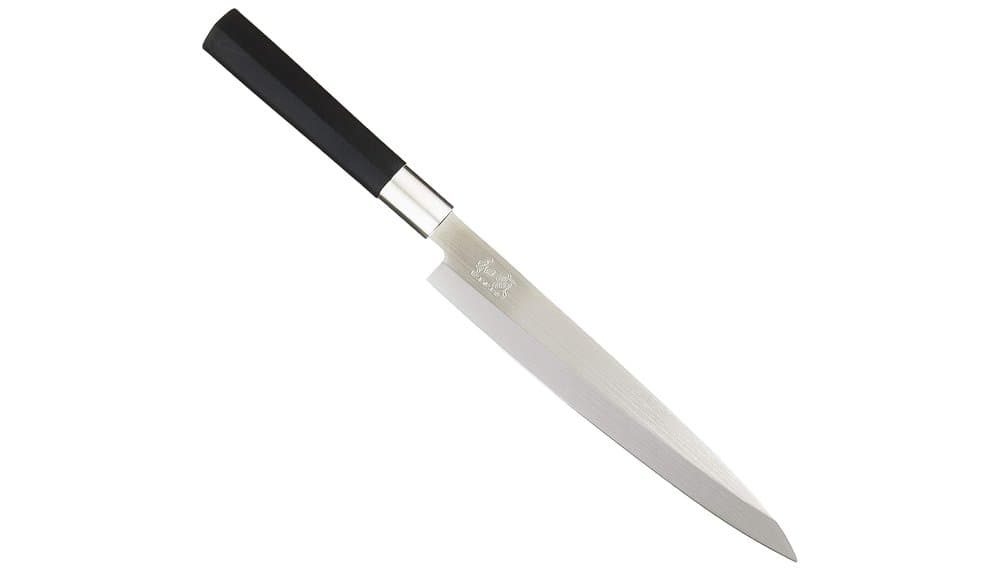
In the highly codified world of Japanese knives, the Deba holds a special place. Originally designed for preparing fish, its robust profile and thick blade make it a precise tool for butchering and boning. Traditionally forged in Japan from carbon steels, it often represents a significant investment. The HEZHEN 18CM Deba Fish Knife presents itself as a contemporary alternative to this tradition, combining a Japanese design, European steel, and Chinese manufacturing. What interests us here is to dissect this proposition from the angle of a durable, high-performance tool. Can it claim a place in the arsenal of a serious cook, a fan of professional quality and longevity? We analyze the specifications, community feedback, and expert observations to answer this question.
Strengths & Weaknesses: The Quick Verdict
Strengths
- Remarkable Factory Edge: Users and testers agree on an exceptional initial sharpening, described as "formidable" and "razor-sharp".
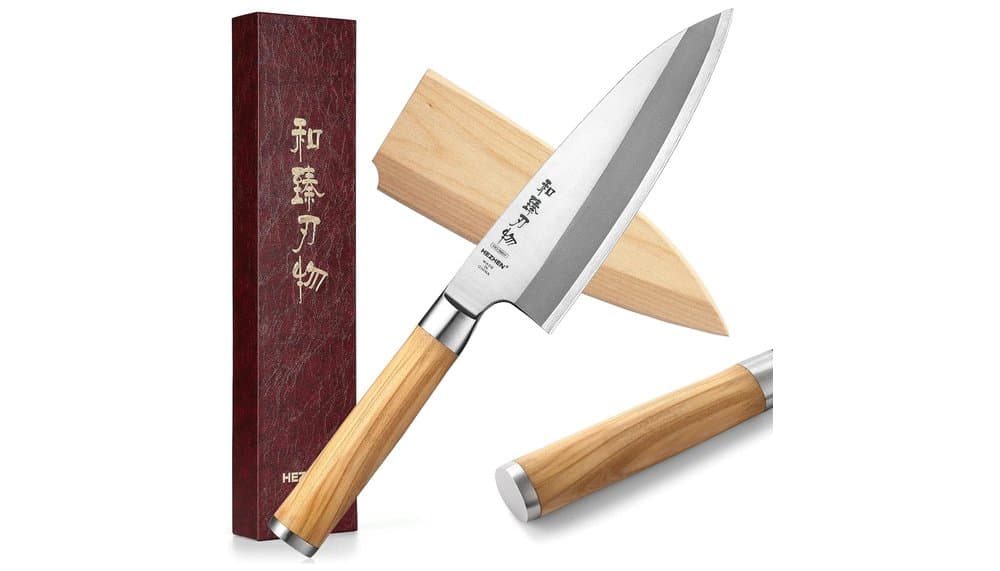
- Careful Finish and Aesthetics: The combination of the forged blade, the olive wood handle, and the included wooden sheath gives an impression of a premium, complete object.
- Robust Forged Construction: The blade is forged (not stamped), which promises better structural integrity and balance.
- Perceived Solid Value for Money: For its price segment, it is often judged as offering interesting value compared to established brands.
- Absence of Major Recurrent Flaws: Unlike other knives of similar origin, the community does not report systematic problems like pronounced recurve (reverse curve) or faulty handle assembly.
Weaknesses
- Variable Quality Control: This is the main issue raised. Manufacturing can lead to specimens with balance defects or a feeling of heaviness in hand, as noted by one disappointed user.
- Steel with Limited Performance: The X8Cr14MoV (equivalent to AUS-8 / 8Cr13MoV) is a decent but common steel. Its edge retention will be inferior to that of superior steels like VG-10 or carbon steels.
- Debatable Weight and Balance: For an 18cm Deba, a weight of 350g is significant. Some feedback indicates that the balance is not always optimal, potentially causing fatigue during prolonged use.
- Moderate Rockwell Hardness: With an announced hardness of 58±2 HRC, it sits at the lower end of the range for a modern Japanese knife, which implies compromises between edge retention and ease of resharpening.
Detailed Analysis: Under the Buy-It-For-Life Microscope
See priceThe Blade: The Pragmatic Choice of X8Cr14MoV
On paper, the specs announce a forged X8Cr14MoV steel. This is a martensitic stainless steel with a good reputation in the entry/mid-range segment. Its composition makes it relatively easy to sharpen, even for a beginner with a waterstone. This is a positive point for longevity, as a knife that is easy to maintain is a knife you keep for a long time.
However, the counterpart to this ease of maintenance is average edge retention. Compared to VG-10 (HRC 60-62) or Aogami (Blue Steel, HRC 62+), it will require more frequent trips to the stone with regular use. The hardness of 58±2 HRC confirms this positioning: sufficient to resist deformation, but far from the levels that allow weeks of intensive use without a noticeable loss of sharpness. For a knife dedicated to cutting fish (soft flesh, bones), this hardness is nevertheless perfectly suited to the task. The promise of an exceptional initial edge is corroborated by many reviews, showing that the factory sharpening is well executed.
The blade profile incorporates elements of Japanese tradition like the Urasuki (concavity on the flat side) which reduces drag and facilitates clean cuts. The typical Deba shape, with its pronounced belly and thick heel, is well respected for splitting heads and cutting through bones.
The Handle and Ergonomics: Comfort in Question
The olive wood handle is a strong aesthetic and tactile argument. Olive wood is dense, offers good grip even when wet, and ages elegantly. The assembly with a stainless steel bolster and a G10 ferrule seems correct, avoiding the gross assembly flaws sometimes encountered.
It's on overall ergonomics that feedback diverges. The weight of 350g for an 18cm blade is considerable (an equivalent Japanese Deba often weighs 100g less). This mass can be an asset for cutting through bones with authority, but it can become a source of muscle fatigue when filleting several fish in a row. Balance, a crucial element for a precision knife, seems to depend on the quality control of the received specimen. Some users find it "perfect," others judge it "poorly balanced." This inconsistency is the main obstacle to an unreserved recommendation from a professional perspective.
Construction and Long-Term Durability
The forged construction is a guarantee of solidity. It offers better shock resistance than a stamped blade. The stainless steel eliminates rust concerns, a practical point for a knife constantly in contact with water and fish. The included wooden sheath is a real added value for edge protection and storage, contributing to the tool's longevity.
The lifetime guarantee displayed by HEZHEN is a strong marketing argument, typical of a "buy-it-for-life" perspective. Its real value will depend on the manufacturer's customer service responsiveness and policy.
Who is this knife for? It suits a serious home cook who prepares fish regularly but not intensively, who appreciates aesthetics and immediate sharpness, and who is ready to sharpen it regularly. It can also serve as a first introduction to the Deba style without breaking the bank. On the other hand, for a sushi professional or a purist demanding maximum edge retention, perfect balance finesse, and the heritage of a blacksmith, traditional Japanese brands will remain the essential reference.
Technical Specifications
| Characteristic | Detail |
|---|---|
| Model | HEZHEN 18CM Deba Fish Knife |
| Blade Type | Deba (Japanese fish knife) |
| Blade Length | 180 mm (18 cm) |
| Blade Material | X8Cr14MoV (Forged stainless steel) |
| Rockwell Hardness (HRC) | 58 ± 2 |
| Cutting Angle | ~28° (single-bevel edge) |
| Processing | Forged, high-temperature heat treatment |
| Finishes | Urasuki (concavity), polishing |
| Handle Material | Solid olive wood |
| Assembly | Stainless steel bolster, G10 ferrule |
| Total Weight | 350 grams |
| Included Equipment | Wooden protective sheath |
| Maintenance | Sharpening with a waterstone. Hand wash only. |
What Users Say: A Synthesis of Feedback
Cross-referencing customer reviews and expert comments online paints a nuanced but overall positive consensus.
The majority of users are impressed by the initial sharpness, often described as impressive, even dangerous. The aesthetic finish is also widely praised: the forged blade, olive wood, and packaging give a feeling of a high-end product. The inclusion of a wooden sheath is consistently cited as a very appreciated "nice extra."
In terms of performance, it fulfills its role as a fish knife effectively. Its robustness is noted, and some also find it suitable for chopping herbs or poultry thanks to its pronounced belly.
Criticisms focus on a few recurrent points. Weight and balance are debated. While some report no problems, several accounts mention a knife that is "very heavy and not balanced," harming comfort. This corroborates expert analyses pointing to potentially variable quality control from one specimen to another, a characteristic sometimes associated with this product category. Finally, a few users expressed disappointment related to the country of manufacture (China), expecting a Japanese product, although this information is usually indicated.
Conclusion: A Serious Alternative, Under Conditions
The HEZHEN 18CM Deba Fish Knife is a product that defies expectations for its segment. It is not a Japanese artisan's knife, and it does not claim to be. However, it constitutes a serious, well-finished, and performant alternative for anyone looking for a functional Deba without committing the budget of a traditional Japanese brand.
Its assets are clear: an impeccable factory edge, robust forged construction, noble materials (olive wood), and careful presentation with its sheath. Its X8Cr14MoV steel, although modest, is easy to maintain, a crucial point for longevity.
Its main pitfall lies in its ergonomic inconsistency. The significant weight and potential balance defects make it less predictable than a product from a major brand. Our conclusion is therefore conditional: it is an excellent choice for an informed amateur ready to check their specimen upon receipt (balance, handle spine finishing). For regular domestic use, it will provide proud service for years. For a professional demanding absolute homogeneity and finesse, or for the purist attached to artisanal heritage, investing in a Japanese Deba made of superior steel (carbon steel or VG-10/SG2) will remain the royal path.