Suehiro Double Grain 150-500 Diamond Flattening Stone Review
Introduction
In the serious world of sharpening, where the flatness of the stone is as crucial as the quality of the knife itself, the Suehiro Double Grain 150-500 Diamond Whetstone Flattening Stone presents itself as an essential maintenance tool. It is not a sharpening stone, but a stone flattener, a precision tool designed to restore the flat surface of your waterstones. For the enthusiast of white steel, VG-10 at 60+ HRC, or carbon steel blades, a dished or uneven stone is a major handicap. Here we analyze this product from a "buy-it-for-life" perspective, breaking down its construction, real-world effectiveness, and long-term durability, in light of technical specifications and community feedback.
Strengths
- Effective double diamond grit: The combination of 150 grit for rough work and 500 grit for polishing allows for a complete flattening process with a single tool, eliminating the need for two separate plates.
- Performance on hard stones: Its electrodeposited diamond technology is specifically designed to tackle the hardest non-absorbent synthetic stones (like the Gokumyo, Kouseki, Debado series) against which traditional silicon carbide flatteners struggle.
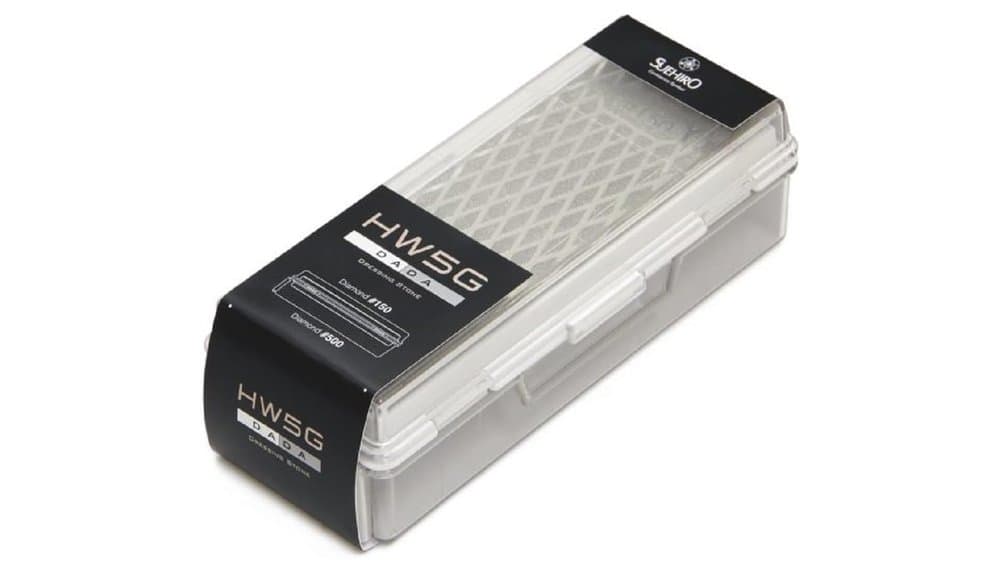
- Built-in practicality: The plastic storage case also serves as a stable support base during use, a design focused on ergonomics and storage.
- Speed of action: Feedback agrees on its effectiveness and speed in restoring a flat surface, a welcome time-saver for the regular user.
Weaknesses
- Coating durability in question: The main point of concern is the long-term wear of the electrodeposited diamond coating. It is not a forever tool.
- Risk of surface defects: Several reports, especially from experienced users, point out inconsistencies in grit size (oversized particles on the 500 side) which can scratch the stone instead of polishing it uniformly.
- Limited usable size: Despite the advertised dimensions, the effective abrasive surface is reported to be narrower (about 55mm) than the product's total width, which can make flattening large stones less comfortable.
- Susceptibility to rust: Testimonials indicate that the metal backing plate can rust if not perfectly dried after use, potentially compromising the flatness of the tool over time.
Detailed Analysis
Construction and Materials: diamond on a vulnerable base
The Suehiro Double Grain 150-500 is based on a simple principle: a metal plate coated, on each side, with a layer of electrodeposited diamond particles. This coating is what makes it effective, offering aggressive bite and abrading the whetstone without dulling prematurely. However, this is where the "buy-it-for-life" concept meets its limit. Unlike a cast iron or hardened steel slab that lasts generations, this is a consumable precision tool. Its lifespan depends on frequency of use and the hardness of the stones being flattened.
Feedback is clear: the underlying metal plate is not stainless steel. A German user even describes it as a "thin metal sheet" prone to rust if the tool is poorly dried, which then leads to surface irregularities. For a product intended for maintaining high-end tools, this vulnerability to oxidation is a notable weak point in the construction. The plastic case, while practical, reinforces the feeling of a functional tool whose absolute robustness is not its primary selling point.
See pricePerformance and Daily Ergonomics
On paper, the specs describe an ideal tool for the demanding user. And in practice, for the majority of users, it fulfills its primary mission well. The community notes that the 150 grit side is very effective at quickly removing material and eliminating the "dish" of a moderately used stone. Switching to the 500 grit side then allows for a uniform surface, ready for sharpening.
Ergonomics are generally appreciated. The ability to use the case as a support stabilizes the tool during flattening, a significant plus. The overall size, although criticized by some for being smaller than anticipated, remains manageable and suitable for standard-sized stones. However, for owners of extra-large format stones or nagura stones, the limited working width can make the process more tedious.
The critical point, raised by testers and experienced users, concerns the finishing quality of the 500 surface. A Japanese review specifies that disproportionate grit particles can create deep scratches ("scratches that catch the nail") on the whetstone. This runs counter to the goal of polishing and could degrade the surface of high-end stones. This suggests variable quality control between units.
Durability and Maintenance: a tool that requires care
Adopting this product means accepting that it is not indestructible. Its maintenance is crucial to extending its lifespan. It must be thoroughly rinsed and dried after each use to prevent abrasive mud residue from clogging the diamond interstices (reducing its effectiveness) and, above all, to prevent rust on the base plate.
The durability of the diamond coating is the key factor. According to user feedback, it is good but not infinite. With very intensive use or on extremely hard stones, wear becomes noticeable. A French user notes "signs of coating wear" but specifies that the abrasive performance remains intact. This progressive wear is normal for this type of technology, but it places the product in the category of medium/long-term durable tools rather than "for life" heirlooms.
Technical Specifications
| Characteristic | Detail |
|---|---|
| Product Name | Suehiro Double Grain 150-500 Diamond Whetstone Flattening Stone |
| Type | Flattening plate / Double-sided diamond flattening stone |
| Grit Sizes | #150 (coarse) / #500 (medium-fine) |
| Abrasive Technology | Electrodeposited Diamond |
| Base Material | Metal plate (susceptible to rust) |
| Accessory/Support | Plastic storage case usable as a support base |
| Dimensions (L x W x H) | Approximately 171 x 73 x 51 mm (total dimensions with case) |
| Weight | 350 grams |
| Recommended Use | Flattening and maintenance of all sharpening stones, especially the hardest types (like Debado, Gokumyo) |
| Manufacturer | Suehiro (Japan) |
What Users and Experts Say
A synthesis of customer reviews and expert analyses online paints a nuanced, but overall positive picture for targeted use.
Praise mainly concerns effectiveness and speed. Phrases like "Works very well for flattening stones of different hardness" or "Super cutting performance" frequently recur. The practicality of the case-support is also very often mentioned as a major asset. A user in the Netherlands confirms satisfaction after two years of use.
Recurring criticisms are focused on three points:
- Durability and finish: Concerns about coating wear and surface defects (uneven grit on the 500 side) are the most negative and technical feedback, often from experienced users.
- Perceived size: Several buyers express disappointment with the actual width of the abrasive surface, considered less than expected.
- Susceptibility to rust: The detailed testimony about corrosion of the metal plate warns of the need for impeccable drying.
Web experts confirm this analysis: it is a high-performing and well-designed tool, particularly suited to high-end hard stones where it excels. However, they also emphasize that it is not eternal and that its use requires a minimum of care to maintain its performance.
Conclusion
Is the Suehiro Double Grain 150-500 Diamond Whetstone Flattening Stone a "for life" purchase? The answer is no, if by that one means an unbreakable object passed down through generations. On the other hand, it is a wise and durable investment for any serious owner of quality knives and stones.
Its true audience is the enthusiast or demanding cook who owns hard synthetic stones, blades in high-carbon or powdered metallurgy steel (HRC 62+), and for whom maintaining a perfectly flat surface is non-negotiable. For this use, its fast and effective double action is a precious time-saver.
However, one must acquire it knowing its limits: it is a precision tool with a lifespan limited by the wear of its diamond coating. Its construction requires meticulous maintenance (perfect drying) to prevent oxidation. Finally, it is advisable to check the uniformity of its abrasive surface upon receipt, particularly on the 500 grit side, to ensure you do not have a defective unit.
In short, it is not the forged-for-life piece of your workshop's heirloom piece, but it is very likely the most effective and practical maintenance tool you will buy for the next ten years of sharpening, provided you treat it with the respect due to a precision instrument.