KEEMAKE Yanagiba Sashimi Knife Review & Test
Introduction
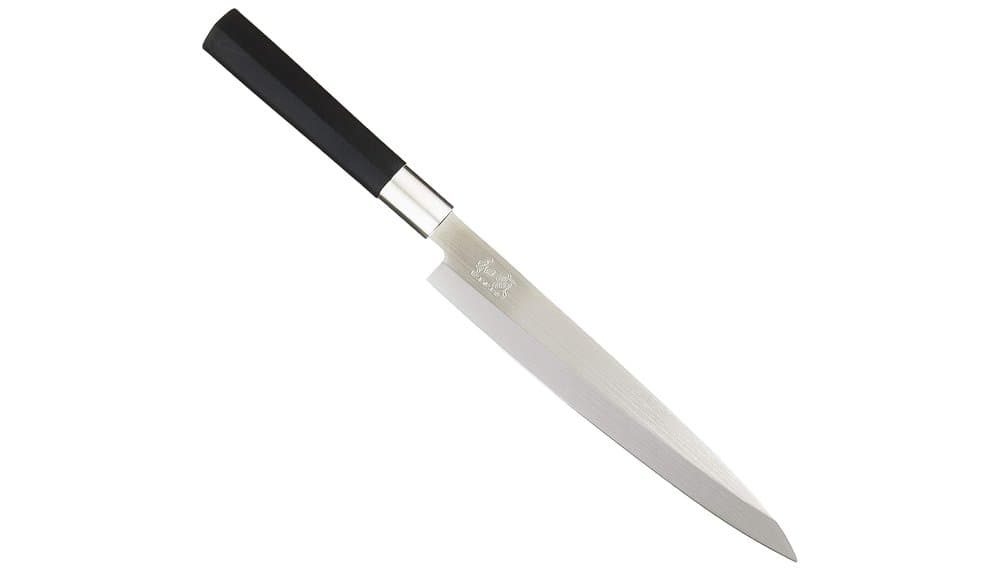
In the highly codified world of Japanese knives, the yanagiba holds a special place. Dedicated to the precise cutting of raw fish for sashimi and sushi, it is a specialist's tool that demands a long, thin, and perfectly sharpened blade. The KEEMAKE Yanagiba Japanese Sashimi Knife presents itself as an entry point into this tradition for passionate cooks. On a site dedicated to long-lasting culinary tools, we are not interested in gadgets, but in instruments designed to last. This review therefore examines this product from the demanding perspective of "buy-it-for-life": its materials, construction, performance in use, and relevance for a serious cook.
Strengths
- High-performance AUS-8 steel blade: The blade core uses a recognized Japanese stainless steel known for its good balance between hardness, edge retention, and corrosion resistance, all without the demanding maintenance of carbon steel.
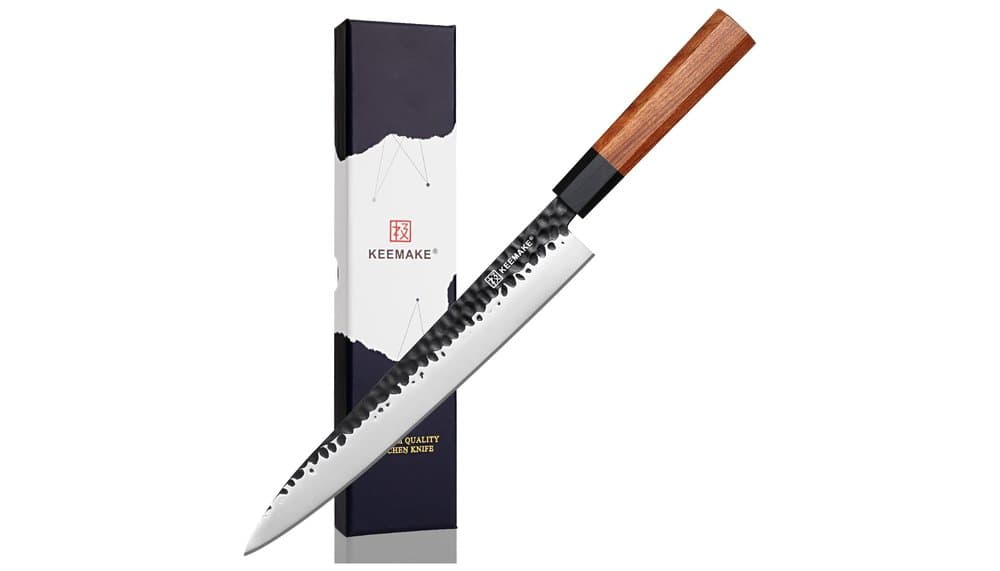
- Anti-adhesive and anti-stain coating: The application of a black food-safe coating on the blade (except for the edge) is a notable feature. According to specifications, it facilitates cleaning, improves rust resistance, and reduces food sticking.
- Reported balance and comfort: The majority of user feedback praises the knife's good balance, located at the bolster, and the comfort of the grip thanks to its octagonal wooden handle and well-integrated shoulder.
- Effective factory sharpness: Reviews converge on a razor-sharp knife upon receipt, ready for clean slicing.
- Careful presentation: The knife comes in a rigid cardboard box with a foam insert, which is appreciated for long-term storage and protection.
Weaknesses
- Entry-level steel: While of correct quality, AUS-8 does not offer the ultimate edge retention of more premium steels like VG-10, SG2, or carbon steels (White #2, Blue #2). More frequent sharpening will be necessary compared to the latter.
- Finish and origin: Some purists and reviewers note that the finish, although neat for the price, cannot match the level of detail and prestige of hand-forged Japanese yanagiba. The "Made in China" mention, while not prejudging quality, is a point of debate for some enthusiasts.
- Standard wooden handle: The rosewood (or sapele, according to sources) wooden handle is classic and comfortable, but it requires maintenance (occasional oiling) to retain its nice appearance over time. It is not waterproof like some high-tech composites.
- Potentially light profile: The web context notes that its weight and feel in hand may seem lighter or less "substantial" than high-end professional models, which can influence personal preference for push-cutting or pulling cuts.
Detailed Analysis of the KEEMAKE Yanagiba
Blade Materials and Long-Term Performance
The heart of the analysis lies here. KEEMAKE specifies a stainless steel forged blade with an AUS-8 core. This Japanese steel is a common choice in the price-quality segment. Its Rockwell hardness (HRC) is announced at 58±2. This figure is crucial:
- At 58 HRC, we are in solid hardness territory, typical of performance Japanese knives. This provides good edge retention, far superior to that of a standard Western kitchen knife (often around 52-56 HRC).
- However, this hardness remains below that of steels like VG-10 (around 60-61 HRC) or more heavily tempered carbon steels (which can exceed 62 HRC). In practice, based on community feedback, this means the edge will remain effective for a long time for regular domestic use, but a professional chef using it daily will need to sharpen it more frequently.
- The positive aspect of this moderate hardness is the relative ease of sharpening. AUS-8 is known to be quite accommodating on a water stone, even for informed amateurs. This is an asset for longevity: a knife that can be easily maintained and revived is a knife that lasts a lifetime.
The black anti-adhesive coating is a particularity. Theoretically, it protects the blade from oxidation (although AUS-8 is already quite resistant) and reduces friction during cutting. For a fish knife, where thin slices must detach cleanly, this is an interesting feature. One must simply ensure, when sharpening, not to damage this coating on the blade's spine.
See priceConstruction, Balance, and Ergonomics
The construction is described as forged, with a thick stainless steel bolster connecting the blade and the handle. This construction, often synonymous with robustness, contributes to the overall durability of the tool by reinforcing a stress area.
The balance is consistently cited as good. A well-balanced yanagiba, with a pivot point at the blade/handle junction, allows for precise control and reduces fatigue during the long pulling motions needed to slice fish. Users confirm this feeling of control.
The octagonal wooden handle (rosewood/sapele) is a classic of Japanese cutlery. Its octagonal shape offers natural tactile references for precise and secure finger positioning. The wood provides a natural warm and non-slip feel. Its main drawback is its sensitivity to water and harsh detergents: quick manual cleaning and immediate drying are imperative to prevent it from drying out, cracking, or discoloring over the years.
Market Comparison and Target Audience
The web context clearly positions this knife as an excellent entry-level option. It does not claim to rival workshop-made Japanese yanagiba in Shirogami (White Steel) or Aogami (Blue Steel), whose edge is more aggressive, retention excellent, and finish perfect, but whose price is three to ten times higher and maintenance (for carbon) more demanding.
Its natural audience is the serious amateur cook, the home sushi enthusiast, or even the professional in a small operation looking for a reliable and performant tool without a massive initial investment. For domestic use, even regular, its materials and construction are largely sufficient to last decades with proper care. It perfectly fulfills its main function: making clean and neat fish slices.
Technical Specifications
| Feature | Detail |
|---|---|
| Model | KEEMAKE Yanagiba Japanese Sashimi Knife |
| Blade Length | 25 cm (approx. 9.8 inches) |
| Blade Type | Yanagiba (long, thin, single or double-bevel blade) |
| Blade Material | Forged stainless steel / AUS-8 core |
| Hardness (Rockwell) | 58 ± 2 HRC |
| Coating | Black anti-adhesive and anti-stain (hydrophobic/oleophobic) |
| Handle Material | Rosewood or Sapele wood (octagonal shape) |
| Construction | Forged with full bolster |
| Balance | At the bolster level |
| Weight | Approximately 180 g |
| Maintenance | Hand wash only. Immediate drying. Sharpening on a water stone. |
| Packaging | Gift box with foam insert |
What Users and Reviewers Say
A synthesis of 144 customer reviews (with an overall rating of 4.5/5) and web analyses reveals a strong consensus.
Praise is recurrent on several points:
- Exceptional sharpness upon arrival: Terms like "sharp", "cuts perfectly", "very sharpened" appear constantly. Users are impressed by its immediate performance.
- Comfort and balance: "Excellent grip", "light and suitable", "good feel" are frequently noted. The ergonomics of the octagonal handle are praised.
- Value for money: Many call it "very good value for money", "good quality for the price", considering it a wise purchase.
- Beauty and presentation: Its appearance with the hammered black blade and wooden handle is highly appreciated. The storage box is seen as a plus.
Criticisms or reservations focus on more nuanced aspects:
- Inconsistent factory sharpening: A few rare reviews (notably a German reviewer) mention receiving a knife not sharp enough upon arrival, requiring immediate sharpening on a stone. This points to potentially variable final quality control.
- The question of origin: For some purists, the "Made in China" mention associated with the "Japanese knife" designation is a point of friction, even if most users judge based on results.
- Realistic expectations: The web context and some reviews remind that this is a beginner's knife or for informed amateurs. One should not expect the absolute finesse, perfectly studied balance, and edge retention of an artisan model.
Conclusion
The KEEMAKE Yanagiba Japanese Sashimi Knife is a very convincing proposition for anyone wishing to seriously get into Japanese fish cutting without committing to a professional budget. Its main asset is to offer, on paper and confirmed by most feedback, a solid and reliable technical foundation: a well-treated AUS-8 steel at 58 HRC, a balanced forged construction, and careful ergonomics.
Is it an absolute "buy-it-for-life" item? For serious domestic use and with proper care (hand washing, drying, regular sharpening on a stone), its potential durability is excellent. It will survive and perform for many years. However, the demanding aficionado, the professional seeking the ultimate edge and artisanal perfection, will naturally turn to more noble steels and traditional Japanese craftsmanship, with the investment and more complex maintenance that entails.
In summary, this KEEMAKE Yanagiba succeeds in its goal: it democratizes access to a specialized tool with remarkable technical honesty. It is not a gimmicky product, but a real working knife that respects the canons of its category. For the cooking enthusiast who wants to add a skill and a quality tool to their arsenal, it represents a safe and reasonable choice.