Kitory Santoku 17cm Damascus Steel Knife Review
Introduction: An Aesthetic and High-Performance Santoku for Everyday Cooking
In the world of kitchen knives, the Japanese santoku has established itself as an essential, combining versatility and precision. The Kitory Santoku Knife Damascus Steel 17cm Kitchen Knife presents itself as an accessible interpretation of this classic, blending the visual appeal of Damascus steel with the performance promises of a modern carbon steel. On our site dedicated to durable culinary tools, we systematically evaluate from a "buy-it-for-life" perspective. Is this knife a long-term investment for the passionate cook, or simply a beautiful object with an ephemeral edge? We have analyzed its technical specifications, cross-referenced community feedback and expert observations to provide you with a clear vision.
Strong Points: Factory Sharpness and Remarkable Balance
According to user feedback and testers, this knife immediately stands out due to several affirmed qualities.
- Aggressive Sharpness Straight Out of the Box: The most recurring argument is its exceptional sharpness upon receipt. Phrases like "cuts like a razor," "very, very sharp," or "super sharp" are repeated. This edge allows for clean, effortless cuts through vegetables, fruits, and fish fillets.
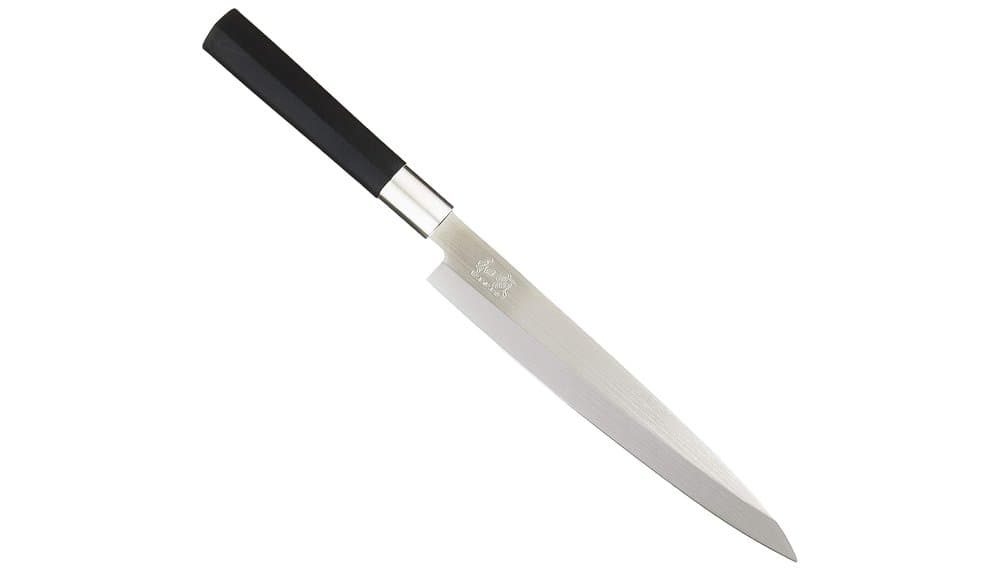
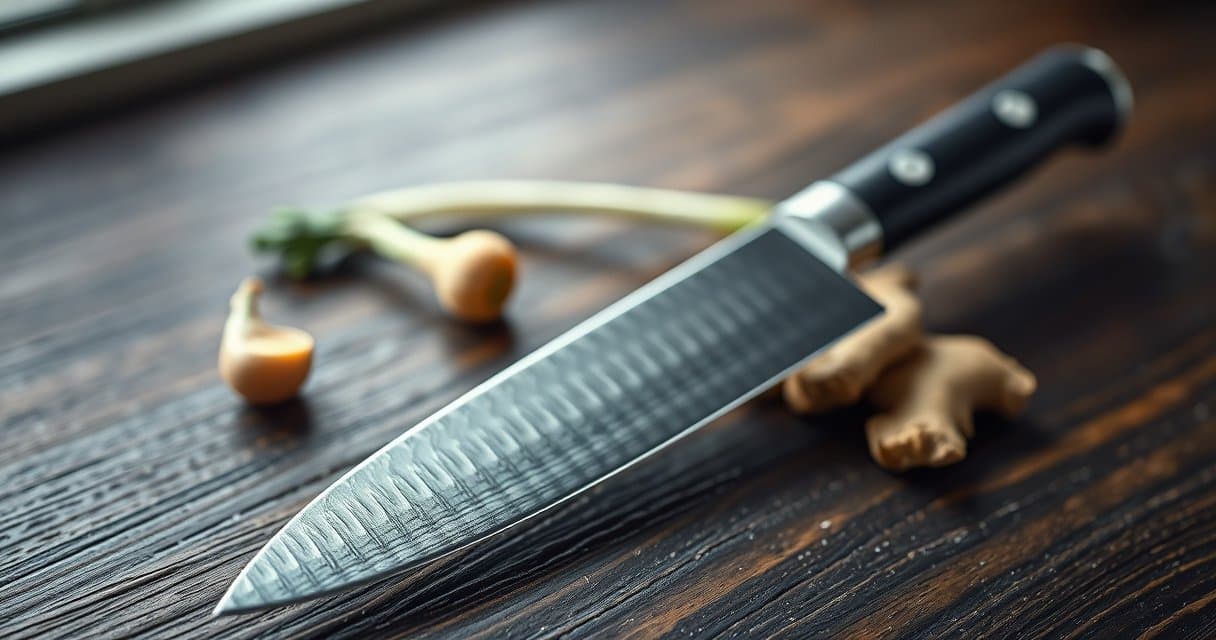
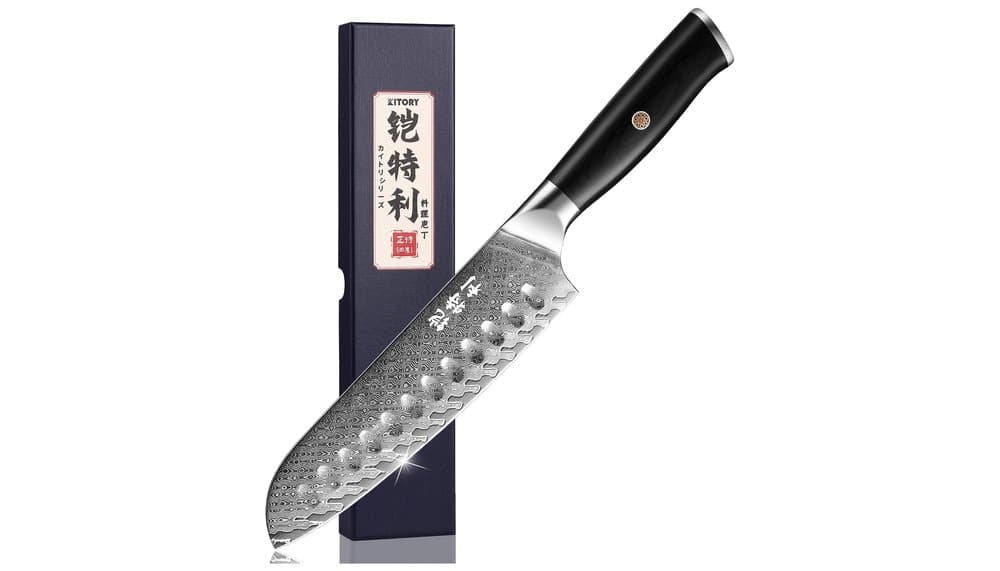
- Careful Design and Finish: The aesthetic aspect is a major purchase driver. The blade made of 73-layer Damascus steel offers a characteristic wave pattern which, beyond its appearance, is renowned for reducing food adhesion. The assembly with the Pakkawood handle and brass inlay contribute to a quality impression.
- Successful Ergonomics and Balance: The majority of users highlight a good balance, with a pivot point located at the blade-handle junction. The Pakkawood handle is described as comfortable and offering a secure grip, even during prolonged work sessions.
- Perceived Positive Value for Money: Within its price segment, the community often feels they get their money's worth, offering a "premium" experience at a reasonable entry cost.
Weak Points: Questions About Edge Longevity
Despite its assets, some technical reservations emerge from experience reports and comparisons with higher standards.
- Edge Retention Under Scrutiny: The main question mark concerns the durability of the edge. Several users note that the factory edge, while exceptional, can dull noticeably after a few months of regular use, especially on hard vegetables. This requires more frequent sharpening than some high-end steels.
- A Damascus Pattern That Is Sometimes Subtle: Some buyers, like user "AndyH," point out that the Damascus pattern can be less pronounced in reality than in marketing photos, which is a disappointment for aesthetics purists.
- Blade Length Limited for Certain Tasks: The 17 cm (approx. 6.7 inches) size is perfect for precision and common vegetables. However, for heavy-duty work like cutting a large cabbage or squash, experienced users might prefer a 20 cm santoku.
- "VG-10 Equivalent" Steel: The blade core is made of 10Cr15CoMoV, presented as a Chinese equivalent of Japanese VG-10. While its performance is generally considered good, it does not have the same history and recognition in terms of purity and quality control as VG-10 from renowned Japanese forges.
Detailed Analysis: Technical Dissection of a Serious Entry-Level Knife
The Soul of the Blade: Steel, Heat Treatment, and Hardness
The choice of steel is the foundation of the "buy-it-for-life" philosophy. Kitory bets here on 10Cr15CoMoV carbon stainless steel. This designation means it contains about 0.95-1.05% carbon (the "10" at the beginning of the Chinese name), 15% chromium (Cr) for corrosion resistance, as well as Molybdenum (Mo), Cobalt (Co), and Vanadium (V). These latter elements improve toughness, wear resistance, and the fine grain of the steel.
On paper, the specs announce a Rockwell Hardness (HRC) of 60-62. This is a solid range and typical of good Japanese kitchen knives. An HRC of 60+ promises excellent edge retention, allowing the blade to stay sharp for a long time. The flip side is that the harder a steel is, the more brittle it can be (risk of micro-chipping on bones or hard surfaces) and the more sharpening requires technique and quality stones. User feedback confirms this duality: the knife holds an edge well but requires proper maintenance when it's time to sharpen it.
The 73-layer Damascus structure here is mainly aesthetic. It envelops the 10Cr15CoMoV core. This "sandwich" forging technique protects the harder core and offers the anti-adhesion advantages of Damascus, but it is not in itself indicative of the quality of the central steel.
See priceManufacturing, Balance, and Ergonomics
The knife is advertised as hand-forged and treated with vacuum quenching. This heat treatment process under a controlled atmosphere is a mark of seriousness, allowing for uniform hardness throughout the blade and minimizing impurities.
Balance is crucial for comfort and reducing fatigue. The community notes that this santoku's balance is well set, generally just in front of the handle. This makes it an agile knife, favoring a cutting motion by pressure rather than force.
The Pakkawood handle is a judicious choice. Pakkawood is a wood and resin composite, renowned for its great durability, excellent resistance to moisture and temperature variations compared to solid wood. It is also easier to clean. Its shape, seemingly ergonomic, receives praise for its comfort, although a few users with large hands might find it a bit thin.
Maintenance and Durability: The Conditions for "Buy-It-For-Life"
This is where the true longevity of the product is decided. Despite the "dishwasher safe" mention in the specs, any knife of this quality must absolutely be hand-washed, dried, and stored immediately. The dishwasher is torture for edges (shocks) and can damage the handle over time.
The resharpening potential is excellent thanks to the high HRC. The good quality 10Cr15CoMoV steel lends itself well to restoration on a whetstone. The ability to resharpen it to one's liking is a pillar of the "for life" philosophy. User "Cziller" confirms that sharpening "takes a little time but goes well."
Corrosion resistance is ensured by the chromium content. However, as with any steel, careful drying after washing is imperative to avoid any staining or corrosion, however minimal.
Recap of Technical Specifications
| Characteristic | Detail for the Kitory Santoku 17cm Damascus |
|---|---|
| Blade Type | Santoku (versatile) |
| Blade Length | 17 cm |
| Total Length | Approximately 30 cm |
| Blade Material | Damascus Steel (73 layers) with 10Cr15CoMoV core (VG-10 equivalent) |
| Hardness (HRC) | 60-62 HRC |
| Cutting Angle | Approximately 12° per side (double bevel) |
| Manufacturing | Forged blade, vacuum heat treated |
| Handle Material | Pakkawood with brass inlay |
| Balance | Balanced at the blade/handle junction (according to feedback) |
| Weight | Approximately 330 g |
| Maintenance | Hand washing mandatory, immediate drying |
What Users Say: Synthesis of Community and Expert Feedback
Customer reviews largely converge towards high satisfaction, with an average rating of 4.7/5 stars. The recurring positive points are, in order:
- The exceptional sharpness upon receipt.
- The knife's beauty and careful finish.
- The cutting quality for vegetables, fruits, fish.
- The handle comfort and good balance.
Criticisms or reservations are less numerous but revealing:
- Some note a faster edge loss than anticipated after several months of intensive use.
- The appearance of the Damascus pattern can be disappointing, being less pronounced than in photos.
- The 17 cm length is sometimes seen as somewhat limiting.
Expert observations and forum feedback corroborate and nuance these points. They emphasize that this knife offers very honorable performance for its price, with a factory edge that rivals more expensive models. However, they caution: one should not expect the long-term edge retention of a professional knife in VG-10 or Aogami Super from an established Japanese brand. 10Cr15CoMoV steel is good, but the heat treatment and quality control of major brands make a difference over time. Experts also insist on strict hand maintenance and regular sharpening as keys to longevity.
Conclusion: An Excellent Companion for the Careful and Passionate Cook
The Kitory Santoku Knife Damascus Steel 17cm Kitchen Knife is much more than a decorative knife. It is a serious cutting tool, impressive for its aggressive sharpness from the start, its successful balance, and its careful aesthetics. For a demanding home cook wanting to experience the feel of a Japanese knife without an exorbitant initial investment, it constitutes a very convincing choice.
However, from an absolute "buy-it-for-life" perspective, expectations should be tempered. While its construction seems robust and its steel of good quality, feedback suggests that its edge retention over several years of intensive use might not equal that of Japanese professional references. Its durability is therefore intimately linked to the maintenance and sharpening you provide.
In summary, this Kitory santoku is an excellent tool for those willing to take care of it. It will reward your maintenance with remarkable cutting performance. For regular and careful domestic use, it has the potential to last for many years. The professional cook or purist enthusiast seeking the unbeatable reference for decades to come might turn to historical Japanese brands, but at a much higher cost. Here, the pleasure-performance ratio is undeniably high.