KOTAI Bunka Petty Universal Knife Review
Introduction
In the kitchen knife market, where the choice often boils down to the extreme precision of Japanese knives and the all-terrain robustness of Western knives, the KOTAI Bunka Petty Universal Kitchen Knife presents itself as a hybrid object. Its stated ambition is to marry the two worlds, offering a tool that would be precise, durable, and versatile at the same time. This 13.5 cm knife aims directly at the heart of daily preparation, positioning itself as a luxury utility knife or a precision partner for the demanding cook. Here, we will dissect it from a "buy-it-for-life" perspective, examining its construction, performance, and long-term value for money to determine if it deserves its place in a serious kitchen arsenal.
Strengths
Based on specifications and unanimous feedback, the main assets of this knife are immediate.
- Exceptional Factory Sharpness: Almost all users highlight a remarkable out-of-the-box sharpening, capable of slicing tomatoes and fine herbs effortlessly, thus preserving textures and flavors.
- Balance and Ergonomics: The octagonal geometry of the ebony handle is praised for offering a firm, intuitive, and comfortable grip, for both right-handed and left-handed users, even with wet hands. Its weight (540g with packaging, the knife alone being much lighter) and its center of gravity seem well managed.
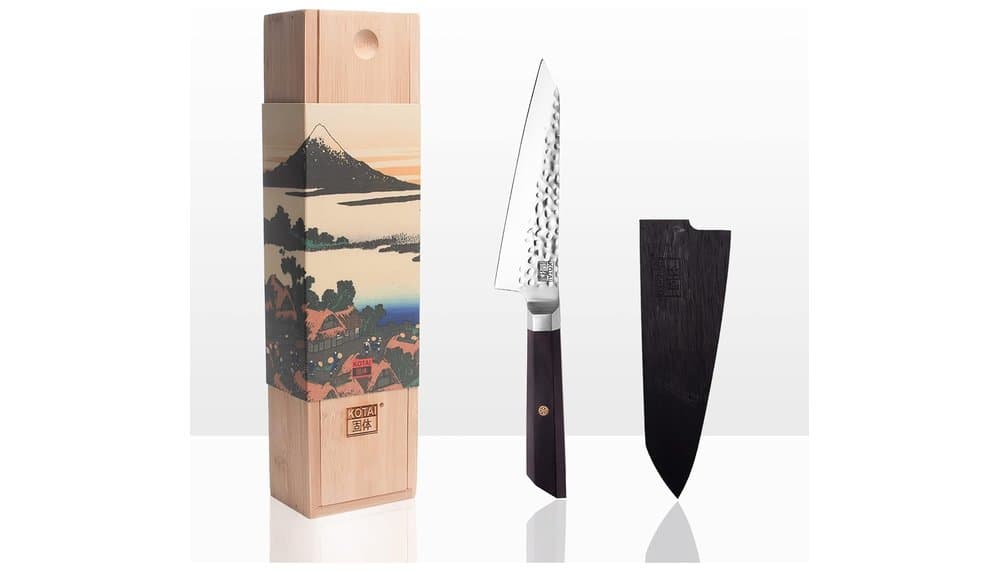
- Premium Construction and Finish: The hand-hammered finish (Tsuchime) is not just aesthetic; according to Japanese knife-making principles, it reduces food stickiness. The whole, from the blade to the handle and the wooden sheath (Saya), gives an impression of artisanal quality and attention to detail.
- Smart Versatility: The Bunka Petty profile, with its relatively flat blade and fine tip, is designed to be a universal small-sized knife, ideal for precision cutting, slicing, and working with vegetables and fish.
Weaknesses
Feedback, although very positive, highlights some limitations inherent to the concept.
- Limiting Size: With its 13.5 cm blade, this knife excels at fine tasks but is clearly not designed to replace a chef's knife. Slicing a large chicken or cutting up a cabbage may prove awkward. Its versatility is that of a utility knife, not a main knife.
- 440C Steel: A Pragmatic but Debated Choice: While 440C steel (containing 1% carbon and 17% chromium) offers an excellent corrosion resistance/ease of sharpening compromise, it is not among the "high-end" steels like VG-10, AUS-10, or carbon steels (White Steel #1 or #2). Its edge retention, although good, is generally inferior to that of steels richer in carbon or complex alloys, as noted by some experts.
- Non-negotiable Maintenance: Like any good knife, it requires proper maintenance: immediate hand washing and thorough drying are mandatory. Its sharpening, although facilitated by the nature of the steel, will require using a whetstone to restore its optimal sharpness, a step that some occasional users may find burdensome.
Detailed Analysis
The Blade: Between Specifications and Real-World Usage
The choice of steel is the first element of analysis. Japanese 440C is a solid and reliable stainless steel. Its carbon content (about 1%) gives it a good ability to take and hold an edge, while its high chromium content (17%) effectively protects it against rust. On paper, the specs advertise a blade "3x harder". While this is a marketing claim, it indicates a Rockwell hardness (HRC) that, for this type of steel, is typically between 57 and 59 HRC. This is a very decent hardness.
This is where the compromise appears. A hardness in this range means:
- Edge Retention: Good, but not exceptional. User feedback confirms that after several months of regular (but not professional) use, the knife retains a good edge but may require light touch-ups. This is not a steel that will hold for months without contact with a stone, unlike some VG-10 or very hard powdered steels (61-64 HRC).
- Ease of Sharpening: This is its strong point. 440C steel is relatively easy to re-sharpen on a stone, even for a moderately experienced amateur. This is a major asset from a "buy-it-for-life" perspective, as it ensures the user can maintain their tool long-term without requiring master-level skills or tools.
The hand-hammered finish is not mere plating. This traditional technique, in addition to its unique visual aspect, creates microscopic dimples that reduce the contact surface with food. The community notes that this works particularly well with wet or sticky ingredients like potatoes, cucumbers, or cheese, effectively limiting adhesion.
See priceThe Handle and Ergonomics: Long-Term Comfort
The solid ebony octagonal handle is a strong argument. Ebony is a dense, hard wood naturally resistant to water, making it a premium choice for cutlery. Its octagonal shape serves as a natural tactile guide for finger placement, ensuring a secure and repeatable grip that reduces fatigue during prolonged use. Expert testers emphasize that this ergonomics, coupled with good blade/handle balance, makes the knife pleasant and safe to handle, an essential characteristic for a tool meant to last.
Durability and "For Life" Potential
Durability rests on several pillars:
- Construction: The knife is forged, meaning the steel was hot-worked to align its molecular structure, generally synonymous with better strength and durability than a stamped blade.
- Materials: The combination of 440C steel (corrosion-resistant) and solid ebony (very stable and hard wood) is robust.
- Warranty: The Lifetime Warranty offered by KOTAI is a strong commitment that aligns with a product designed to last.
The point of vigilance remains maintenance. This knife is not dishwasher safe. The aggressive heat, shocks, and detergents would irreparably degrade the edge, the wooden handle, and could even damage the blade. Its "lifetime potential" is therefore directly linked to the rigor of its manual care.
For Which Type of Cook?
The KOTAI Bunka Petty finds its perfect place with the demanding amateur cook or the professional seeking a secondary precision knife. It does not claim to be the only knife in the kitchen, but it aims to be the best in its niche: precision tasks and daily work on small ingredients. Those seeking the ultimate edge retention of a pure Japanese carbon steel will find here a more practical and less corrosion-maintenance-demanding compromise. It is an excellent introductory knife to Japanese quality, without the sometimes off-putting constraints of non-stainless carbon steels.
Technical Specifications
| Feature | Detail |
|---|---|
| Model | KOTAI Bunka Petty Universal Kitchen Knife |
| Blade Length | 13.5 cm |
| Blade Material | Japanese 440C Stainless Steel (forged) |
| Blade Finish | Hand-hammered (Tsuchime) |
| Edge | Hand-sharpened, double bevel (likely) |
| Handle Type | Octagonal |
| Handle Material | Solid Ebony |
| Balance | Reported as well-balanced |
| Total Weight | Approximately 540 g (with full packaging) |
| Care | Hand wash mandatory, immediate drying |
| Warranty | Lifetime Warranty |
| Accessories | Wooden sheath (Saya), bamboo box, certificate |
What Users Say
The synthesis of 135 customer reviews (average rating 4.6/5) and available expert analyses paints a very consistent picture of the product.
Recurrent praise focuses on:
- Immediate Sharpness: Phrases like "razor," "slices tomato without touching it," "formidably efficient" constantly reappear. Users are impressed by the cutting performance right out of the box.
- Finish and Aesthetics: The knife is regularly described as a "beautiful object," "magnificent," with a "careful" and "high-end" finish. The presentation with its bamboo box and wooden sheath is highly appreciated, making it a prized gift.
- Comfort of Use: The ebony handle and overall balance receive praise for the safe and pleasant grip, even during prolonged sessions.
- Versatility for Small Tasks: Many describe it as having become their "everyday" knife for chopping, slicing, and preparing vegetables, herbs, and fish fillets.
The noted reservations or criticisms are:
- Size: Several comments imply that its dimensions confine it to a supporting or precision role, not a primary knife role.
- Steel and Sharpening: A few knowledgeable users, including a Vine program tester, note that the factory edge, although excellent, could be even more aggressive, and that re-sharpening was necessary after a few weeks of use to regain optimal performance. This corroborates the analysis of the "good but not extraordinary" edge retention of 440C steel.
- Perceived Value for Money: A minority, while acknowledging the quality, believes the price is mainly justified by aesthetics and packaging rather than unprecedented technical performance.
Conclusion
The KOTAI Bunka Petty Universal Kitchen Knife is a success in the category of accessible high-end precision knives. It makes no mystery about what it is: a specialized tool for fine tasks, built with noble materials and a stated artisanal know-how. Its bet to mix Japanese finesse with Western robustness is successful, mainly thanks to the pragmatic choice of 440C steel – easy to maintain and re-sharpen – and the excellent ergonomics of its ebony handle.
Is it a "for life" purchase? Yes, provided one accepts it for what it is: a complementary knife in a balanced arsenal, and scrupulously respects its manual maintenance. Its lifetime warranty and forged construction guarantee this. It will not beat an aogami super steel knife on long-term edge retention, but it will require much less vigilance against rust. For the serious at-home cook who wants a reliable, beautiful precision tool and is not afraid to learn to use a whetstone to maintain it, the KOTAI Bunka Petty represents a sensible and durable investment. It is a knife that impresses from the first grip and, well-maintained, will become a faithful kitchen companion for decades.