KRODEAIR Non-Stick Stainless Steel Wok Pan Review
Introduction: An "All-in-One" Wok That Stands the Test of Time?
On our site, we are used to talking about culinary tools made to last: carbon steel woks that improve with age, raw cast iron, Japanese steel blades. The KRODEAIR Non-Stick Stainless Steel Wok Pan falls into this category with a different proposition. It is not a traditional Chinese wok, but a "Western-style" wok that bets on absolute versatility and immediate ease of use, without requiring seasoning.
Our analysis here will focus on a central question: can this product claim a place in a "buy-it-for-life" kitchen? We will dissect its specifications, community feedback, and expert observations to determine if it is a robust tool for the serious cook or a practical solution with inherent compromises.
Strengths
- Universal Compatibility: Its stainless steel construction and adapted base make it usable on all types of stoves, including induction, which is a decisive advantage for many modern kitchens.
- Immediate Non-Stick Function: The non-stick coating allows for cooking with little fat and extremely easy cleaning, without the learning curve of seasoning.
- Complete Construction: The product comes with a glass lid, a practical element for braising or stewing, often sold separately for professional woks.
- Simple Maintenance: Unlike carbon steel or cast iron, it does not rust and does not require special care after each use, apart from respecting the coating.
Weaknesses
- Conditional Coating Durability: The most critical point. No non-stick coating is eternal. Its longevity depends entirely on the use of appropriate utensils (wood, silicone) and non-abrasive cleaning.
- Thermal Limits for Searing: Stainless steel, especially with a coating, does not tolerate extreme temperatures (typically above 260°C) and conducts heat less effectively than carbon steel. The high-heat searing characteristic of wok cooking may be less effective, with risks of hot spots.
- Absence of "Patina" and Personalization: Unlike a carbon steel wok that develops a natural and unique non-stick patina over the years, this wok remains a static tool. It does not improve with time and use.
- Weight and Maneuverability: Based on feedback on similar models, the weight of stainless steel is often perceived as greater than that of an equivalent-sized carbon steel wok, potentially affecting maneuverability during vigorous stir-frying motions.
Detailed Analysis: Specifications vs. Real-World Use
Materials and Construction: The Paradox of "Stainless Steel Non-Stick"
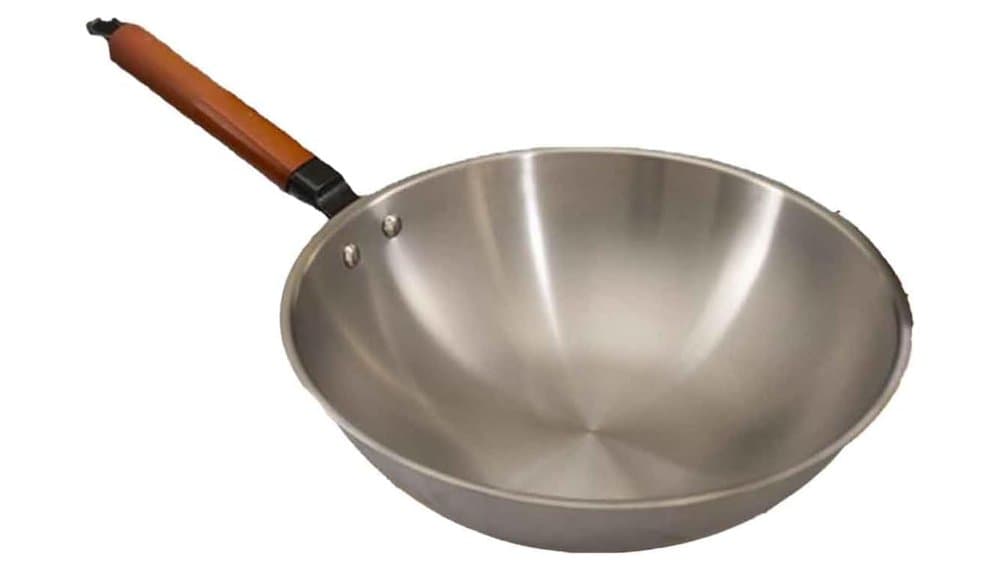
The product name, KRODEAIR Non-Stick Stainless Steel Wok Pan, is in itself an oxymoron in the world of durable cookware. Stainless steel is indeed renowned for its robustness, corrosion resistance, and near-unlimited longevity. It is an excellent material for uncoated pots or pans.
However, the marriage with a non-stick coating introduces a fragility. This coating, even if advertised as "PFOA/PFAS-free" and "scratch-resistant," remains the most vulnerable part of the utensil. Testers emphasize that its long-term durability is the big unknown and depends entirely on the care provided. On paper, the specs announce a "hammered" finish which, according to the brand, improves heat retention and distribution. This is primarily an aesthetic aspect and potentially adds rigidity, but it does not equal the thermal conductivity of good carbon steel or a multi-layer base.
See priceCulinary Performance: Versatility vs. Mastery
This wok excels in versatility roles. It allows for lightly searing vegetables, sautéing chicken pieces, braising, or even frying over medium heat. The included lid makes it a complete tool for various recipes. It is an ideal utensil for someone who wants a single wok to do everything, without complication.
On the other hand, for the cook seeking authentic wok performance – the "wok hei," that intense fire flavor – the compromises are significant. Stainless steel has lower thermal conductivity than carbon steel or copper. Combined with a coating that fears overheating, it imposes a temperature limit. You cannot heat it until smoking white-hot on a powerful burner like with a carbon steel wok. Heat distribution can be less uniform, as some experts note, leading to food cooking unevenly if the heat is not well managed.
Ergonomics and Finish
Feedback on similar products indicates that handles are generally designed to stay cool and offer a good grip. The weight, although potentially higher than a carbon steel wok, remains manageable for most users. The "hammered" finish and polished edges give an impression of solidity. The real ergonomic test for a wok is the ease of lifting and tossing it with one hand during high-heat cooking – a maneuver where weight becomes a critical factor.
Durability: The Coating Equation
This is the heart of the "buy-it-for-life" debate. A bare carbon steel wok, well-maintained, can be passed down. A cast iron wok too. The KRODEAIR, however, has a lifespan theoretically tied to the integrity of its coating. Even with the best care (no metal utensils, no dishwasher, no overheating), coatings wear out over time. The community of serious cooks is often divided: this tool is durable in its body (the stainless steel), but has a component (the non-stick) with built-in obsolescence, making it a product with conditional longevity, not absolute longevity.
Technical Specifications
| Characteristic | Detail |
|---|---|
| Product Name | KRODEAIR Non-Stick Stainless Steel Wok Pan |
| Main Material | Stainless steel (likely 18/10) with non-stick coating |
| Surface Treatment | "Hammered" finish, PFOA/PFAS-free non-stick coating |
| Compatibility | All stovetops: induction, gas, electric, ceramic |
| Base | Likely magnetic / multi-layered for induction |
| Diameter | Often around 34-36 cm (to be verified per model) |
| Handles | Fixed, ergonomic, heat-resistant coating |
| Included Accessories | Tempered glass lid (with steam vent hole) |
| Maintenance | Hand washing recommended, non-metallic utensils |
What Users and Experts Say
A synthesis of community feedback (forums, expert tests) on this type of wok gives us a nuanced and consistent picture.
Recurring Positive Points:
- The versatility is highly praised, especially compatibility with induction, which is a major asset for many.
- The non-stick works well from the first use, enabling healthy cooking and quick cleaning.
- Having an included lid is very appreciated and seen as good value for money.
- The finish and overall look give an impression of quality and solidity upon receipt.
Recurring Negative Points or Reservations:
- Coating durability is the number one concern. Several users report deterioration after a few months to a year of regular use, even with careful attention.
- High-temperature performance is judged inferior to that of carbon steel woks. It is not suitable for stir-fry techniques requiring very intense heat.
- The weight is sometimes mentioned as a hindrance to easy and quick handling, essential for stir-frying.
- Some note that heat distribution is not perfectly even, requiring more frequent moving of food to avoid local burning.
Conclusion: For Whom Is This the Right Choice?
The KRODEAIR Non-Stick Stainless Steel Wok Pan is not the modern, indestructible equivalent of a traditional carbon steel wok. It is a different product, with its own strengths and weaknesses.
It is an excellent choice for the cook looking for a single, easy-to-use and easy-to-maintain utensil, compatible with all cooktops, and capable of handling 80% of daily kitchen tasks (gentle searing, braising, frying, steaming). It is the tool of versatility and practicality.
On the other hand, for the serious, demanding cook, who considers their tools as lifetime investments and seeks ultimate technical mastery – perfect searing, wok hei, the almost organic relationship with a tool that ages with you – this wok presents too many compromises. The potential fragility of the coating and the thermal limitations make it a product with uncertain lifespan and limited peak performance.
In summary, it is a good product for a modern and practical kitchen, but it is not, in the "buy-it-for-life" spirit we champion, an heir to the great durable classics like carbon steel or cast iron. Its purchase is justified by an immediate need for ease and compatibility, accepting that its longevity may be that of its coating, and not of its stainless steel body.