Lantana Smart Sharp 3-Phase Knife Sharpener Review
Introduction
In a world where the knife is an extension of the cook's hand, its sharpness is a matter of performance and safety. For the discerning amateur or serious cook, blade maintenance is not an option, but a discipline. Faced with traditional methods requiring skill and time, and electric sharpeners that are often aggressive, guided manual solutions offer a middle path. We analyze here the Lantana Smart Sharp 3-phase manual knife sharpener, a device that promises a professional result in three steps. Our goal is clear: evaluate this tool according to a "buy-it-for-life" philosophy. Is it designed to last, with materials and construction that justify a long-term investment? Is it suitable for the arsenal of a demanding cook who owns quality knives? We have scrutinized its technical specifications, cross-referenced the feedback from thousands of users and web analyses to provide you with a complete and uncompromising overview.
Key Strengths
- Proven Effectiveness and Versatility: According to user feedback, the three-phase system manages to restore a functional, even very sharp, edge to most dull Western-style kitchen knives, including those with hardened steel.
- Well-Designed Ergonomics and Safety: The community unanimously emphasizes the comfortable grip of the handle, suitable for left- and right-handed users, as well as the stability provided by the heavy non-slip rubber base.
- Accessible Simplicity of Use: The device is designed to democratize sharpening. The detailed instructions and video tutorial are praised for effectively guiding beginners toward the correct technique.
- Perceived Robust Construction: On paper and based on reviews, the assembly, sharpening materials (tungsten, diamond, ceramic) and the weight of the device (185g) inspire confidence in its immediate solidity.
Weaknesses
- Limited and Exclusive Compatibility: This is the main limitation. The manufacturer clearly states that the sharpener is not compatible with Japanese knives (too acute an angle), ceramic knives, scissors, or – crucial point – with any knife previously sharpened on a stone, steel, or grinder, as the blade's angle may have been altered.
- Initial Lack of Clarity on Technique: Several users note that the paper instructions do not specify the movement (push or pull the blade?) sufficiently, making the tutorial video almost indispensable for an optimal result.
- Long-Term Durability Not Proven: Although there is a 5-year parts warranty, long-term feedback on several years of intensive use is rare. The durability of the abrasive discs over a decade or more remains an unknown.
- Fixed and Non-Customizable Sharpening Angle: The angle is locked at 20°, which is the standard for Western knives. This makes it a specialized tool, but unsuitable for a collector or professional using varied angles (such as the 15° of a Japanese chef's knife).
Detailed Analysis
Construction Philosophy and Materials
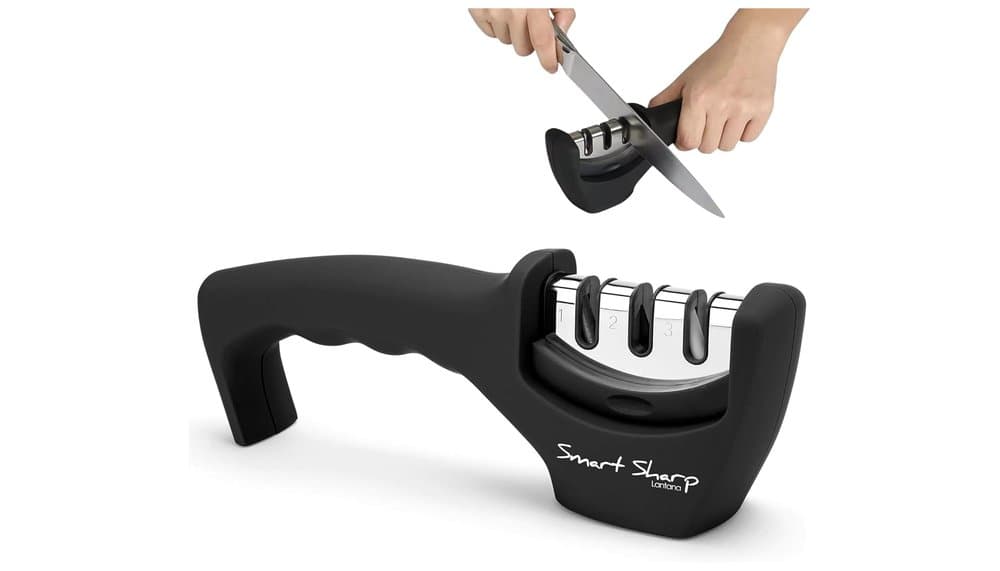
The Lantana Smart Sharp adopts a pragmatic approach to sharpening, far from the artisanal finesse of a waterstone, but distinguishes itself from low-end single-stage "pull-through" sharpeners. Its promise relies on the sequence of three abrasive materials, each with a defined role:
- Preparation Phase (Diamond): The coarse diamond discs are tasked with leveling micro-notches and imperfections on the blade edge. Diamond is an extremely hard and abrasive material, ideal for this initial corrective work without which sharpening would be irregular.
- Sharpening Phase (Tungsten Carbide): This intermediate phase, with tungsten carbide discs, shapes the new edge. Tungsten carbide is a material very resistant to wear, common in guided sharpeners, which removes material efficiently and in a controlled manner thanks to the fixed 20° angle.
- Finishing Phase (Ceramic): The final step uses ceramic discs to polish the edge, remove the burr (the raised metal micro-particles), and refine the sharpness for a cleaner and more durable cutting edge.
From a "buy-it-for-life" perspective, it's noticeable that the abrasive materials are chosen for their effectiveness and hardness. However, unlike a natural or synthetic sharpening stone that slowly wears away, the durability of these integrated discs is not explicitly quantifiable. Their lifespan will depend directly on the frequency of use and the number of knives treated. The 5-year parts warranty is a significant asset that demonstrates a certain confidence from the manufacturer.
See priceSharpening Performance: Results and Limits
Feedback is unanimous on one point: for its target audience, the Lantana Smart Sharp works. Users report that dull knives regain a functional edge in a few passes, capable of slicing paper cleanly. This is its main merit: offering a fast, reproducible, and skill-free solution for the regular maintenance of common kitchen knives.
However, this performance has a strict framework. The manufacturer's warning regarding previously stone-sharpened knives is crucial. A knife whose angle has been modified (for example, sharpened to 17° or 25°) will not fit correctly into the 20° guides. Sharpening would then be ineffective and could even permanently damage the blade by creating a double bevel or wearing the blade asymmetrically. This device is therefore ideal for someone who wants to standardize the maintenance of new knives or those already sharpened with this same system, but it is excluded for restoring or maintaining knives with a history of other methods.
For a serious cook owning Japanese knives in VG-10 steel, AUS-10, or carbon steel (White Steel) with Rockwell hardness (HRC) levels often above 60, this tool is not an option. These steels, renowned for their exceptional edge retention, require precise sharpening at their original angle (often 12°-15° per side) on appropriate grit waterstones. The fixed 20° angle and aggressive abrasion of the carbide would be unsuitable and would degrade the blade.
Ergonomics and Long-Term Handling
This is an area where the product excels according to the community. The ergonomic handle is designed to be held firmly, allowing full control of the blade movement. Unlike many suction cup or small-handled sharpeners, the Smart Sharp, with its weight and wide rubber base, remains perfectly stable during use. This stability is a guarantee of safety (the blade doesn't slip) and consistency (the angle is maintained constant with each pass).
For a maintenance session of several knives, this ergonomics significantly reduces fatigue. It's a far cry from the uncomfortable and technical position required for stone sharpening. This ease of use makes it a tool more likely to be used regularly, which is the best way to extend the life of your knives.
Technical Specifications Table
| Characteristic | Detail |
|---|---|
| Product Name | Lantana Smart Sharp 3-phase manual knife sharpener |
| Type | 3-phase guided manual sharpener |
| Abrasive Materials | Diamond (Phase 1), Tungsten Carbide (Phase 2), Ceramic (Phase 3) |
| Sharpening Angle | Fixed at 20° |
| Construction Material | Reinforced plastic, metallic and ceramic abrasive elements |
| Available Finishes | Black/Chrome, Dark Red, Bright Green |
| Base | Heavy non-slip rubber |
| Handling | Ambidextrous ergonomic handle |
| Weight | 185 grams |
| Dimensions (LxWxH) | 20 x 4.5 x 7.5 cm |
| Compatible Knives | Western-style knives with a flat spine (chef's, utility, etc.), wide-toothed knives (bread), hardened steels. |
| INcompatible Knives | Japanese knives, ceramic knives, scissors, serrated knives, knives previously sharpened on stone/steel/grinder. |
| Parts Warranty | 5 years |
What Users Say: Trends and Warnings
Analyzing thousands of customer reviews and online expert feedback reveals very clear trends.
Recurrent praise centers on immediate effectiveness ("it really sharpens well", "restores sharpness in seconds", "surprisingly effective"), simplicity once the technique is understood, and perceived build quality ("solid", "sturdy", "good quality"). Satisfaction is high among users whose knives strictly match the compatibility criteria.
Reservations and criticisms consistently point to two elements:
- The Learning Curve: Several testimonies, such as one user noting "usage is not very clear", confirm that the paper instructions are insufficient. The video tutorial is described as indispensable for mastering the correct movement (generally a firm pass pulling the blade towards oneself).
- Usage Restrictions: The warnings regarding stone-sharpened knives are taken very seriously by the informed community. One review summarizes the necessary caution well: "It is not compatible with knives sharpened on stone, steel, or grinder." This limitation is the main source of disappointment for those who did not read the specifications carefully.
Specialized testers and forums confirm this positioning: the Smart Sharp is an excellent solution for standard domestic maintenance, effective and hassle-free, but it does not and cannot claim to replace professional stone sharpening for high-end knives or those with specific angles.
Conclusion
The Lantana Smart Sharp 3-phase manual knife sharpener is a well-designed tool that perfectly fulfills its primary mission: offering effective, fast, and safe sharpening for the regular maintenance of classic Western-style kitchen knives. Its successful ergonomics and robust construction make it a pleasant product to use, likely to last for many years for standard household use, as evidenced by its 5-year parts warranty.
However, from the strict "buy-it-for-life" and demanding cook perspective, its scope is deliberately circumscribed. It is in no way a universal or professional tool. Its total incompatibility with Japanese knives and with any knife maintained on stone confines it to a very specific role. It is the ideal ally for someone who owns a set of Western knives and wants an infallible maintenance method without complex learning. Conversely, for someone whose drawer holds a Japanese VG-10 chef's knife or a carbon steel heirloom, investing in a good sharpening stone and learning the technique remains the only way to truly "buy for life" and preserve the integrity of their blades. The Smart Sharp is an excellent key, but it does not open all doors.