Lodge L9OG3 Cast Iron Crepe Pan Test
Introduction
In the universe of durable kitchenware, raw cast iron occupies a unique place. It represents the very archetype of a "buy-it-for-life" product, lasting decades without fail. The Lodge L9OG3 Natural Cast Iron Crepe Pan fits directly into this lineage. It is not simply a crepe pan, but a versatile cooking surface made of pure cast iron, forged in the American foundries of Lodge since 1896. On our site dedicated to serious culinary tools – from carbon steel to Japanese knives – we analyze objects for their material integrity, performance, and heritage. The L9OG3 lays claim to all of this: a 100% natural cast iron construction, factory pre-seasoning, universal compatibility, and a 20-year warranty. But do these promises hold up to the demanding use of a passionate cook? Let's dive into a technical and practical analysis, decoding the specifications and cross-referencing community feedback to assess whether this griddle deserves its place in a professional or semi-professional kitchen.
Strengths & Weaknesses
Strengths
- "Indestructible" construction and warranty: Made in the USA from a single piece of cast iron, the L9OG3 is renowned for its extreme durability. Lodge's 20-year warranty demonstrates solid confidence in the product's longevity, allowing it to be passed down through generations.
- Health and safety: Free of PFAS, PFOA, PTFE, or any synthetic coating, it offers a natural cooking surface. Non-toxicity is guaranteed, a major argument in the face of concerns about traditional non-stick coatings.
- Exceptional thermal versatility: Compatible with all heat sources – induction, gas, electric, oven (up to 400°C), barbecue, and even campfires. This universality makes it a unique tool for indoor and outdoor cooking.
- Superior heat retention and inertia: The mass of the cast iron (nearly 2 kg) ensures even heat distribution and excellent heat retention, ideal for uniform and stable cooking, as required for perfect crepes.
- Evolving non-stick potential: The factory pre-seasoning allows for immediate use, but it's over time and with careful seasoning that the griddle develops its own natural coating, which improves with each use.
Weaknesses
- Weight and maneuverability: At 1.94 kg, it is significantly heavy for a crepe pan. User feedback confirms that this weight can be a hindrance for flipping or prolonged handling, especially for more fragile wrists.
- Grip comfort: The main handle is cast iron, one piece with the griddle. It heats up completely and quickly, consistently requiring the use of a potholder or the included silicone sleeve (whose fit is sometimes criticized).
- Learning curve and maintenance: Unlike "carefree" Teflon, cast iron demands a maintenance ritual: cleaning without harsh soap, immediate and thorough drying, regular oiling to prevent rust. It's a commitment.
- Induction compatibility with conditions: Although compatible, its efficiency on an induction cooktop depends on the size of the burner. If the burner is smaller than the griddle's diameter, testers note problems with uneven heating (cold edges, burning center), sometimes requiring a heat diffuser.
Detailed Analysis of the Lodge L9OG3
Materials and Manufacturing: The Archetype of Durability
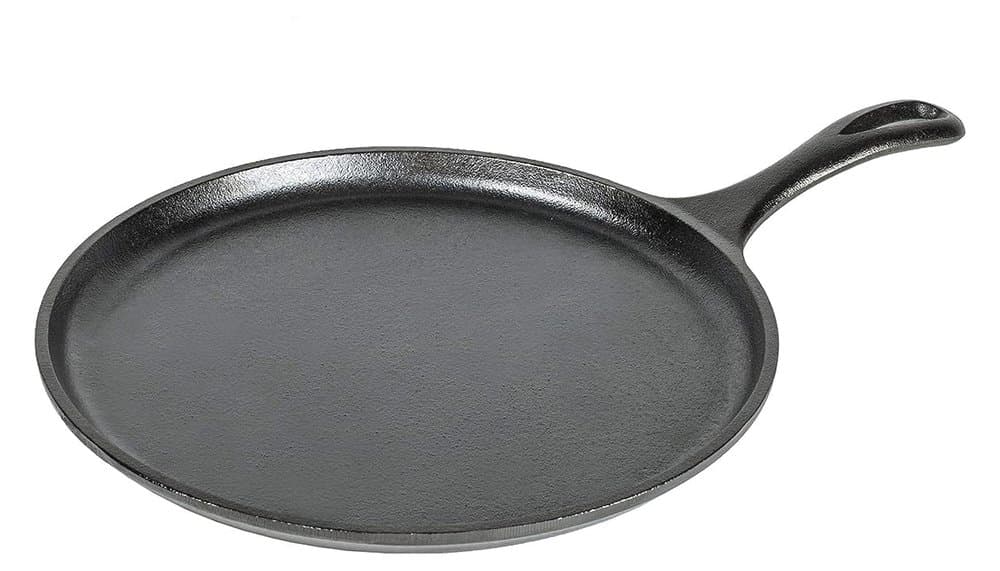
The heart of the L9OG3's "buy-it-for-life" argument lies in its materials. It is made of raw natural cast iron, an alloy of iron and carbon cast in a single piece. There are no joints, rivets, or weak points. This monobloc construction is what gives it its reputation for indestructibility. The surface finish is rough to the touch, characteristic of modern Lodge production (as opposed to the smooth sanding of vintage pieces or some high-end brands). This finish, according to experts, offers excellent grip for seasoning, which will fill in the micro-asperities over time to create a smooth, non-stick surface. The 20-year warranty is not trivial; it places this product in the category of a heritage tool, comparable to a good forged knife.
See priceCulinary Performance: Heat and Versatility
Thermal performance is the absolute strong point of cast iron. With the L9OG3, heat retention is exceptional. Once hot, it maintains a stable temperature even when cold batter is poured onto it, ensuring even cooking. This is crucial for crepes and pancakes. Heat distribution is also very good, although the community notes that on concentrated heat sources (like a standard gas burner), the burner's pattern may be slightly discernible on the food if the griddle is not sufficiently preheated. Its versatility goes far beyond crepes: users report success with fried eggs, bacon, steaks, quesadillas, pancakes, and even as a mini-plancha on the barbecue. Its low rim (about 1 cm) is ideal for sliding a spatula, but obviously limits its use for saucy dishes.
Ergonomics and Handling: The Weight/Performance Compromise
This is the most obvious point of compromise. The mass of nearly 2 kg is a direct attribute of its thermal performance, but it is also its main ergonomic flaw. Flipping a crepe with a quick motion requires more strength and technique than with a lightweight aluminum pan. The handle is solid and well-proportioned, but it becomes burning hot quickly. The included silicone sleeve is a necessity, but some users find it slippery or not secure enough for a firm grip. Safe handling requires strict discipline: a potholder is mandatory.
Maintenance, Seasoning, and Long-Term Durability
Maintenance is the aspect that distinguishes the cast iron enthusiast from the novice. The L9OG3 arrives pre-seasoned with a vegetable oil, allowing you to start cooking right away. However, most feedback from experts and experienced users recommends re-doing an initial seasoning yourself to optimize the surface. Community discussions reveal debates about the best methods: flaxseed oil, while creating a hard film, is sometimes accused of flaking over time due to thermal cycles. Animal fat (lard, bacon grease) or high-smoke-point oils (like canola) are often preferred for their resilience. Routine maintenance is simple but non-negotiable: cleaning with hot water (possibly with a little mild soap, contrary to the myth), immediate and complete drying on the stove or in the oven, and application of a thin layer of protective oil. This routine prevents rust. In the very long term, the beauty of cast iron is its repairability: bad seasoning, rust, or scratches can be fixed by sanding and re-seasoning, giving new life to the utensil for additional decades.
Technical Specifications
| Characteristic | Detail |
|---|---|
| Model | Lodge L9OG3 Natural Cast Iron Crepe Pan |
| Diameter | 26 cm (approximately 10.5 inches) |
| Material | Raw natural cast iron (iron-carbon alloy) |
| Weight | 1.94 kg |
| Finish | Factory vegetable oil pre-seasoning |
| Handle | Cast iron (monobloc), silicone sleeve included |
| Compatibilities | All stovetops (induction, gas, electric, ceramic), oven (up to 400°C), barbecue, campfires |
| Features | PFAS/PFOA/PTFE-free, made in USA |
| Maintenance | Hand washing recommended, immediate drying mandatory |
| Warranty | 20 years |
What Users Say
An analysis of tens of thousands of reviews and expert feedback available online reveals clear trends and a strong consensus.
Recurrent praise revolves around the perceived solidity, healthy cooking (absence of chemical coatings), and performance once seasoning is mastered. Users who have passed the learning curve are often enthusiastic, describing an effective natural non-stick surface, an "authentic" cooking feel, and the satisfaction of using a near-eternal object. Many appreciate its versatility, using it for breakfast as well as an outdoor plancha. The fact that it is Made in USA and the 20-year warranty are frequently cited as marks of trust and quality.
The most common criticisms focus on three points:
- The weight: It is systematically mentioned as a major drawback for maneuverability, especially for crepes.
- Heat management on induction: Several detailed reviews (like the very instructive one referenced in the data) warn of heating problems if the induction burner is smaller than the griddle's diameter, leading to a central hot spot and cold edges. The solution involves using a diffuser or a suitable burner.
- Learning the maintenance: Beginners may encounter rust problems if they do not dry the griddle sufficiently, or sticking if they do not follow the preheating and light oiling steps before cooking. The experience of flaxseed oil seasoning flaking, shared in a detailed review, is a textbook case on the importance of method.
Experienced testers emphasize that this is not a "plug and play" utensil. It is a tool that improves with time and the attention given to it. For those who accept these rules of the game, the reward is a utensil of exceptional reliability and longevity.
Conclusion: Who is this Lodge Crepe Pan For?
The Lodge L9OG3 Natural Cast Iron Crepe Pan is not a kitchen gadget. It is a serious, demanding, and extremely rewarding tool. It will never imitate the lightness and immediate ease of use of a disposable non-stick pan. On the other hand, it offers something infinitely more valuable to the passionate cook: permanence, health, and total mastery over their tool.
It is perfectly suited for the user who:
- Is looking for a "lifetime" investment, eco-friendly, far from disposable consumption.
- Prioritizes health and wants to eliminate synthetic coatings from their kitchen.
- Appreciates extreme versatility (from the stovetop to the campfire).
- Is willing to dedicate a few minutes to a simple but rigorous maintenance ritual.
- Accepts the weight as the necessary trade-off for professional-grade thermal inertia.
It will be less suitable for those who:
- Primarily seek lightness and quick maneuverability.
- Want a "carefree" utensil that can go in the dishwasher.
- Own an induction cooktop with burners significantly smaller than 26 cm, without a diffuser.
In summary, the Lodge L9OG3 is much more than a crepe pan. It is a cornerstone for healthy and sustainable cooking. It demands an initial commitment, but in return, it promises – and according to the community, delivers – decades of faithful service. For the serious cook who understands and accepts the philosophy of cast iron, it is not a purchase, but an acquisition.