Müller AN10040 Original Arkansas Stone Review
Introduction
In a world where synthetic sharpening stones dominate the market with standardized grits and fast cutting times, natural stones retain a special aura, synonymous with craftsmanship, exceptional finishing, and durability. The Müller AN10040 Original Arkansas Sharpening Stone belongs to this lineage. On paper, it's a tool seemingly built to last a lifetime, an ideal candidate for a "buy-it-for-life" philosophy. But what is it really worth for the demanding cook, a fan of Japanese carbon steel knives (Shirogami, Aogami) or Western blades with high hardness tempering? This comprehensive analysis is based on technical specifications, community feedback, and expert tests to determine if this Arkansas stone deserves its place next to your cutting board and precision tools.
Strengths and Weaknesses
Strengths
- Material and Durability: Cut from natural Arkansas novaculite, a stone with an extremely dense and hard grain, its wear resistance is exceptional. It's an investment for several decades.
- Quality Finish: It produces a razor-sharp and polished edge, highly valued for the final edge on kitchen knives, wood chisels, and precision tools. The bite is gentle and controlled.
- Minimal Maintenance: Contrary to some misconceptions, it works very well with water or light oil (like honing oil). Many users simply use water, which greatly simplifies the routine.
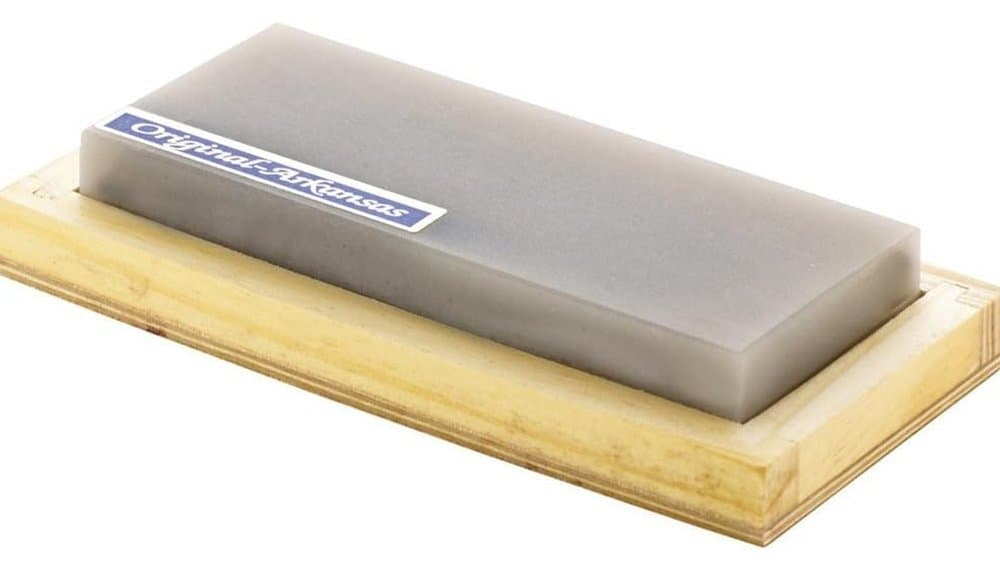
- Practical Dimensions: Its 100 x 40 x 20 mm format makes it handy and stable for a wide variety of blades, from small paring knives to large chef's blades.
Weaknesses
- Sharpening Speed: As a dense, hard natural stone, its abrasion is slow. It is not designed for reprofiling an angle or repairing a chip; its role is maintenance sharpening and finishing.
- Surface that can "glaze": Over time and use, metal particles can clog the stone's pores, reducing its bite. Regular cleaning is necessary.
- Learning Curve: Testers emphasize that this stone is poorly suited for beginners. It rewards technique and patience but does not forgive errors in angle or pressure.
- Single and Fine Grit: Although web context sometimes mentions two grits, the official product sheet describes it as a fine stone. It is therefore a step in a progression, not a single, all-purpose solution.
Detailed Analysis
Material and Construction: Novaculite, a "Buy-It-For-Life" Choice
The heart of the analysis lies in its material: novaculite. This siliceous sedimentary stone, extracted from the mountains of Arkansas, is famous for its extremely fine and dense crystalline structure. This is not a disposable tool. Its phenomenal hardness means it wears at an infinitely slower rate than an ordinary synthetic stone. For the user, this translates into a work surface that stays flat for a very long time and an investment paid off over years, even generations of reasonable use. The construction is simple: a cut block of stone, without a base or superfluous accessories. It is the very essence of a tool dedicated to its function.
See priceSharpening Performance: For the Final Edge and Finesse
The performance of the Müller Arkansas must be evaluated through the prism of its fine grit. According to expert feedback, it is not designed for coarse work. Its role is to refine an already established edge and give it a polished and durable finish. On a Japanese knife made of white steel (Shirogami) or blue steel (Aogami), often tempered between 60 and 65 HRC, this stone excels. It allows for the creation of an extremely sharp micro-bevel without excessively attacking the steel.
For very hard stainless steels like VG-10 or AUS-10, feedback is mixed. Some users find its bite too slow for these steels with large carbides, preferring ceramic or diamond synthetic stones for sharpening. Others appreciate precisely its slowness for total control over edge polishing. It will, however, be less suitable for very soft steels or high-consumption knives, where a more abrasive stone would be more effective.
Handling and Ergonomics
With its 100 mm length, it offers sufficient surface area for most kitchen knives, allowing for long, regular passes. Its 40 mm width is standard and comfortable. The 20 mm thickness is a guarantee of stability and ensures a long service life before the stone becomes too thin to use. Users note that its weight (approx. 176g) and format make it stable in hand, whether placed on a work surface or held directly. No feedback reports major ergonomic issues, which is consistent with the simplicity of the design.
Maintenance and Longevity
Longevity is the absolute strong point of this stone. To preserve it, maintenance is crucial but simple. The manufacturer's recommendations suggest the use of light oil or kerosene. However, a large part of the community successfully uses water, which is cleaner for kitchen use. The key is cleaning after use. Metal particles (sharpening mud) must be regularly removed with a slurry stone (Nagura) or steel wool to avoid clogging ("glazing") of the surface. Once cleaned and air-dried, it is ready for the next use. This small ritual is the price to pay for a stone that will outlast you.
Technical Specifications
| Characteristic | Detail |
|---|---|
| Product Name | Müller AN10040 Original Arkansas Sharpening Stone |
| Material | Novaculite (Natural Arkansas Stone) |
| Dimensions (L x W x H) | 100 x 40 x 20 mm |
| Weight | 176 grams (approx.) |
| Grit Type | Fine (approximate equivalent to 800-1000 grit for a waterstone, but with a more polishing action) |
| Recommended Lubricant | Light oil (honing oil type) or kerosene. Water is used by many practitioners. |
| Recommended Use | Finishing sharpening and maintenance of sharp tools (knives, scissors, plane blades) |
| Construction | Cut block of natural stone |
What Users and Experts Say
The synthesis of customer reviews and expert feedback paints a very consistent picture of the product.
The recurring positive points revolve around the quality of the final edge. Users use terms like "razor sharpness", "perfect finish", and "excellent polish". Many call it an essential tool in their arsenal, especially for enthusiasts who like to refine their blade. Its solidity and timeless character are also widely praised. Several comments note that it is "handy" and "precise" on small blades. One expert summarizes its role well: "more for abrading and polishing than for sharpening in the coarse sense of the term".
The criticisms and points of caution are equally instructive. The debate about dimensions sometimes comes up: one user complained about receiving a stone thinner than the advertised 20 mm, highlighting the importance of checking the seller's origin. The slowness of action is the most frequently cited negative point; it's a stone for the patient. Finally, several reviews, including one from an expert, insist that it is "very poorly suited for beginners". It requires prior mastery of sharpening technique to fully benefit from it. One user also mentions that the sticker on the stone must be removed (which is done easily during the first use), a practical but minor detail.
Conclusion
The Müller AN10040 Original Arkansas Sharpening Stone is not a universal stone. It is the antithesis of fast, tolerant double-sided synthetic stones. It is a specialist's tool, designed for the final step of sharpening, the one that turns a sharp knife into a "scalpel-sharp" knife.
For the serious cook or sharp tool enthusiast who already has a sharpening progression (a medium stone for repair and a fine stone for the main work), this Arkansas stone represents a sensible investment in extreme durability and professional-quality finishing. It is perfectly suited to the pure carbon steels of Japanese knives and will reward technique and care.
On the other hand, if you are looking for your first and only stone to restore dull knives, we advise against starting with it. Its slowness and specificity could be frustrating. It is not the Swiss Army knife of sharpening, but rather the sculptor's chisel: a specialized tool of remarkable precision and longevity, intended for those who understand and seek that level of finesse in execution. In this context, it is a perfect "buy-it-for-life" candidate for finishing your most valuable blades.