Pietuley Rolling Knife Sharpener Test and Review
Introduction: A Practical Revolution or a Gadget of Limited Usefulness?
In the demanding world of sharpening, where Japanese waterstones and rigid guided systems reign supreme, the Pietuley Rolling Knife Sharpener arrives with a seductive promise: to make precision sharpening accessible to everyone, without a learning curve. Its concept, based on a diamond-coated roller guided by a magnetic angle, is immediately appealing for its apparent simplicity. But on a site dedicated to culinary tools designed to last, like VG-10 steel Japanese knives or carbon steel woks, the central question is this: is this rolling sharpener a serious tool for the passionate cook, or simply a convenient but limited accessory for basic maintenance? We will dissect its specifications, confront feedback from the community and testers, and evaluate its real capacity to fit into a philosophy of durable and high-performance equipment.
Strong Points: Simplicity, Accessibility, and Fast Results
According to specifications and user feedback, the Pietuley Rolling Knife Sharpener presents undeniable assets that explain its success with a broad audience.
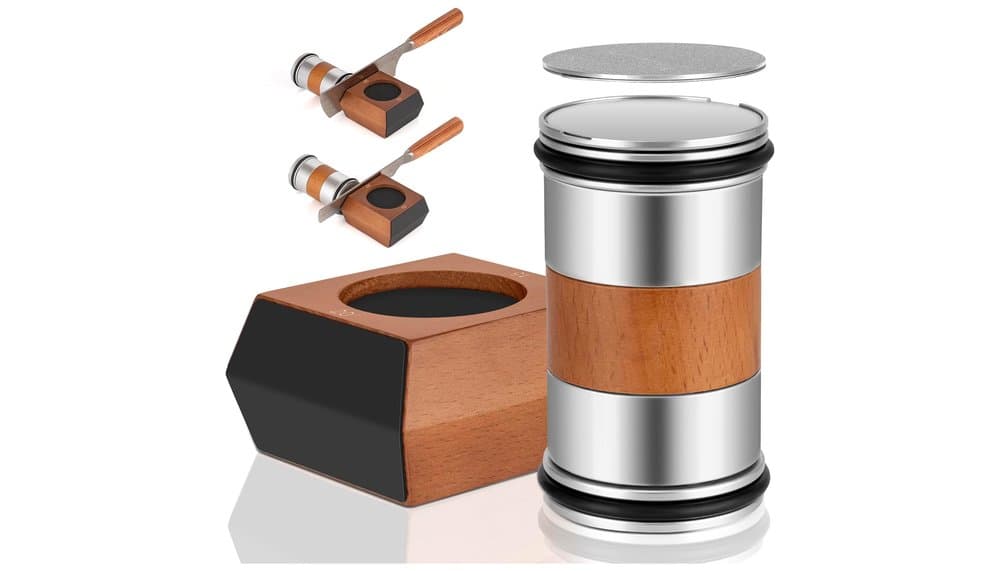
A magnetic guide system that eliminates uncertainty. The centerpiece is its magnetic base which holds the blade at a fixed angle. On paper, this removes the main challenge of freehand stone sharpening: maintaining a constant angle. Users confirm this makes the process immediately accessible, even for a complete novice. The presence of two preset angles (15° and 20°) is a real plus, allowing for rough adaptation to needs: a finer angle (15°) for precise cuts and a more robust angle (20°) for general Western kitchen use.
Proven effectiveness for routine maintenance. The double-sided diamond discs (#400 for reprofiling, #1000 for refining) are described as effective at restoring a functional edge to knives dulled by domestic use. Many reviews, like that of a British user, testify to "phenomenal" results on heavily worn knives with a quick procedure. This is its main selling point: a tangible result in a few minutes, without any particular technique.
A design focused on safety (in appearance) and ergonomics. The "rolling" design keeps fingers away from the abrasive part during the motion. Its size, described as large, is appreciated by people with wide hands. The stainless steel finish (though unspecified, likely folded or chromed steel) contributes to an initial impression of solidity and facilitates cleaning.
Weak Points: Technical Limits and Questionable Durability
However, a thorough analysis and more critical feedback reveal structural weaknesses that place it behind professional sharpening tools or those dedicated to enthusiasts.
A perfectible angle precision and a problematic edge wear. The magnetic system, while practical, does not offer the rigidity and absolute precision of a mechanical guide. An independent tester points out that this can lead to a less optimal edge and uneven wear on the blade over the very long term. Worse, for some users, the system "does not go far enough into the edge," leaving a micro-burr unsharpened. This is a critical flaw for a tool meant to guarantee a uniform result.
Questionable abrasive durability. This is the most frequent black mark in negative or mixed reviews. A French user notes that "you have to change the discs after 5 knives," judging them "very thin." If this experience is extreme, it points to a potentially limited abrasive quality, incompatible with a "buy-it-for-life" philosophy. The availability and cost of replacement discs are unclear, adding uncertainty about the total cost of ownership.
Restricted versatility and safety risks. The tool struggles with highly curved blades (like santoku or cimeterre) and thick heels, limiting its use to standard Western chef's knives. More worryingly, several web experts point out a safety risk: the hand manipulating the roller passes very close to the blade's edge during the operation, a wrong move potentially causing a cut. This point is rarely raised in general public reviews but is crucial for a tool used regularly.
A construction that sometimes hides flaws. Behind the stainless appearance, some feedback reports assembly defects, like a "coating on the magnets arriving peeled off." This raises questions about quality control and the real longevity of internal components, notably the long-term magnetic strength.
Detailed Analysis: Who is this sharpener for, and what can it really do?
Materials and Construction: Solid on the surface, questions in depth
The Pietuley is presented as being made of stainless steel. This is likely a structure of chromed steel for the body and roller, offering good corrosion resistance and ease of cleaning. However, we lack information on the specific steel quality (grade 304, 430?), on the treatment of moving parts (bearings), and on the exact composition of the magnets. The weight of 600g indicates a certain heft, aiding stability. Nevertheless, feedback on the fragile finish of the magnets and the presumed thinness of the abrasive discs casts a shadow on the robustness over time. This is not a tool forged or machined with the same intent as a high-carbon steel knife; it is a mechanical accessory whose durability depends on the quality of its consumable parts (discs) and its assembly.
See priceSharpening Performance: Between effective and approximate
Performance is this product's great paradox. On one hand, a majority of users obtain a radically improved edge compared to their knives' previous state. Moving from the #400 to the #1000 grit effectively reforms a burr and refines it. On the other hand, purists and some demanding users point out fundamental limits.
- Control: No control over pressure or fine movement. The roller standardizes everything, for better (simplicity) and for worse (lack of finesse).
- Edge: The produced edge is often a micro-serrated "saw" edge due to the diamonds, very aggressive short-term, but which may dull differently and be less durable than an edge polished with a fine-grit waterstone.
- Adaptability: It is totally unsuited for hard steels (Rockwell 60+ like on many Japanese knives) which require meticulous sharpening on a stone. It risks damaging them through overly brutal and poorly controlled material removal.
Ergonomics and Handling: A generally positive point
On this point, feedback converges. The grip of the roller is intuitive and comfortable, even during prolonged sharpening sessions of several knives. The magnetic base, heavy and stable, prevents the blade from moving. This is undeniably one of its most marked strong points. Angle selection is simple and visual.
Comparison with "Buy-It-For-Life" Standards
Compared to our references, the Pietuley pales:
- Versus a Japanese waterstone (Shapton, Naniwa): No comparison possible in terms of result finesse, control, versatility, and durability (a hard stone lasts decades). The stone requires learning, the Pietuley gives an instant but limited result.
- Versus a rigid guided system (Edge Pro, TSProf): These systems offer surgical angle precision, adaptability to all blades, and an unlimited choice of grits. They are the tool for the enthusiast or professional. The Pietuley is a simplified, much less precise consumer version.
- Versus its direct competitors (Horl 2, Tumbler Rolling Sharpener): Based on cross-analyses, the Pietuley is often seen as an economical alternative to models like the Horl 2. The latter is frequently described as having more noble materials (aluminum, wood), a smoother mechanism, and higher quality consumables. The Pietuley sacrifices some finish and durability for price.
Technical Specifications
| Characteristic | Pietuley Rolling Knife Sharpener Details |
|---|---|
| Main Material | Stainless steel (unspecified) |
| Weight | 600 grams |
| Abrasives | Removable double-sided diamond discs |
| Available Grits | #400 (coarse) / #1000 (fine) |
| Sharpening Angles | 15° and 20° |
| Principle | Manual roller on magnetic base |
| Maintenance | Dry cleaning (cloth) |
| Blade Versatility | Limited to straight or slightly curved blades |
What Users Say: A Popular Success Tainted by Concrete Disappointments
The synthesis of over 600 reviews and web expert analyses paints a clear picture.
The praise (majority) focuses on ease of use ("fun to use," "bluffing result," "anyone can sharpen like a pro"), immediate effectiveness ("super effective," "restores the edge to my blades"), and well-thought-out concept ("constant angle," "safety"). For the average user wanting to restore bite to their standard kitchen knives, it is a very satisfactory solution.
The criticisms (recurring and significant) concern consumable durability ("discs very thin," "need changing after little use"), sometimes failing precision ("doesn't sharpen the whole edge," "result not reliable"), and manufacturing defects (poor quality magnets). Frustration arises when the tool does not keep its technical promises over time or on somewhat particular blades.
Conclusion: A Practical Tool, But Not a Companion for Life
The Pietuley Rolling Knife Sharpener is not a "buy-it-for-life" tool. It is a practical and effective accessory for a specific need: the regular and quick maintenance of standard Western kitchen knives, by home cooks who do not wish to invest time in learning traditional sharpening.
For the serious cook owning quality knives (Japanese high-carbon steel knives, high-end Western chef's knives), it can only be a stopgap. Its lack of absolute precision and its aggressive abrasive are incompatible with the meticulous maintenance these blades deserve. Its intrinsic durability, notably that of its discs, raises questions in the long term.
In summary, the Pietuley finds its place in a kitchen as a convenience solution, not as an expertise tool. It does very well what it promises: to radically simplify sharpening for the average person. But it will never cross the threshold of a kitchen where knives are considered precision instruments, requiring the control, finesse, and almost artisanal relationship offered by a good waterstone and practice.