Plys Kiritsuke Knife Review: A Sharp Hybrid Performer
Comprehensive Analysis of the Plys Kiritsuke Chef Knife: A Damascus Hybrid for the Discerning Cook
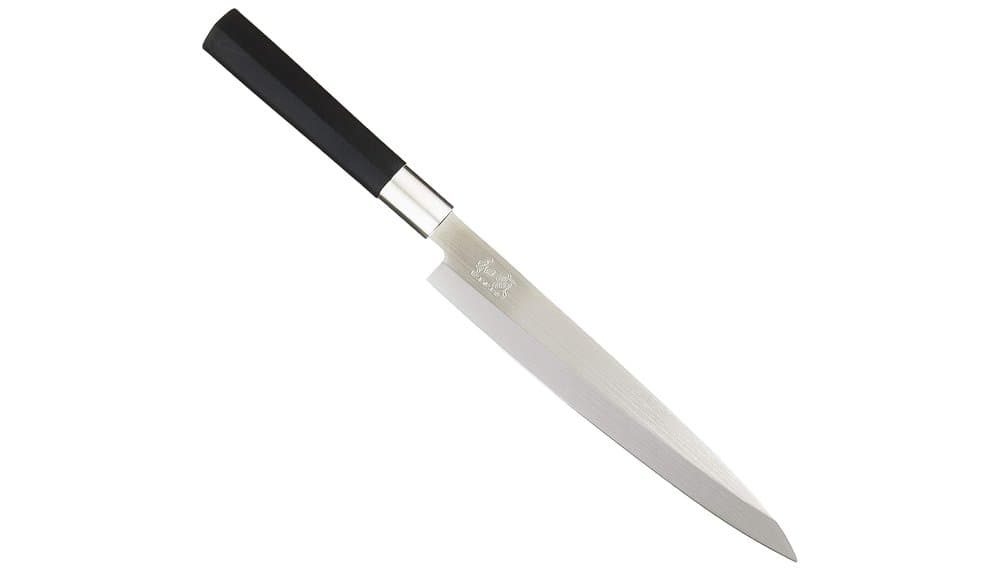
The Kiritsuke knife holds a special place in the culinary imagination. Perceived as the weapon of choice for the executive chef in Japan, it combines the finesse of a vegetable knife (Usuba) and the length of a sashimi knife (Yanagiba). It is not a tool for beginners, but an instrument of precision. The Plys Kiritsuke Chef Knife attempts to democratize this iconic object by offering a Damascus steel version at an accessible price. Our analysis looks at its technical reality and long-term performance, to determine if it deserves its place in a "buy-it-for-life" kitchen.
Strengths
- Versatility of the hybrid design: The 20 cm blade with a K-tip (flat tip) allows for seamless transitions between precise protein slicing and rapid vegetable chopping.
- Exceptional out-of-the-box sharpness: Feedback consistently points to a "scalpel-like cut" right out of the box, thanks to a fine sharpening at 13° per side.
- VG-10 steel construction: The blade core uses this renowned Japanese stainless steel, offering a good balance of edge retention, corrosion resistance, and relative ease of sharpening.
- Ergonomic G10 handle: The G10 composite material, known for its durability and excellent grip even when wet, forms an octagonal handle that naturally guides finger placement.
- Perceived value for money: The majority of user reviews consider it a product offering premium specifications for a contained investment.
Weaknesses
- Tip fragility: The K-tip, very sharp and thin, is inherently more fragile. It is unanimously advised against for any inappropriate manipulation (e.g., prying foods with the tip).
- Required cutting technique: The very straight blade profile (flat profile) requires a push-pull technique rather than a typical Western chef's knife "rocker" motion. This can represent a learning curve.
- Questions about the Damascus finish: An isolated but critical review raises the possibility that the Damascus pattern is laser-etched rather than the result of authentic multi-layer forging. This does not affect blade performance, but questions the "artisanal" aesthetic value.
- Limited robustness: With an announced hardness of 60 HRC, the blade is hard and sharp, but also more brittle. It is totally unsuitable for cutting bones, frozen foods, or any butchering work.
Detailed Component Analysis
The Blade: Specifications and Real-World Performance
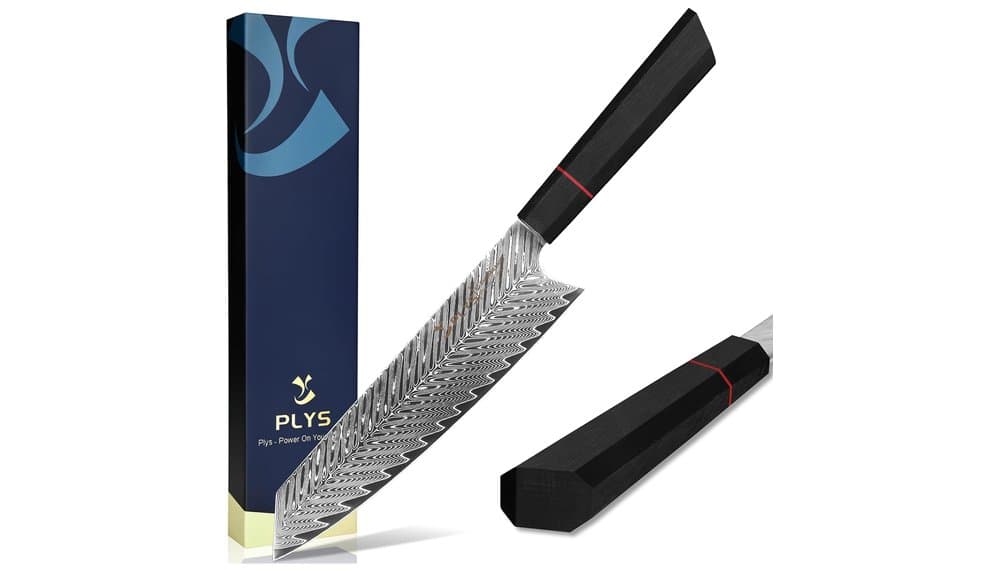
At the heart of the buy-it-for-life analysis is the blade. The Plys Kiritsuke announces a construction of 67-layer Damascus steel enveloping a VG-10 core. On paper, this is a serious configuration.
VG-10 is a Japanese stainless steel containing cobalt, renowned for its fine grain. A hardness of 60 HRC (Rockwell C) is announced. This is a solid and typical value for this type of steel. It promises very good edge retention, confirmed by users reporting several months of daily use without sharpening. However, this hardness comes at a price: the steel is less forgiving. The micro-teeth (the "edge") are more likely to chip if the blade encounters an avocado pit, a bone, or an inappropriate work surface (glass, ceramic, granite). Sharpening it, although simpler than on ultra-hard steels like ZDP-189 (67 HRC), will require quality stones (ideally diamond or ceramic) and a certain technique.
The Damascus (the visual patterns) is presented as the result of 67-layer forging. Its main function is to prevent food from sticking to the blade. The question raised by one user about potential laser etching is difficult to resolve without physical examination. Nevertheless, the knife enthusiast community notes that in this price segment, it is common for the pattern to be more aesthetic than structural. This does not affect the cutting performance at all, which depends solely on the VG-10 core and the edge geometry.
The geometry is the major asset. The "saber" grind (grind) at 13° per side (giving a total angle of 26°) is extremely fine. This is what provides that "gliding" and effortless cutting sensation in soft products (tomatoes, peppers, fish fillets). This makes it a specialized knife for precision work on fresh ingredients.
See priceThe Handle and Ergonomics: Long-Term Comfort
The handle is a point where this knife seems to excel according to feedback. G10 is a reference material in the world of high-end knives and professional tools. It is a composite resin reinforced with fiberglass, waterproof, inert, and extremely resistant to wear and impact. It will not warp, dry out, and will withstand all cleaning products.
Its octagonal shape is a Japanese classic. It allows for intuitive and secure finger placement, offering several comfortable grips, especially for precision techniques. Several testers emphasize that the handle remains comfortable and safe, even with wet or greasy hands. The overall balance of the knife, although dependent on individual perception, is described as good, with a weight slightly favoring the blade, which promotes cutting by the tool's own weight.
Long-Term Durability and Maintenance
This is where the "buy-it-for-life" status is determined. The "full-tang" construction (the blade runs through the entire handle) is not explicitly mentioned but seems likely given the weight and photos. This is a guarantee of structural solidity.
Maintenance is non-negotiable:
- No dishwasher: The chemical and physical aggression of the dishwasher is the fastest way to ruin the edge, oxidize the Damascus layers (even on stainless steel), and eventually deteriorate the junction between the handle and the blade. Hand washing and immediate drying are imperative.
- Regular sharpening: No knife, even in very hard steel, stays sharp forever. VG-10 at 60 HRC revives well on a ceramic sharpening steel for routine maintenance. But it will require regular passes on sharpening stones (e.g., 1000/3000 grit) to reform the edge. The fineness of the edge (13°) demands a certain regularity in this maintenance.
- Appropriate cutting board: A cutting board made of soft wood (like acacia) or polyethylene is mandatory to preserve the fine tip and delicate edge.
With this appropriate care, the materials (VG-10, G10) have the potential to last a lifetime. The potential fragility of the tip remains the main point of vigilance against accidental breakage.
Technical Specifications
| Component | Detail |
|---|---|
| Blade Type | Kiritsuke (Bunka/K-tip hybrid) |
| Blade Length | 20 cm (20.2 cm precisely) |
| Core Steel | Japanese VG-10 |
| Hardness (HRC) | ~60 HRC (announced) |
| Construction | Forged blade, 67-layer Damascus |
| Sharpening Angle | ~13° per side (26° total) |
| Handle Material | G10 (fiberglass/resin composite) |
| Handle Shape | Octagonal |
| Total Weight | ~199 grams |
| Maintenance | Hand wash imperative, immediate drying |
| Finish | Damascus pattern, black finish (Kurouchi?) |
What Users and Experts Say
The synthesis of 34 customer reviews (average rating 4.4/5) and expert context gives us a nuanced and realistic picture.
Praise is recurrent on several points:
- The exceptional initial sharpness is the most cited argument. Terms like "razor," "scalpel," "cuts perfectly" come up constantly.
- The comfort of the G10 handle is also highly appreciated, described as offering a "secure grip" and being "very comfortable."
- Its value for money is praised, with several users comparing it favorably to more expensive brands.
- Edge retention is judged to be very good in the medium term with basic maintenance (ceramic steel).
Criticisms and warnings come mainly from the expert context and informed reviews:
- Experts remind that the Kiritsuke profile requires a technical adaptation. It is not an "all-purpose, quick-and-dirty" knife like a Western chef's knife.
- The fragility of the K-tip and the thin blade is systematically mentioned as the main limitation. It is categorized as a knife for precision work on fresh products.
- The question of the authenticity of the Damascus forging is raised by one user, pointing to a risk of a purely aesthetic pattern. The majority of reviews only mention the visual aspect, "very beautiful."
- Its use is very specialized: it excels on vegetables, herbs, fish, and boned meats, but will fail at tasks requiring force.
Conclusion: Who is this knife for?
The Plys Kiritsuke Chef Knife is not a universal knife, but it is a serious tool that offers a captivating entry point into the world of precision Japanese knives.
It is perfectly suited for the passionate home cook who:
- Seeks exceptional sharpness and high-performance blade geometry for a controlled budget.
- Is ready to adopt a more linear cutting technique and take care of their tool (hand wash, appropriate board, sharpening).
- Seeks a knife specialized for precise slicing of vegetables, fish fillets, or fine cuts of meat.
- Appreciates the aesthetics of Damascus and the comfort of a G10 handle.
It is not suitable for someone who:
- Wants a single all-purpose, robust, and intuitive knife (a Western chef's knife in X50CrMoV15 will be more suitable).
- Has brutal habits (dishwasher, glass board, thawing with a knife).
- Seeks a tool for butchering or cutting through small bones.
From a buy-it-for-life perspective, the core materials (VG-10 core, G10 handle) have decade-long durability potential, on the absolute condition of rigorous and appropriate maintenance. Its possible weakness is not in wear, but in resistance to shocks and misuse. It is an excellent second knife, a precision specialist, that can last a lifetime in the hands of a careful user aware of its limits. It is a convincing offer that brings high-end specifications within reach, in return demanding the respect due to a precision instrument.