Rockingham Forge Essentials 20cm Chef's Knife Review
Introduction
In the very crowded market of affordable chef's knives, the Rockingham Forge Essentials 20cm Chef's Knife has established itself as a recurring choice, often cited for its value for money. On our site dedicated to durable and high-performance culinary tools, we are interested in what constitutes a product's true long-term value. Is this knife a genuine "buy-it-for-life" tool for the serious cook, or an entry-level piece of equipment with a limited lifespan? By cross-referencing the manufacturer's technical specifications, user community feedback, and expert analyses available online, we will separate fact from fiction about this blade designed in Sheffield.
Key Strengths
Based on the synthesis of reviews and tests, three main strengths emerge for this Rockingham Forge knife.
An Impressive Factory Edge: Almost all feedback, whether from individuals or technical observers, agrees on one point: the knife arrives extremely sharp. This quality original sharpening allows for easy and precise cutting right from the first use, a significant advantage that immediately wins over the user.
Appreciated Ergonomics and Lightness: Users consistently highlight the comfortable grip of the handle. Its ergonomic design, coupled with a light weight (130g), significantly reduces wrist and hand fatigue during prolonged prep sessions. This balance makes the knife very maneuverable, especially for fine cutting and chopping tasks.
Versatility and Ease of Maintenance Suited for Daily Use: Designed as a daily work tool, it excels at a wide range of tasks: cutting vegetables, boning, slicing meats. Furthermore, its dishwasher-safe status (though not recommended for longevity) and its advertised corrosion resistance make it a practical product for active households seeking a balance between performance and minimal maintenance constraints.
Weaknesses
The identified weaknesses are closely linked to construction and material choices, often dictated by the product's price positioning.
Medium-Quality Steel and a Problematic Blade Thinness: This is the most frequent critical point. Experienced testers and users note that the blade is very thin. While this contributes to lightness and easy penetration, it can harm rigidity and robustness over time, especially when dealing with frozen products or accidental bones. The quality of the steel, not specified as a high-performance tool steel (like VG-10, AUS-10), is considered standard, which directly impacts edge retention.
Long-Term Durability Questioned: Several reviews report a limited lifespan, with mentions like "lasts 3 to 4 years." This contrasts with the "buy-it-for-life" ideal. The construction is not forged but stamped, meaning the blade is cut from a sheet of steel, generally associated with lower strength and a different balance compared to a forged knife. The tang is not fully described as "full tang," raising doubts about the long-term solidity of the handle attachment.
At-Home Sharpening Made More Delicate: Some advanced users point out the difficulty in properly re-sharpening this knife, particularly due to the low cutting angle and the thinness of the blade. To maintain its performance, more precise techniques may be required.
Detailed Analysis For The Demanding Cook
Materials and Construction: The Gap with "Pro-Grade"
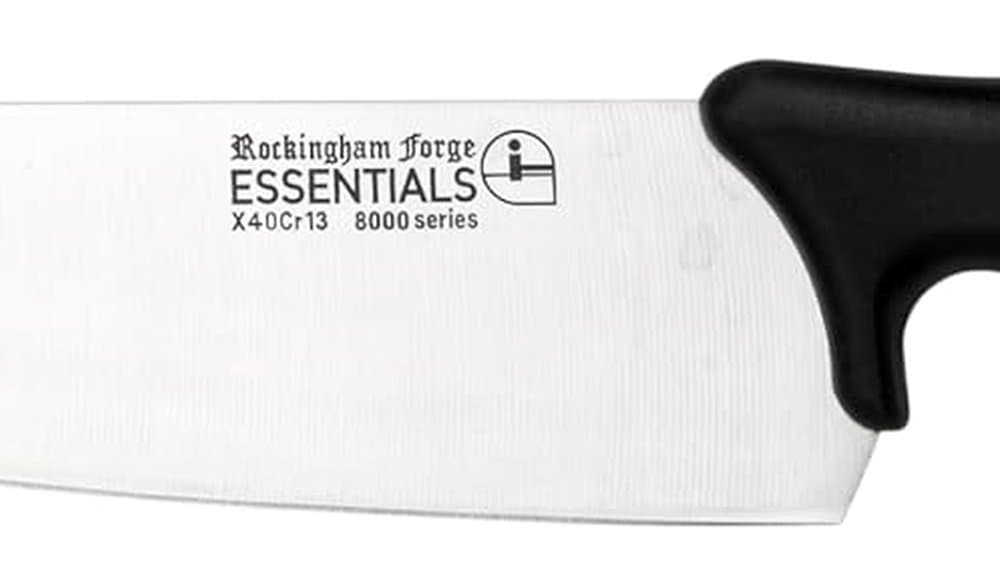
What interests us here is the substance behind the marketing. The Rockingham Forge Essentials 20cm Chef's Knife uses a non-specified quality stainless steel (likely an X50CrMoV15 or equivalent), a standard choice in the affordable segment. Its Rockwell hardness (HRC) is not communicated by the manufacturer, but experts estimate it around 55-57 HRC. This hardness level represents a compromise: it allows for relatively easy sharpening with standard tools, but at the expense of edge retention. Compared to Japanese steels (White Steel #2 at ~62 HRC) or high-end stainless steels (VG-10 at 60-62 HRC), this steel will lose its edge faster and require more frequent passes on a sharpener or stone.
The stamped construction is another key indicator. Unlike a forged knife where the steel is worked to create a robust spine and better balance, stamping produces a thinner, lighter blade. It is an economical choice that offers good immediate maneuverability but may lack heft (the blade's rigidity) for heavy work. For general domestic use, it is often sufficient. For intensive or professional use, the limit is quickly reached.
See priceErgonomics and Grip: The Undeniable Strength
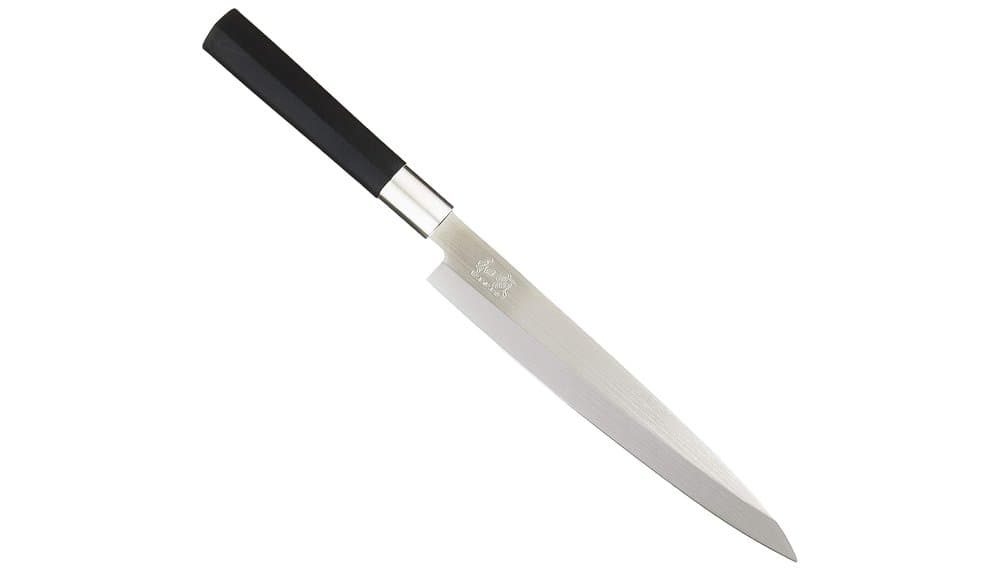
On this point, feedback is unanimous. The handle made of POM (polyoxymethylene), a technical plastic, is ergonomically well designed. Its shape fits the palm and fingers, offering secure control. Its featherweight (130g for 20cm) is a major asset for cooks who prioritize speed and precision on vegetables, or for those who suffer from wrist fatigue. However, purists of heavy knives (like some carbon steel or forged Western models) might find this lightness synonymous with a lack of "bite" and authority in the cut, especially on hard products.
Durability and "Buy-It-For-Life" Potential
This is the heart of the debate. Can the Rockingham Forge Essentials claim the status of a lifelong tool? The answer, based on materials and feedback, is nuanced. No, as a finished product and under intensive use. Its stamped construction, moderate hardness steel, and blade thinness destine it for a limited lifespan under a heavy workload. A professional would wear it out quickly.
However, for the serious amateur cook who takes care of it, it can represent an excellent companion for many years. The key lies in maintenance: hand washing is imperative to preserve the edge and the integrity of the handle long-term, despite the "dishwasher safe" indication. Regular sharpening on a water stone or with a steel will compensate for the average edge retention. Under these conditions, it far surpasses the majority of low-end supermarket knives.
Comparison with Professional Standards
Compared to a true forged chef's knife in carbon steel (which requires maintenance against rust) or in high-carbon Japanese steel (demanding in sharpening), the Rockingham Forge falls into a different philosophy: accessibility and simplicity. It does not compete with these tools in terms of ultimate performance, edge retention, or cutting feel. On the other hand, it offers about 80% of the performance for a fraction of the price and zero specific maintenance (aside from sharpening). It's a "ready-to-use" knife that works perfectly as a first serious knife or as a versatile, worry-free secondary work blade.
Technical Specifications
| Characteristic | Detail |
|---|---|
| Model | Rockingham Forge Essentials 20cm Chef's Knife |
| Blade Length | 20 cm |
| Blade Material | Stainless steel (standard quality, estimated X50CrMoV15 type) |
| Hardness (HRC) | Not specified by manufacturer (estimated ~55-57 HRC) |
| Construction | Stamped blade |
| Handle Material | Black POM (Polyoxymethylene) |
| Tang Type | Partial tang (probable) |
| Weight | 130 grams |
| Balance | Light, centered towards the handle |
| Care | Dishwasher safe (not recommended for longevity) |
| Warranty | Legal conformity guarantee (2 years) |
What Users Say: A Synthesis of Reviews
Analyzing hundreds of customer reviews and online discussions paints a very clear consensus.
The praise revolves around three axes: the remarkable sharpness upon receipt, the comfort of use due to the ergonomic handle and light weight, and the excellent value for money. Many describe it as far superior to what they expected for its price, easy to maneuver for vegetables, and a perfect "all-purpose" knife for family cooking. The "designed in Sheffield" mention is often perceived as a mark of craftsmanship.
The recurring criticisms are just as instructive. The excessive thinness of the blade is the main complaint from the most demanding users, sometimes judging it too flexible and potentially fragile. The steel quality is considered decent but nothing more, with edge retention that declines fairly quickly, requiring regular maintenance. A few isolated mentions report a durability limited to a few years of regular use, sometimes with handle loosening or difficulty in properly re-sharpening the blade after several wear cycles. Finally, despite the "dishwasher safe" mention, part of the community strongly advises hand washing to preserve the product.
Conclusion
The Rockingham Forge Essentials 20cm Chef's Knife is a product that knows exactly what role it plays. It is not a "buy-it-for-life" knife in the noble sense of the term, forged from premium steels and destined to last decades. It is, however, an excellent candidate for a "buy-it-for-many-years" with appropriate care.
For the serious cook looking for an ultimate professional tool, it will be a bit light, both literally and figuratively. Its materials and stamped construction limit its potential. On the other hand, for the enthusiast looking for a high-performance introductory blade, for the household wanting to replace their low-end knives with an effective and pleasant object, or even as a secondary service knife in an already well-equipped set, its argument is unbeatable. It offers a cutting experience far superior to its price, successful ergonomics, and definite versatility, all without demanding maintenance requirements (aside from sharpening). It is a successful bridge between the world of disposable utensils and that of durable culinary tools.