SHAN ZU Nakiri Knife Review & Performance Test
Introduction
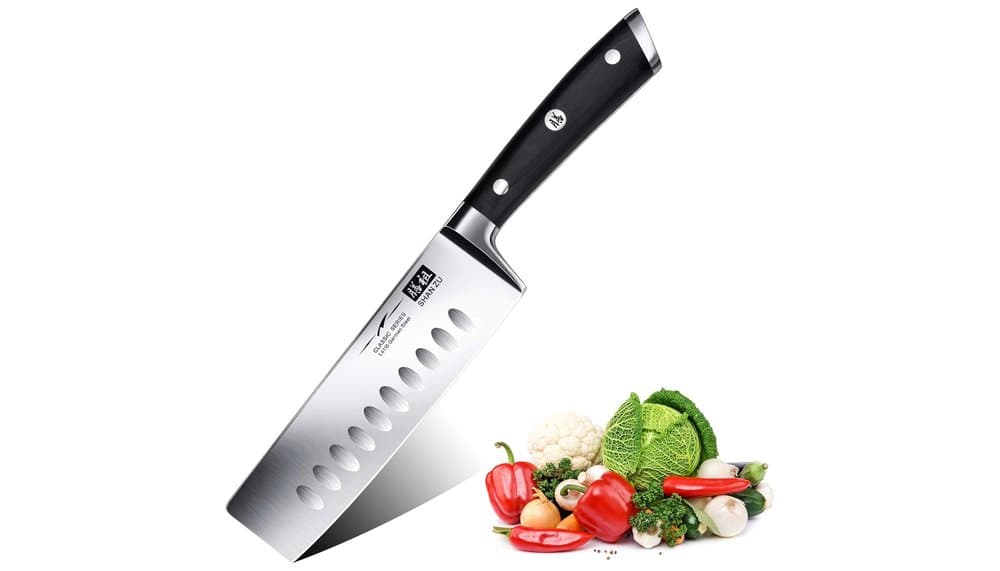
In the world of kitchen knives, the Japanese Nakiri holds a unique place. Specifically designed for chopping vegetables, with its straight profile and squared-off tip, it is the preferred tool for any serious cook focused on precision. Today, we examine the SHAN ZU Nakiri Japanese Vegetable Knife, a product presented as a bridge between accessibility and performance. On paper, it promises to apply the principles of Japanese cutlery with robust German steel. But from a "buy-it-for-life" perspective, how does it really position itself? This analysis cross-references technical specifications, community feedback, and expert opinions to determine whether this Nakiri deserves a place in the kitchen of a demanding enthusiast.
Strengths
- Remarkable factory sharpness with a double-bevel edge sharpened to 15°, allowing for clean, precise cuts right out of the box.
- Widely praised comfort and ergonomics: Pakkawood handle with triple rivets, a 50mm blade width protecting the knuckles, and a weight of 260g considered well-balanced for prolonged work without fatigue.
- Ease of maintenance thanks to the use of German 1.4116 stainless steel, highly resistant to corrosion, making it a worry-free choice for beginners or those apprehensive about maintaining carbon steels.
- Perceived excellent value for money for a first Nakiri-type experience, rivaling more expensive brands on everyday tasks.
Weaknesses
- Moderate hardness (HRC) of 55-57, which translates to limited edge retention compared to harder Japanese steels (VG-10, Aogami). More frequent sharpening is necessary.
- Obvious mechanical limits: the blade is not designed for heavy-duty tasks, cutting bones, joints, or overly hard root vegetables. Some fragility is reported.
- Sometimes uneven finish: some user feedback points to minor machining defects on the handle or edge, typical of large-scale production.
- Performance ceiling: it's an excellent entry-level knife, but it will not rival the finesse, edge retention, and feeling of quality of a hand-forged Nakiri in high-end steel.
Detailed Analysis
The Blade: Compromise Between Performance and Easy Maintenance
The heart of the analysis lies in its materials. The SHAN ZU Nakiri uses German 1.4116 stainless steel, a strategic choice. This steel is known for its excellent corrosion resistance and relative ease of sharpening. It's a major argument for home cooks who don't want to worry about the immediate drying required by carbon steels. On paper, the specs announce a Rockwell hardness (HRC) of 55-57. This figure is revealing.
This hardness is on the low end of the scale for a so-called "Japanese" knife. It offers a good balance between shock resistance (the blade is less brittle) and the ability to take an edge. However, the direct trade-off, emphasized by expert testers, is average edge retention. In short, the knife will be very sharp initially but will require regular honing with a steel or sharpening stone to maintain its edge. It is not a "set-and-forget" knife. Its cutting angle of 15° per side is quite fine and promising for clean cuts through vegetables without crushing cells.
See priceErgonomics and Handling: The Confirmed Success
This is a point where feedback overwhelmingly converges. The Nakiri design is well executed here. The Pakkawood handle (a composite of wood and durable resin) with its traditional rivets offers a secure and comfortable grip. The weight of 260 grams and the reported balance give an impression of lightness and maneuverability, ideal for the back-and-forth motion characteristic of the "push-cut." The generous 50mm width is a practical feature that, as intended, prevents knuckles from hitting the cutting board, even for wide hands. Based on user feedback, this greatly contributes to reducing fatigue during prolonged cutting sessions.
Construction and Long-Term Durability
The knife is advertised as "forged." The forging process, if well done, densifies the steel structure and can improve durability. The full-tang construction (where the blade extends into the handle) is generally a sign of strength and balance. The triple riveting reinforces this solidity. From a "buy-it-for-life" perspective, the construction seems robust for regular domestic use. However, the limitation comes from the steel and its heat treatment. The HRC of 55-57 means the edge will round faster than on a knife at 61-63 HRC. Thus, the "life" of the knife will depend on the owner's willingness to learn and practice regular sharpening. It is not a tool that will remain performant for years without active maintenance.
Target Audience: Who Is This Nakiri For?
This SHAN ZU Nakiri finds its ideal audience among serious home cooks or motivated beginners who wish to discover the advantages of a vegetable-dedicated knife without committing a large budget. It is perfectly suited for those who prioritize ease of maintenance (stainless steel) and immediate comfort. It is also an excellent secondary knife to complement a kitchen already equipped with a good chef's knife, offering a pleasant specialization.
On the other hand, professionals in intensive service or purists of Japanese cutlery seeking ultimate edge retention, extreme blade finesse, or the cutting nuances of carbon steels (like Blue Steel or White Steel) will find its limits here. As the expert context emphasizes, it is an effective entry-level product, which excels on soft vegetables but reveals its weaknesses when faced with tougher tasks or over time without sharpening.
Technical Specifications
| Feature | Detail |
|---|---|
| Model | SHAN ZU Nakiri Japanese Vegetable Knife |
| Blade Type | Nakiri (straight blade, square tip) |
| Blade Length | 16.5 cm (6.5 inches) |
| Blade Material | German 1.4116 stainless steel |
| Hardness (HRC) | 55-57 Rockwell |
| Sharpening Angle | Double bevel 15° ± 1° |
| Construction | Forged / Full tang |
| Handle Material | Pakkawood (composite wood) |
| Handle Fixation | Traditional triple rivet |
| Blade Width | 50 mm |
| Total Weight | 260 grams |
| Maintenance | Hand wash only. Immediate drying recommended. |
What Users and Experts Say
A synthesis of 4,841 global reviews (rated 4.7/5) and external technical analyses reveals clear trends.
Recurring praise focuses on ergonomics ("comfortable handle," "no fatigue"), initial sharpness ("cuts like a razor," "perfect for onions and herbs"), and perceived quality for the price ("a lot of knife for the money," "excellent alternative to more expensive brands"). Many users are surprised by its performance from the first use.
Criticisms and warnings are equally instructive. Several note that the sharpness diminishes after a few months of regular use, confirming the need for maintenance. A few mention finishing defects (slight play in the handle, uneven polish). The expert context is unequivocal: this is not a tool for heavy-duty tasks. Bones, frozen products, and overly hard squashes should be avoided to prevent chipping the blade. Experts recommend using it on soft wood or suitable plastic cutting boards and sharpening it regularly on a water stone to preserve its qualities.
Conclusion
The SHAN ZU Nakiri Japanese Vegetable Knife is an honest and well-executed proposition within its segment. It fully succeeds in offering an accessible Japanese cutting experience, combining an authentic blade profile with the robustness and easy maintenance of a common German steel. Its ergonomics are its master asset, making it a pleasant and effective everyday tool for vegetable preparation.
However, the technical analysis from a "buy-it-for-life" angle tempers this enthusiasm. Its limited hardness (HRC 55-57) and 1.4116 steel make it a companion that will require a commitment to sharpening to remain performant in the very long term. It is not an heirloom that will last decades without care, but rather an excellent learning and daily work tool.
In summary, if you are a home cook looking for an effective, comfortable, and low-maintenance Nakiri, the SHAN ZU represents a very wise and likely satisfying choice. If you seek an ultimate investment, a blade that defies time with near-permanent sharpness and the finesse of Japanese sword steels, it will point you toward higher ranges. This Nakiri is not the final destination, but it is undoubtedly a very good starting point.