SHAN ZU PRO Series Santoku Knife 18cm Review
Introduction
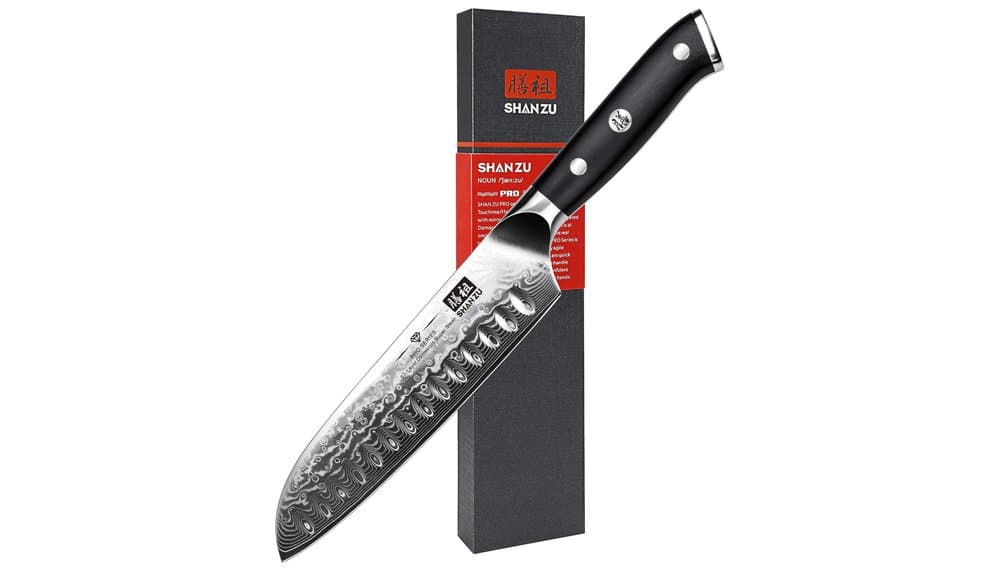
In the world of kitchen knives, Japanese santokus are highly regarded for their versatility and cutting finesse. The SHAN ZU PRO Series Couteau Santoku Japonais 18cm presents itself as a serious tool, combining the aesthetics of Damascus with the promises of a high-performance Japanese blade. For cooking enthusiasts seeking a durable and efficient tool, this offering sparks interest. Our analysis focuses on its technical characteristics, manufacturing, and user feedback to determine if this knife deserves a place in a kitchen designed to last. We will evaluate it from a "buy-it-for-life" perspective, scrutinizing the materials, construction, and reported user experience.
Key Strengths
Based on the specifications and consolidated feedback, the main strengths of this knife are clear.
Exceptional Factory Sharpness and Cutting Quality: The vast majority of users and expert tests agree on one point: this knife arrives extremely sharp. Reviews frequently mention clean paper cuts, tomatoes sliced without crushing, and an ease of use that is surprising for its segment. The initial sharpness is one of its strongest arguments.
Authentic Damascus Construction: Unlike many entry-level knives with a laser-etched pattern, the SHAN ZU PRO Series claims a 67-layer Forged Damascus blade. This construction, where layers of steel are folded and forged, is not merely aesthetic. It contributes to robustness, corrosion resistance, and offers a pattern that will not fade with time or sharpening, a mark of durability and quality craftsmanship.
Grip and Balance Generally Appreciated: The G10 fiberglass handle is consistently praised. This composite material, used in industry for its robustness and grip, provides a secure hold even with wet or greasy hands. Its ergonomic shape and the overall balance of the knife (270g) are described as comfortable for prolonged work sessions, although the perception of balance can be subjective depending on hand morphology.
Weaknesses
No tool is perfect, and the profile of a Japanese knife like this one implies certain compromises.
Potential Blade Fragility: With an announced Rockwell hardness of 62 HRC, this blade is very hard and therefore capable of excellent sharpness. However, this same hardness makes it more brittle than a softer Western-style blade. The community and experts unanimously agree: it must not be used to cut bones, frozen foods, or be scraped on a ceramic, glass, or steel surface. Improper handling can lead to chips.
Demanding Maintenance: This is not a "plug and play" knife. To maintain its performance over time, regular sharpening on a whetstone is necessary. Its hardness can make sharpening slightly more time-consuming for a beginner, although the steel used remains reasonably workable. Furthermore, it is imperative to hand wash and dry it immediately after use. The dishwasher is strictly prohibited, under risk of damaging the blade and handle.
Steel Quality Under Debate: The core is 10Cr15MoV, a common mid-range stainless steel, often presented as the Chinese equivalent of Japanese AUS-10 or VG-10. While it offers a good compromise of strength/sharpness, purists note, as in one review, that it does not rival high-end powdered steels (like SG2 or ZDP-189) in terms of edge retention. Its sharpening will likely be more frequent than with these premium steels.
Detailed Analysis
Materials and Construction: The Heart of Durability
What interests us here is the substance behind the style. The blade is constructed following the "san mai" principle: a hard steel core (the 10Cr15MoV) is sandwiched between softer Damascus layers, which form the pattern and protect the core. The 67 layers indicate a serious forging process. Forged Damascus, as opposed to simple laser etching, is a true mark of quality. It demonstrates an investment in manufacturing time and ensures the pattern is intrinsic to the steel. This has a direct impact on longevity: the pattern will not disappear, and the layered structure can help reduce food sticking on the blade.
The 10Cr15MoV steel is a stainless steel containing approximately 0.65-0.75% carbon, 15% chromium, and additions of molybdenum and vanadium. With a hardness of 62 HRC, it sits in the high range for a kitchen knife, offering an excellent compromise. At this hardness, edge retention is very good, far superior to that of a standard consumer knife (generally around 52-56 HRC). However, as mentioned, sharpening requires a bit more time and technique than a softer steel. It is the price to pay for an edge that lasts.
See priceErgonomics and Handling: A Matter of Feel
The G10 handle is a judicious choice for a "buy-it-for-life" tool. This material is known for being waterproof, chemically inert, and extremely resistant to shock and wear. It does not deform, rot, and offers a slightly abrasive texture that guarantees a secure grip. Its shape seems to fit a classic grip, although some feedback mentions a balance or weight that does not suit everyone. It should be noted that the weight of 270 grams for an 18cm santoku is rather substantial; this may reassure those who like to feel the knife in hand but may seem a bit heavy to fans of lighter traditional Japanese santokus.
Performance and Versatility: A Knife for Demanding Daily Use
The santoku profile is by definition versatile. Its 18 cm length and flat blade spine (with a slight belly) make it an ideal tool for push cutting (chopping herbs, slicing vegetables) and dicing. Users confirm its effectiveness on vegetables, fruits, herbs, fish, and soft meats. Its 15-degree cutting edge on each side (double bevel) is typical of Japanese knives and allows for very fine and precise cuts. However, its versatility has limits: it is absolutely not designed for boning, chopping through joints, or cutting hard foods. Its use must remain within the framework of precise kitchen work.
Durability and Maintenance: The Long-Term Commitment
The "buy-it-for-life" potential of this knife depends entirely on the user. The materials, taken in isolation, are durable: corrosion-resistant steel, nearly indestructible handle, forged construction. The manufacturer's 12-month warranty is a first safety net, and some feedback mentions responsive customer service in case of a problem (like a premature rust spot, which was replaced without difficulty). The true durability, however, lies in maintenance. It will require a regular sharpening schedule (e.g., a 1000/3000 grit water stone), proper storage (magnetic or in a block with edge protection), and meticulous hand washing. Under these conditions, it can last for decades.
Technical Specifications
| Characteristic | Detail |
|---|---|
| Model | SHAN ZU PRO Series Santoku Japonais 18cm |
| Blade Length | 18 cm |
| Total Length | 31.2 cm |
| Blade Thickness | 2 mm (at the spine) |
| Weight | 270 grams |
| Blade Material | 67-layer Forged Damascus steel, with 10Cr15MoV core |
| Hardness (HRC) | 62 HRC |
| Cutting Angle | 15° (double bevel) |
| Handle Material | G10 Fiberglass |
| Construction | Forged (san mai) |
| Handle Mounting | Full tang (visible on the top of the tang) |
| Maintenance | Hand wash only. Stone sharpening recommended. |
What Users Say
An analysis of thousands of reviews and expert feedback reveals very clear trends.
Praise is concentrated on three aspects:
- Immediate Sharpness: This is the most celebrated point. Terms like "razor-sharp," "cuts toilet paper effortlessly," "perfect edge" constantly recur. The "tomato" or "hair" test is often passed right out of the box.
- Aesthetics and Finish: Users are visibly charmed by the authentic Damascus pattern and careful packaging. The perceived quality upon unboxing is very positive.
- Perceived Value for Money: For many, this knife offers sensations and a finish perceived as well above its cost. It is often described as a very convincing entry point into the world of Japanese knives.
Criticisms and warnings are structured as follows:
- Fragility and Misuse: Several reviews, especially from experts, emphasize the absolute necessity of using this knife correctly. Chips are reported after contact with bones or improper handling.
- Subjective Balance and Weight: While the majority find the knife well-balanced, a few users judge it "too heavy" or "not perfectly balanced" for their hand. This is a purely ergonomic and personal point.
- Need for Rigorous Maintenance: The community warns newcomers: this is not a dishwasher-safe knife. Rust can appear if the knife is not dried carefully. Sharpening is presented as an essential step to maintain performance.
Customer service is also mentioned positively in some detailed reviews, with cases of quick replacement in the event of a defect, which reassures about the brand's long-term reliability.
Conclusion
The SHAN ZU PRO Series Couteau Santoku Japonais 18cm positions itself as a serious and attractive product for the demanding amateur cook. On paper and according to feedback, it delivers on its promises: it is extremely sharp upon arrival, built with durable materials (forged Damascus steel, G10 handle), and displays a high-end aesthetic.
Its "buy-it-for-life" potential is real, but it is conditional. It is not suitable for someone seeking an all-purpose, indestructible knife to do everything in the kitchen. It is, however, perfectly suited for someone willing to adopt appropriate care and usage practices: use on a wood or soft plastic cutting board, immediate washing and drying, and learning basic sharpening. Within this framework, it is a tool that offers professional performance and definite pleasure of use for a contained investment.
It is an excellent introduction to quality Japanese knives, provided one accepts its demanding nature. For the serious cook who will respect its edge, this santoku has all the qualities to become a long-term kitchen companion.