SHAN ZU TAKUMI Serrated Bread Knife Review
Introduction: A Blade Dedicated to Bread, at the Crossroads of Traditions
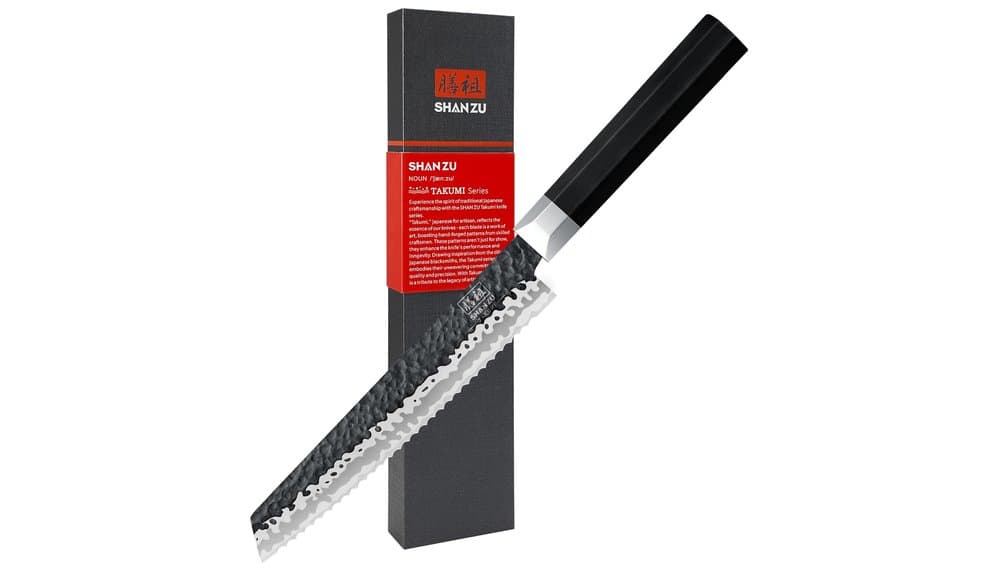
In the highly specialized world of kitchen knives, the bread knife holds a unique place. Its serrated blade, designed to saw without crushing, is an indispensable tool for those who value a clean and aesthetic cut. The SHAN ZU TAKUMI Series Serrated Bread Knife presents itself as a hand-forged piece, integrating reputable materials and proclaimed Japanese craftsmanship. But beyond the marketing, does this product live up to its promises for a buyer seeking a durable, high-performing tool built to last? Here we analyze its specifications, compare user and expert feedback, and evaluate its potential as a "buy-it-for-life" investment for the passionate cook.
Strengths and Weaknesses: A Quick Summary
Strengths
- Exceptional Initial Sharpness: Universally recognized as extremely sharp upon receipt, capable of cleanly slicing through the hardest crusts.
- Marked Comfort of Use: Its balance and ergonomic G10 handle are consistently praised for reducing fatigue.
- Finishes and Aesthetics: The hand forging and "oriental" design offer a pleasing object, often described as a beautiful gift.
- Perceived Value for Money: The community considers it to offer material and performance characteristics superior to its price segment.
Weaknesses
- Durability of the Black Coating: The coating on the blade is reported to be a paint or surface treatment, susceptible to wear over time, unlike a blade colored throughout its mass.
- Long-term Maintenance: Like any serrated knife, resharpening is a complex process requiring specific tools and skills, potentially discouraging.
- Robustness of the Serration: Although not explicitly reported as a defect, the delicate nature of the teeth demands very careful handling and storage to avoid chipping.
Detailed Analysis: Under the Microscope of the Demanding User
The Blade: Heart of the Performance
The crux of the matter for a bread knife lies in its blade. Here, SHAN ZU relies on 9Cr18MoV steel. While this designation is Chinese (the "Cr" corresponding to Chrome), it is directly inspired by Japanese steels like AUS-10 or VG-10. On paper, it is a high carbon (approx. 0.9%) stainless steel with molybdenum-vanadium, promising a good balance between hardness, corrosion resistance, and toughness.
The announced hardness is 60 HRC (Rockwell C). This value is interesting: it is at the high end of the spectrum for a serious domestic use knife. A 60 HRC offers excellent edge retention, which explains the many user reports noting that the knife "was still cutting very well after several months." However, this hardness also makes the steel more brittle and, theoretically, more difficult for a novice to sharpen. Fortunately, the serrated nature of the blade postpones the question of traditional sharpening.
The 7-layer construction (a 9Cr18MoV core sandwiched between 6 layers of softer steel) is a pattern-welded damascus process that is primarily aesthetic. It gives the characteristic wavy patterns and can, to a certain extent, improve flex resistance and reduce food sticking, but its impact on pure cutting performance is minor compared to the quality of the steel core.
The serration itself is the crucial point. According to analyses and expert feedback, it is designed to act like a fine saw, each tooth cutting a small segment of the crust before the next one engages. Users confirm its effectiveness across a wide range of textures, from crispy baguettes to soft brioche, without crushing. The 20 cm length is a standard that offers a good compromise between control (for small breads) and the capacity to slice large loaves.
See priceHandling: Ergonomics and Balance
A tool designed to last must be pleasant and safe to use. On this point, opinions overwhelmingly converge. The G10 handle is a strong point of the product. This composite material made from fiberglass and resin is renowned for its extreme durability, total impermeability, and resistance to chemicals. It will not warp, shrink, and provides a non-slip grip even with greasy or wet hands. Its octagonal shape, inspired by Japanese knives (wa-handle), allows for a natural and precise finger placement, which testers describe as "a comfortable grip," "good control," and "no wrist fatigue."
The overall balance of the knife is also frequently cited as a major asset. Good balance, generally located at the junction between the blade and the handle (the "ricasso"), allows the tool to work almost by itself, reducing muscular effort. Comments like "well balanced," "heavy but not too much," and "pleasant in hand" indicate that SHAN ZU has successfully found a balance point suitable for prolonged use.
Durability and Maintenance: A Purchase for Life?
This is the central question for our site. Can the SHAN ZU TAKUMI be a "buy-it-for-life" item?
- Construction: The blade is forged (not stamped), which densifies the molecular structure of the steel and is generally associated with better long-term durability and stability.
- Materials: 9Cr18MoV steel at 60 HRC and the G10 handle are, on paper, high-end and time-resistant choices. No reports mention breakage, active corrosion, or delamination after several months of regular use.
- The Sensitive Point: Sharpening. This is the Achilles' heel of any serrated bread knife. Sharpening a serrated blade requires specific tools (tapered diamond rods or grooved stones) and a particular technique. Manufacturers often assume the user will send their knife to a professional. Although the steel offers good edge retention, it will eventually dull. The user's ability and willingness to invest in this specialized maintenance will largely determine the "like new" lifespan of the knife.
- The Black Coating: Several customer reviews note with a hint of disappointment that the black on the blade is a superficial coating (paint or PVD), not a color permeating the metal. This means that in the very long term, this coating could scratch or wear, especially if the knife is frequently rubbed against other utensils in a drawer (which is discouraged anyway). This does not affect cutting performance but alters the aesthetics.
In summary, the product is solid and well-built with durable materials. Its "for life" potential will largely depend on the care given to its serration and the acceptance of potential cosmetic wear on the coating.
Target Audience: Who Is It For?
The SHAN ZU TAKUMI Series Serrated Bread Knife is not a low-end disposable knife. It clearly targets:
- The serious amateur cook looking to replace a disappointing standard bread knife with a professional tool.
- The lover of fine tools sensitive to the aesthetics and finishes of a kitchen object.
- Someone who understands that a specific knife (for bread) is essential and is willing to care for it (hand washing, separate storage). It can be an excellent entry point into quality cutlery without the price tag of a major Japanese brand. However, for the professional baker who would use it for hours a day, the question of maintenance at very high volume might arise.
Technical Specifications
| Characteristic | SHAN ZU TAKUMI Series Detail |
|---|---|
| Blade Type | Serrated, specialized for bread/pastry |
| Blade Length | 20 cm |
| Blade Material | 9Cr18MoV Stainless Steel (7-layer damascus) |
| Hardness (HRC) | ~60 HRC (announced) |
| Construction | Hand-forged |
| Handle Material | G10 (fiberglass/resin composite) |
| Handle Shape | Octagonal, ergonomic |
| Balance | Balance reported as excellent by users |
| Maintenance | Hand washing recommended |
| Warranty | Information not provided (refer to seller) |
What Users and the Community Say: A Very Clear Trend
The synthesis of 386 customer reviews (with an average rating of 4.6/5) and available online analyses paints a very clear consensus.
Praise is numerous and convergent:
- Extraordinary Sharpness: Terms like "extremely sharp," "cuts like a razor," "impeccable edge" constantly recur. Users are impressed by its ability to slice hard crusts effortlessly without crumbling the bread.
- Comfort and Balance: "Pleasant in hand," "well balanced," "doesn't tire you out" are recurring remarks. The G10 handle and overall balance are widely acclaimed.
- Beauty and Finish: "Magnificent," "beautiful gift," "very nice presentation" indicate the product meets an aesthetic expectation.
- Perceived Value for Money: Many compare it favorably to more expensive products, calling it "excellent for the price" or "a lot of bang for the buck."
Reservations or criticisms focus on specific points:
- The Nature of the Black Coating: Several users have noted, sometimes with disappointment, that the black on the blade is a painted coating and not a deep metal color. This is a point of attention for purists.
- The Need for Meticulous Maintenance: Although not a criticism of the product itself, several comments emphasize the importance of hand washing and careful storage to preserve the teeth.
- Damaged Packaging: A few reviews mention a gift box arriving dented, which can be annoying for a gift offering.
Absence of Major Recurring Defects: No structural problems (blade breakage, handle detachment, premature corrosion) are reported significantly in the reviews consulted.
Conclusion: A Specialized Tool That Scores Points
The SHAN ZU TAKUMI Series Serrated Bread Knife positions itself as a convincing product in its segment. It does not try to be a universal knife but excels in its primary function: slicing bread and foods with a tender/crispy crust with remarkable precision and comfort.
Its main asset is combining serious technical specifications (9Cr18MoV steel at 60 HRC, G10 handle, hand forging) with an immediately positive user experience, as evidenced by the overwhelming majority of reviews. It is a tool that, from the first use, stands out for its efficiency and pleasant feel.
From a "buy-it-for-life" perspective, its durability rests on robust materials and solid construction. The main long-term challenge will be the maintenance of its serrated blade, which requires a proactive approach. The superficial black coating is a concession to aesthetics that could show signs of wear over the years, without affecting performance.
Ultimately, we recommend this knife to the passionate cook seeking a dedicated, high-performing, and pleasant-to-use tool for bread. It represents a smart investment for those who value cutting quality and comfort, and who are aware that such a tool deserves special care to accompany its user for many years. It is proof that it is possible to access performance cutlery, inspired by Japanese principles, without necessarily committing to the prices of the very high end.