SHAN ZU VENUS Series Damascus Chef Knife Test & Review
Introduction
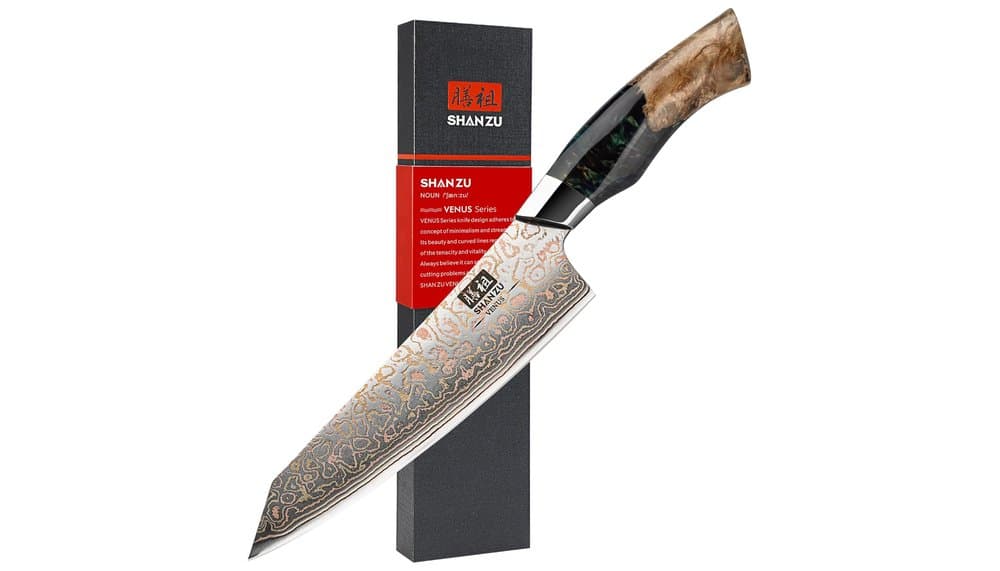
In the highly crowded chef's knife market, the promise of a tool that is both aesthetic and performant at an affordable price always attracts attention. The SHAN ZU VENUS Series 20cm Damascus Chef Knife positions itself precisely as such a proposition: a hand-forged knife, boasting a spectacular copper damascus pattern and a colored wood handle. But beyond its artwork-like appearance, what interests us here is its suitability for a "buy-it-for-life" philosophy. Is this knife a durable tool for the serious cook, or is it more of a decorative object? This technical analysis cross-references the manufacturer's specifications, user community feedback, and expert considerations to separate fact from fiction.
Strong Points
- Exceptional Factory Sharpness: The overwhelming majority of users agree on impeccable sharpening upon receipt, allowing for precise cuts without crushing delicate foods.
- High-End Aesthetics and Finish: The 67-layer copper damascus and colored stabilized maple handle create an immediate visual impact, often described as that of a collector's item.
- Balance and Ergonomics: The knife is regularly praised for its good balance and the comfortable, secure grip of its handle, even during prolonged use.
- Perceived Value for Money: For many testers, this knife offers characteristics (forged blade, damascus, crafted handle) typically associated with much higher price ranges.
Weak Points
- Requires Meticulous Maintenance: Like any good Japanese knife, it demands constant care: immediate hand washing and drying, and is absolutely incompatible with a dishwasher.
- Sharpening Requires Skill: The hard steel (62 HRC) retains its edge for a long time but is more difficult for a beginner to re-sharpen, requiring the use of a quality whetstone.
- Potentially Noticeable Weight: At 235g, some users find it heavier than other chef knives of similar size, which may require an adaptation period.
- Long-Term Performance in Question: Despite the warranty, the real durability of the copper damascus and the handle's resistance to years of intensive use remain to be proven over time.
Detailed Analysis
The Blade: Between Technical Spectacle and Real Performance
The technical heart of the SHAN ZU VENUS lies in its construction. The brand announces a forged blade composed of 67 layers of steel and copper, enveloping a core of 10Cr15MoV steel. This designation is the Chinese equivalent of AUS-10 steel or Japanese VG-10, a medium-high carbon stainless steel known for its good balance between edge retention, corrosion resistance, and relative ease of sharpening.
The announced hardness of 62 HRC (Rockwell) is a crucial point. This is a high value, typical of quality Japanese knives, which promises excellent edge retention: the blade will stay sharp longer between sharpenings. However, this hardness has a downside. It makes the steel more brittle (less tough) than steel at 55-58 HRC, and its re-sharpening, when necessary, will be more demanding. You will need to use a suitable grit water stone (starting at 1000). On paper, these specs position this knife in the performant category, provided you accept its maintenance constraints.
The damascus process (folding and forging of layers) is primarily aesthetic here, but it can also, theoretically, reduce food sticking on the blade. The integration of copper is a bold visual signature, but it raises questions about its differential reaction to food acidity and its aging compared to steel.
See priceHandling and Ergonomics: Comfort or Compromise?
According to user feedback, this is an area where the SHAN ZU VENUS excels. The stabilized maple handle (impregnated with resin) is described as smooth, pleasant to the touch, and offering a good grip even with wet hands. Its ergonomic shape, without sharp angles, seems well suited to several types of grip (pinch grip, handle grip).
With a weight of 235g for a 20cm blade, this is a knife with a marked presence in hand. Opinions diverge on this point: some see it as an asset for cutting hard ingredients (squash, pork shoulders), where the blade's weight works with gravity, while others, accustomed to lighter blades, may find it a bit tiring for prolonged delicate work (mincing herbs). The balance is often cited as well-executed, located near the heel of the blade, which facilitates control.
Durability and "Buy-It-For-Life" Philosophy
This is the most complex question. The "for life" potential depends entirely on the user and their maintenance.
- For: The forged construction, the solid steel core (10Cr15MoV/62 HRC), and the stabilized handle (resistant to water and humidity variations) are solid technical foundations. The manufacturer's 3-year warranty, although not "lifetime," demonstrates a certain confidence.
- Against: The composite nature of the damascus (steel + copper) and the complex finishes may present a higher risk of aesthetic or microscopic deterioration over the very long term than a simple monolithic blade. The high hardness also slightly increases the risk of micro-cracks or chipping in case of lateral shock or contact with bones. In summary, this knife can perfectly last for decades in the hands of a knowledgeable user who washes, dries, stores, and sharpens it correctly. Conversely, it will not forgive neglect. It is not "indestructible" like an old rustic carbon steel chef's knife can be; its durability is conditional upon rigorous maintenance.
Technical Specifications
| Characteristic | Detail |
|---|---|
| Blade Length | 20 cm (approximately 8 inches) |
| Blade Type | Chef's Knife |
| Construction | Hand-Forged |
| Blade Material | 67-layer Damascus Steel (carbon steel + copper) with 10Cr15MoV core (equivalent to AUS-10/VG-10) |
| Hardness (HRC) | 62 HRC |
| Edge | Straight (single or double bevel) |
| Handle Material | Stabilized Maple (colored with resin) |
| Weight | 235 grams |
| Balance | Near the heel (according to feedback) |
| Maintenance | Hand washing imperative. Not dishwasher safe. Immediate drying. |
| Warranty | 3 years |
What Users Say
The synthesis of hundreds of customer reviews and online expert analyses reveals very clear trends.
Praise is in the majority and focuses on:
- Immediate Sharpness: Phrases like "razor," "slices tomatoes without crushing them," "able to split a hair" consistently come up. The knife is ready to use without requiring initial sharpening.
- The Beauty of the Object: Terms like "work of art," "magnificent," "superb finish" are omnipresent. Appearance is an important factor of satisfaction and pride of ownership.
- Handling: The handle is described as "comfortable," "pleasant," "perfect" and offering a "good grip." Its balance is also frequently praised.
- Feel of Quality: Users, including professionals cited in reviews, note the careful finish, premium packaging, and a general feeling of solidity.
Reservations and criticisms, less numerous but recurring, concern:
- Mandatory Maintenance: Several remind of the absolute necessity of hand washing and drying, noting that the copper could potentially tarnish.
- Weight and Thickness: A few users find it "a bit heavy" or note that the blade spine is thicker than on some classic Japanese knives, possibly affecting cutting finesse on certain foods.
- Perhaps Overly High Expectations: An isolated review mentions that "the sharpness is not as delivered as I expected," which may indicate quality control variations or unrealistic expectations relative to the price.
- Edge Longevity: While the initial sharpness is praised, a few online expert comments raise the question of long-term edge retention, inherent to steels in this category, which will require professional or skilled sharpening.
Conclusion
The SHAN ZU VENUS Series 20cm Damascus Chef Knife is a seductive proposition that successfully marries the art of spectacle with serious technical performance. Its 10Cr15MoV steel core at 62 HRC and its forged construction make it a potentially very durable and effective tool, capable of competing with more expensive products in terms of sharpness and precision.
However, it is not a universal tool. It is aimed precisely at the passionate cook, enlightened amateur, or semi-professional, who is looking for a performant and aesthetic knife, and who is ready to assume its demanding maintenance. It is not suited for a family kitchen where the knife would go in the dishwasher or be mishandled.
In summary, this knife can perfectly fit into a "buy-it-for-life" approach if and only if its owner adopts the proper maintenance practices specific to quality Japanese knives. It is an investment that rewards care with years of precise service and the pleasure of using a beautiful object. Otherwise, its beauty will be ephemeral and its performance will quickly degrade. It is therefore an excellent choice for those who understand and accept this pact.