SHARPAL 198H Electric Knife Sharpener Review
Introduction
In a world where kitchen tools are often considered extensions of the cook, sharpening is not just a maintenance chore, but an essential ritual for preserving performance. On our site, dedicated to durable instruments like Japanese VG-10 steel knives and carbon steel woks, the question of sharpening is central. The arrival of electric sharpeners like the SHARPAL 198H Electric Knife Sharpener promises to democratize and speed up this process. But is this automated approach compatible with a "buy-it-for-life" philosophy and the care given to high-quality blades? We analyze this machine not as a gadget, but as a tool, dissecting its specifications, user feedback, and its place in the kitchen of a demanding enthusiast.
Strengths of the SHARPAL 198H
Based on its specifications and consolidated feedback, the SHARPAL 198H presents several convincing arguments for the user seeking efficiency and simplicity.
The preset sharpening angle of 20° is its technical pillar. Manufacturers and many reviewers emphasize that this angle offers a good balance between an aggressive edge and edge durability, making it less prone to chipping for versatile domestic use. It is a compromise designed to be universal.
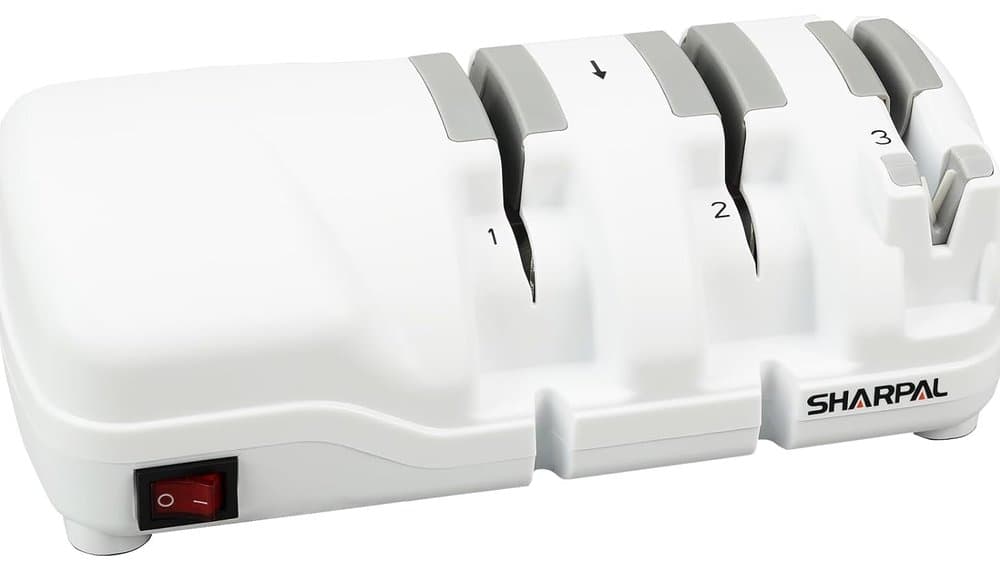
Its truly "skill-free" operation is its major asset. The three-slot system (coarse, fine, polishing/scissors) and the design that sharpens both sides of the blade simultaneously eliminate the learning curve. The community notes that very dull knives regain a functional edge in minutes, without any particular technique.
The controlled noise level (stated under 65 dB) is also a highlighted point. Unlike some noisy electric sharpeners, this one allows for sharpening without disturbing the environment, a welcome detail in a family kitchen.
Finally, practical touches like the removable magnetic tray to collect metal particles (the swarf) and the 3-year warranty indicate a design focused on ease of maintenance and a certain confidence from the manufacturer in its durability.
Weaknesses and Limitations to Know
Despite its advantages, the SHARPAL 198H has limitations inherent to its design, crucial to understand for any owner of high-end knives.
The constraint of the fixed 20° angle is its main limitation. For the purist community and users of traditional Japanese knives (like those in white or blue steel, often sharpened at 15° or less), this preset is unsuitable. It irreversibly alters the blade profile, which can be seen as a lack of respect for the knife maker's intent. It is clearly not the tool for maintaining a single-bevel knife (kataba).
Its compatibility is restricted to double-bevel blades, straight or serrated. Knives with convex grinds, poultry shears, or axes are excluded. Some user feedback also notes difficulties with knives having a large heel (a thick bolster near the handle).
From a "buy-it-for-life" perspective, the long-term durability of components is questionable. While seemingly robust, the system relies on a motor and abrasive wheels which are wear parts. Unlike a whetstone that, well-maintained, lasts decades, the lifespan of the diamond wheels and mechanism is finite. Reviews sometimes report failures, even though the warranty seems well honored.
Finally, its size should be considered. At 22 cm long, it is not as discreet as a manual sharpener and requires dedicated storage space.
Detailed Analysis: Performance, Build, and Target Audience
Materials and Sharpening Mechanism
The SHARPAL 198H uses monocrystalline diamond wheels for the coarse and fine stages, and a pure ceramic rod for polishing. Diamond is an extremely hard and efficient abrasive for quickly removing material. On paper, this allows for great speed. However, it is an abrasive and aggressive method compared to the fine sanding of a waterstone. Expert testers point out that it can generate more heat and remove more steel than necessary if overused. The manufacturer incorporates an anti-overheating device, which is reassuring, but the principle remains that of grinding, not fine sharpening in the traditional sense.
See priceImpact on Different Steels
The central question is: how does it behave with the precious steels of our knives? The fixed 20° angle and rapid abrasion do not differentiate between a soft steel (HRC 54-56) and a hard Japanese steel (HRC 60-63). It will simply grind the edge to fit its template. For a standard Western knife or a daily kitchen knife in AUS-8 or X50CrMoV15, feedback is excellent: a razor-sharp edge is quickly achieved. On the other hand, for a knife in VG-10 or SG2 with high heat treatment, this brutal method can, according to purists, micro-chip the edge or create excessive burr that the ceramic phase does not always perfectly remove. This does not prevent the knife from cutting, but it can compromise the fineness and longevity of the edge that one seeks to preserve.
Ergonomics and Handling
Users agree on the ease and stability of use. The push-button to activate the integrated suction cup is a practical feature to lock the device during use. The sharpening action, which simply involves pulling the blade towards you, is intuitive and not tiring, even for many knives in a row. This is a marked contrast to the posture and concentration required on a whetstone.
Who Should (and Should Not) Consider It?
The SHARPAL 198H finds its ideal audience with the home cook who values speed, simplicity, and effectiveness for a set of common knives. It is a fantastic "overhaul" solution for dull or medium-quality knives. It is also relevant for people reluctant to learn manual sharpening.
Conversely, it is not recommended for enthusiasts and professionals for whom each knife is a specific tool requiring a precise sharpening angle and meticulous care. If your collection includes Japanese knives with acute angles, high-end chef knives you wish to maintain in their original state, or if you consider sharpening an integral part of the culinary art, waterstones (whetstones) remain the only royal path. The SHARPAL 198H is a tool of convenience, not a precision tool for connoisseurs.
Technical Specifications
| Characteristic | Detail |
|---|---|
| Product Name | SHARPAL 198H Electric Knife Sharpener |
| Type | 3-Stage Electric Sharpener |
| Abrasive Materials | Monocrystalline Diamond (Stages 1 & 2), Pure Ceramic (Stage 3) |
| Sharpening Angle | Preset at 20° |
| Compatibility | Double-bevel knives (straight and serrated), scissors |
| Noise Level | < 65 dB (according to manufacturer) |
| Special Feature | Removable magnetic tray for particles, stabilizing suction cup |
| Dimensions (L x W x H) | 22 x 10.5 x 7.1 cm |
| Weight | 0.7 kg |
| Warranty | 3-year limited |
What Users Say: Summary of Reviews
The analysis of thousands of customer reviews and expert feedback reveals clear trends.
The recurring positive points are unequivocal on ease and effectiveness. Phrases like "razor-sharp," "like new," "effortless," and "amazing" come up repeatedly. Users are often surprised by the speed with which a dull knife regains a practical edge. The scissors sharpening function is also widely praised and works well in most cases. Customer service is mentioned positively for its responsiveness in case of problems.
The negative points or reservations mainly revolve around technical limits. Some users note that the edge, while very sharp, does not have the same finesse or longevity as with expert manual sharpening. The fixed angle is a barrier for owners of specific knives. A few isolated reports mention failures (wheel jammed, motor overheating), although often resolved by the warranty. Finally, some users find the result of the ceramic stage (scissors or polishing) less conclusive than the diamond stages.
The overall rating of 4.2/5 from a very large number of reviews reflects this assessment well: very high satisfaction for the general public use it is intended for, tempered by the inevitable technical limitations for more demanding use cases.
Conclusion
The SHARPAL 198H Electric Knife Sharpener is a well-designed machine that perfectly fulfills its promise: to quickly and skilllessly sharpen the majority of common kitchen knives. Its 20° angle, three-in-one system, and low noise make it an extremely practical and effective maintenance tool for the average household.
However, from the "buy-it-for-life" perspective and for the demanding audience of this site – fans of Japanese knives, users of professional knives, and those who see maintenance as an investment – this electric sharpener shows its limits. Its fixed angle and abrasive method make it a tool that standardizes and wears down the blade, rather than preserving it in its original integrity. It is excellent for reviving tools or for simple maintenance, but it is not the ideal partner for cherishing a VG-10 steel knife sharpened at 15° or for perpetuating the perfect edge of an artisanal blade.
In summary, it is an excellent servant for everyday cooking, but not the precision tool for the purist. For the latter, investing in good whetstones and learning the technique remains the essential path to mastery and the absolute longevity of their blades.