Sharpeak 109R Ceramic Honing Rod Test & Review
Introduction: The Sharpeak 109R, A Ceramic Honing Rod for Lasting Sharpness
In the world of durable kitchen tools, maintaining a sharp edge is a discipline in itself. For enthusiasts of Japanese knives (white steel, blue steel, VG-10), Western knives, or forged blades, regular sharpening on a water stone is essential. But between sessions, edge maintenance often involves a honing steel. The Sharpeak 109R Ceramic Honing Rod positions itself as a specialized tool, designed not to reprofile a dull blade, but to realign and polish the edge on well-maintained knives. Here, we analyze this instrument through the lens of the "buy-it-for-life" approach, breaking down its materials, ergonomics, and real effectiveness for the demanding cook who wishes to preserve their investments in the long term.
Strengths & Weaknesses: A Quick Overview
Major Strengths
- Ideal finishing material: The white ceramic rod with a 3000 grit offers an ultra-fine abrasive, perfect for polishing and realigning the edge without excessive material removal.
- Integrated angle guide: The integrated 20° angle guides (40° inclusive for the edge) help maintain valuable consistency, especially for non-experts.
- Design suited for hard steels: Unlike traditional steel rods, ceramic, being harder, is compatible with high-carbon steels and high Rockwell hardness (HRC 60+) such as VG-10 or forged steels.
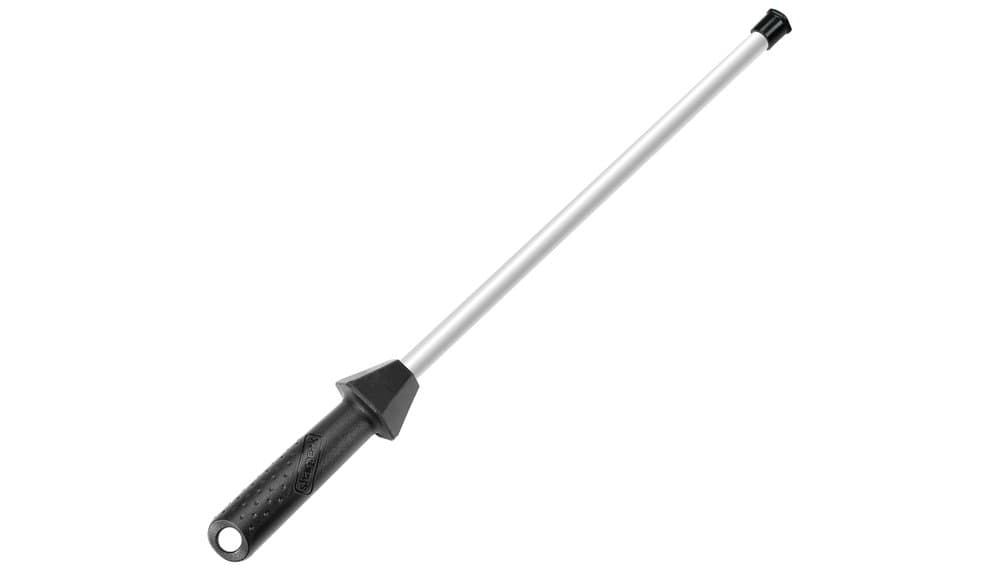
- Generous length: A useful rod length of 30 cm (45 cm total) allows for comfortable handling of large chef's or butcher knives.
- Perceived excellent value for money: The community unanimously highlights the good balance between performance and cost.
Identified Limitations
- Structural fragility: Like any ceramic tool, it is sensitive to shocks and drops. Feedback mentions rods received broken or susceptible to breaking.
- Specific use: This is not a reprofiling tool. It is ineffective on a very dull or damaged blade; its role is strictly that of maintenance and finishing.
- Dependence on a pre-existing edge: To function, it requires the knife to already have a properly formed edge from a water stone.
- Delicate pressure required: Excessive pressure during use can, according to testers, scratch the blade or damage the ceramic.
Detailed Analysis: In Specs and in Practice
Materials and Manufacturing: The Ceramic Promise
The heart of the product is its alumina ceramic rod, advertised as 3000 grit. This level of fineness clearly places it in the category of polishing and realigning (honing) tools, not coarse sharpening. Ceramic, with a hardness superior to most steels, allows treating the edge without risk of the rod wearing prematurely. This is a decisive advantage for owners of Japanese knives or tool steels, often hardened to Rockwell hardness (HRC) between 60 and 65. A classic steel rod, softer, would be ineffective or even harmful on such blades.
The brand emphasizes a Hot Isostatic Pressing (HIP) process to densify the ceramic structure, which, on paper, should improve its wear resistance and longevity. Durability is therefore not linked to a patina or "seasoning" like with carbon steel, but to the physical integrity of the rod. The handle, meanwhile, appears to be reinforced plastic with non-slip inserts. While not a premium material like wood or micarta, this solution is considered sufficient for a good grip.
See priceErgonomics and Handling: Control Above All
Based on user feedback, the handling is comfortable and safe. The ergonomic shape of the handle and the hexagonal guard effectively prevent the hand from sliding onto the rod, a crucial safety point. The weight of 229 grams and overall balance are described as appropriate for controlled use. The rubber cap at the base is a practical touch that protects the work surface, but the instructions recommend removing it if using the rod placed on a table, to avoid an accident with the blade.
The integrated 20° angle guides are one of the most commented-on features. They provide a tangible physical reference for maintaining a constant angle, eliminating a large part of the uncertainty for the occasional user. For a standard edge angle of 40° (20° per side), it's perfect. However, purists of Japanese knives (often sharpened at 15-17° per side) will need to adjust their technique or consider that this rod will create a slightly wider micro-bevel.
Real Performance: Between Myth and Reality
The performance of the Sharpeak 109R is very contextual. Testers and the community agree: it is an exceptional maintenance tool, not a savior for dead knives.
On a quality knife with an edge simply slightly misaligned (the "edge" is bent but the material is there), a few light strokes restore an aggressive, razor-like cutting ability. Reviews mention proven results on steels like VG-10, AUS-10, or forged steels. It excels at "reviving" an edge between two water stone sessions.
On the other hand, on a dull knife (the edge is rounded), it will be powerless. Its 3000 grit is too fine to remove the necessary amount of metal. Its role is to realign, not to reprofile. This is a fundamental distinction. For serious kitchen use, it must therefore be part of a system: water stones (1000 grit for reprofiling, 3000/6000 for sharpening) and this ceramic rod for daily or weekly maintenance.
Durability and Longevity: A Point of Vigilance
The long-term durability of the Sharpeak 109R rests on two pillars: the resistance of the ceramic and the robustness of the assembly. The ceramic itself, if not subjected to shocks, should last a lifetime as it wears very little. However, its fragility to shocks is its Achilles' heel. It is a tool to handle and store with care. The 3-year warranty offered by Sharpeak is a confidence pledge regarding manufacturing defects.
The plastic handle, although adequate, could be the weak point over a decade or more, compared to the screwed and forged handle of a high-end professional rod. Nevertheless, for the vast majority of home users, this construction is largely sufficient.
Technical Specifications
| Characteristic | Detail |
|---|---|
| Model | Sharpeak 109R Ceramic Honing Rod |
| Rod Material | Ceramic (Alumina) |
| Grit Fineness | 3000 (Ultra-fine / Finishing) |
| Total Length | 45 cm |
| Useful Rod Length | 30 cm |
| Integrated Guide Angle | 20° per side (40° total) |
| Weight | 229 g |
| Handle Finish | Ergonomic plastic with non-slip inserts, hexagonal guard |
| Included Accessories | Rubber protective cap |
| Warranty | 3 years |
What Users Say: Review Synthesis
Feedback from the community, compiling over 1400 reviews with an average rating of 4.5/5, paints a very consistent picture of the product.
Recurrent Praise:
- Effectiveness on quality blades: Users of Japanese or hard-steel knives are particularly satisfied. Phrases like "perfect for doing a honing and sharpening on quality knives" or "with this tool I can restore the edge on ultra-hard blades..." come up often.
- Simplicity thanks to guides: The angle guide is praised for its ability to make the technique accessible: "the guide really helps maintain a correct angle, even without being an expert".
- Handling and feeling of quality: The length, weight, and finish are described as solid and professional.
- Value for money: This is the most frequently emphasized point. Users feel they get much more than what they pay for.
Criticisms and Warnings:
- Fragility upon receipt: Several reviews report products delivered broken, highlighting the vulnerability of ceramic during shipping.
- Understood functional limit: Knowledgeable users clearly state it is a maintenance tool, not a rescue tool. "No need for anything else in the kitchen, I maintain a very decent edge... provided the edges are properly formed of course".
- Minor details: One review notes that the magnet at the tip for capturing particles is too weak.
Overall, dissatisfaction mainly stems from a misunderstanding of the product's use (expecting a miracle sharpening) or from damage during delivery.
Conclusion: Who is the Sharpeak 109R Ceramic For?
The Sharpeak 109R Ceramic Honing Rod is a specific and extremely effective tool within its domain. It is not meant to be the sole sharpening tool in a kitchen, but it establishes itself as the ideal companion to water stones for anyone who owns good knives and wants to maximize their performance and longevity.
It is a wise and durable investment for:
- The enlightened amateur cook or the serious home cook who owns high-carbon steel knives (HRC >58) and wants to maintain them properly.
- The owner of Japanese knives (VG-10, AUS-10, blue/white steels) for whom a traditional steel rod is unsuitable.
- Anyone looking for a simple and quick way to restore bite to their blades between full sharpenings.
On the other hand, avoid it if:
- Your knives are primarily very dull and require a complete reprofiling.
- You are looking for a magical all-in-one solution for low-end knives made of soft steel (a classic steel rod would be more suitable).
- You are not willing to handle a ceramic tool with minimum precaution against shocks.
In summary, from a "buy-it-for-life" perspective, the Sharpeak 109R is a quality complement, durable in its materials and targeted utility. It proves that a specialized tool, used correctly, is often the surest path to excellence and longevity in the kitchen.