Skerper Basic SH002 Sharpening Stone Review and Test
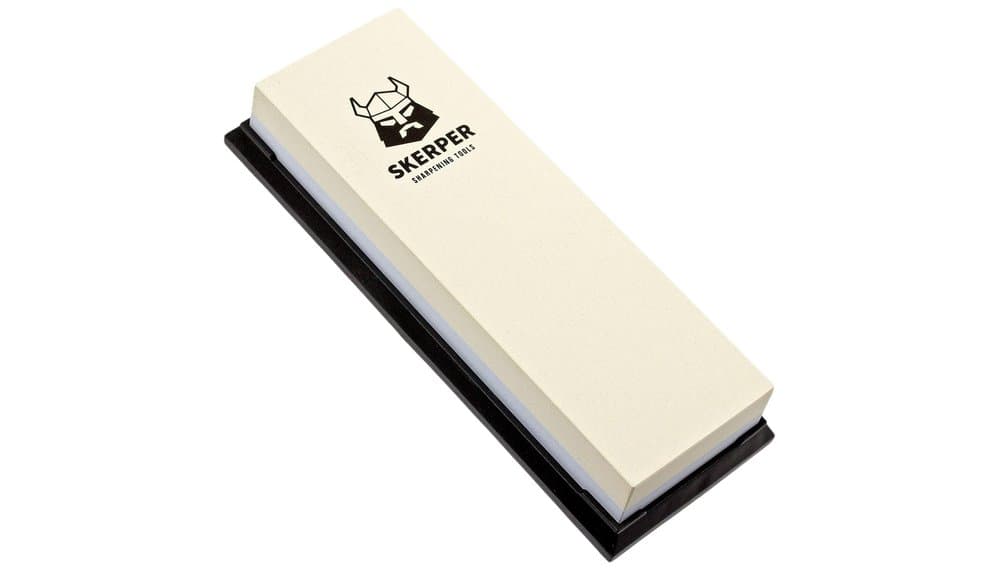
Comprehensive Analysis of the Skerper Basic SH002 1000-3000 Grit Sharpening Stone
In a serious kitchen, a dull knife is a useless tool. The balance between the blade and its edge is sacred, and maintaining it requires a reliable partner: the sharpening stone. Here, we dissect the Skerper Basic SH002 combination stone, a very popular entry-level model. Our goal is to determine if it can claim a lasting place in the arsenal of the passionate cook, analyzing it from a "buy-it-for-life" perspective: materials, performance, durability, and relevance for demanding use.
Strengths & Weaknesses: A Clear Summary
Strengths:
- Exceptional value for money for a double-grit stone.
- Immediate versatility thanks to the 1000 (reprofiling) and 3000 (refining) grits.
- Beginner-friendly: practical size and integrated non-slip base.
- Concrete results: allows for a very effective, razor-sharp edge on most steels.
Weaknesses:
- Limited durability: the stone is relatively soft and wears/dishes faster than high-end references.
- Finishing quality: the 3000 grit does not provide a high-level mirror polish.
- Size: can feel a bit short for comfortably sharpening very large chef's blades.
Detailed Analysis: Beyond the Specifications
Materials and Construction: An Entry-Level Stone
The Skerper Basic SH002 is a synthetic waterstone. According to its technical sheet, it is composed of ceramic aluminum, a common formulation for economical synthetic stones. This is not the white carbon steel (Shirogami) of a forged knife, nor the VG-10 of a modern Japanese knife. Here, the material of interest is the abrasive itself and its binder.
The stone is mounted on a blue slate base. This point is crucial for the user experience. The enthusiast sharpening community highlights that this base is heavy and stable, eliminating the need for an additional holder or non-slip mat. This greatly simplifies the procedure, especially for a beginner.
Stone Performance: Bite, Polishing, and "Feeling"
The core promise of this stone lies in its double grit density. Let's analyze each side:
-
1000 grit side (medium grain): This is the main working face. Testers and user feedback agree that it has a good bite. It is effective for reshaping a dull edge on most common kitchen steels, whether Western tool steels or Japanese steels like AUS-8 or VG-10. It removes metal at a reasonable rate without being too aggressive. It is the ideal grit for regular maintenance.
-
3000 grit side (fine grain): This side is for refinement and polishing. It allows you to remove the micro-tears left by the 1000 grit, resulting in a sharper and more durable edge. However, web context experts specify that the obtained polish remains limited. It is far from the mirror finish ("kasumi") that finishing stones of 6000 grit or more can produce. The result is primarily functional: a sharp, refined edge, but not an advanced aesthetic finishing work.
-
"Feedback" and Wear: This is where the "Basic" positioning of the stone is revealed. Feedback indicates it is softer and less dense than professional Japanese stones (like those from brands such as Shapton, Naniwa, or Suehiro). Concretely, it releases its abrasives more easily (which can slightly speed up work) but wears and dishes more quickly, especially if the user's technique is not perfect (inconsistent angle, excessive pressure). This requires more frequent flattening (sanding on a flat surface) to restore its flatness. This is not a fatal flaw, but a characteristic of its price segment.
Ergonomics and Handling
The stone measures 19 x 6 cm. This size is considered sufficient and practical for the vast majority of kitchen and pocket knives. For a 20 to 25 cm chef's knife, sharpening remains comfortable. On the other hand, for very large blades (like a cleaver or slicer), some experienced users find the stroke a bit short, requiring more passes.
The most cited ergonomic point is the stability of the slate base. It prevents dangerous and anxiety-inducing slipping, a real plus for confidence, especially during initial sessions. The stone requires prior soaking (about 10-15 minutes) before use, like most synthetic waterstones of this type.
Durability and "Buy-It-For-Life" Perspective
This is the central question. Is the Skerper Basic SH002 a purchase for life?
The answer is nuanced. No, as a physically durable object indefinitely. Its nature as a soft stone with a less dense binder destines it for consumption over time. It will wear, dish, and need to be replaced after several years of regular use, or serve as a spare stone once the user has progressed.
Yes, as an initial investment in a lifelong skill. Its true merit is making manual sharpening accessible. For a contained price, it offers a complete learning platform (two useful grits) and produces tangible results that motivate perseverance. It constitutes an excellent training stone. Once the technique is mastered, the user will know precisely what they expect from a higher-grade stone: more hardness, a more advanced finish, slower wear.
Who Is This Stone For?
-
The absolute beginner: Ideal target. It allows learning without breaking the bank and validating interest in manual sharpening.
-
The occasional cook who wants to keep their everyday knives in effective cutting condition.
-
As a secondary or backup stone for an enthusiast who already owns fine stones but wants a simple and quick solution for common tasks.
-
The demanding enthusiast or professional looking for a single, durable stone for precision work on high-end steels (ZDP-189, HAP-40, white carbon steel) should look towards professional ranges, which are denser and have more precise grit.
Technical Specifications
| Characteristic | Detail |
|---|---|
| Model | Skerper Basic SH002 |
| Type | Combination water sharpening stone |
| Grits | 1000 (medium) & 3000 (fine) |
| Dimensions (L x W x H) | 19 x 6 x 2.8 cm |
| Weight | 535 g |
| Abrasive material | Ceramic Aluminum (synthetic) |
| Base/Stand | Slate (non-slip) |
| Preparation | Soaking in water required |
| Use | Kitchen knives, pocket knives, tools |
What Users and the Community Say
A synthesis of customer reviews and expert context reveals very clear trends.
The praise converges on three points:
- Surprising effectiveness for the price: Many users express satisfaction with the results obtained, achieving a "razor-sharp edge" on various steels, including reputedly hard ones like D2.
- Ideal for learning: It is highly recommended as a perfect tool to start without financial pressure. Beginners appreciate the ease of use.
- Practical and complete: The combination of two grits and the stable base are consistently cited as major convenience assets.
The reported criticisms or limitations are just as consistent:
- Accelerated wear: This is the most frequently mentioned negative point. The stone tends to dish and requires regular maintenance (flattening) to maintain a flat surface.
- Limit of the 3000 grit: Users seeking a perfect polish or extreme sharpening for Japanese knives note that the 3000 is a "basic" finish, sufficient for cutting but not for aesthetics.
- Variable finish quality: A few reports mention less regular grit or a stone that can crack if not properly maintained (air-dried, never in sun or on a radiator).
Conclusion: An Excellent Starting Point, Not a Final Destination
The Skerper Basic SH002 1000-3000 Grit Sharpening Stone perfectly fulfills the mission its name suggests: providing a solid and accessible foundation for manual sharpening. It does not have the austere durability of a cast iron block, nor the unalterable fineness of a Japanese white steel hardened to 64 HRC. But it possesses the most important virtue for a beginner: it works and gives encouraging results.
We recommend it without reservation to anyone wishing to seriously start maintaining their knives without a significant initial investment. It is a tool that will accompany you while you acquire the skill, understand your own needs, and determine if you then wish to invest in more specialized and durable stones. It proves that you can achieve a professional edge without professional equipment, making it not a "buy-it-for-life" as an object, but certainly an initiatory step towards a practice that will, itself, last a lifetime.