TUO Fiery Series 6.5 Nakiri Knife Review
Introduction: An Accessible Nakiri for Serious Cooking
In the world of durable kitchen knives, the Japanese Nakiri knife holds a special place. Dedicated to the precise cutting of vegetables, its rectangular blade and straight edge allow for efficient work without catching on food. The TUO Nakiri Knife 6.5" Fiery Series Chef's Knife presents itself as a bridge between this Japanese tradition and the expectations of a modern cook, seeking a high-performance tool without necessarily committing to the investment of a hand-forged Japanese blade. For a site dedicated to "buy-it-for-life" kitchen tools, the analysis of this product must focus on its materials, construction, and its potential to become a reliable and durable work companion. This is exactly what we will dissect, based on its technical specifications and the consolidated feedback from its many users.
Strengths & Weaknesses: A Clear Summary
Strengths:
- Exceptional out-of-the-box sharpness according to users, with a hand-sharpened double bevel at 18° providing a clean and precise cut.
- Remarkable handle ergonomics made of Pakkawood, praised for its comfort during prolonged use and its ambidextrous design.
- Balanced German steel (X50CrMoV15) offering a good compromise between corrosion resistance, edge retention, and ease of sharpening.
- Aesthetic design and finish ("Fiery Series") highly appreciated.
- Perceived excellent value for money, positioning this knife as a serious alternative to more expensive Japanese Nakiri knives.
Weaknesses:
- Specialized use: Designed as a true Nakiri, it is not suitable for boning tasks, cutting meat with bones, or working on frozen products.
- Limited edge retention compared to high-end steels: The steel, while of good quality, does not match the performance of Japanese carbon steels (like VG-10, AUS-10, or carbon steels) over time.
- Necessary maintenance precautions: Like any quality knife, it requires hand washing and immediate drying to preserve its integrity.
Detailed Analysis: A Buy-It-For-Life Approach
The Blade: Robust and Reliable German Steel
The heart of this knife is its steel: X50CrMoV15, a German high-carbon stainless steel very common in the European quality culinary industry. Its composition (approximately 0.55% carbon, 15% chromium, with molybdenum and vanadium) makes it a predictable and balanced material.
The announced Rockwell Hardness (HRC) is 56 ± 2. This figure is crucial. It sits at the lower end of the scale for high-performance Japanese knives (which often start at 58-60 HRC), but above many mass-market knives. This gives us a clear reading of its characteristics:
- Edge retention: It will be decent, but not exceptional. You can rely on a pleasant edge for several weeks of regular home use, but it will require regular maintenance (passing on a ceramic honing rod or stropping on a stone) to maintain its optimal edge. This is not a steel that will hold for months without intervention.
- Ease of sharpening: This is its great advantage. An HRC of 56 makes it relatively soft and forgiving to resharpen, even for a beginner with a medium-grit sharpening stone. It will regain a razor edge without disproportionate effort, which is an essential point for the real durability of a knife.
- Corrosion resistance: Thanks to its chromium content, it is a perfectly stainless steel. It does not require the meticulous care of a carbon steel knife (absolute immediate drying, oiling), making it better suited for an intense home kitchen environment.
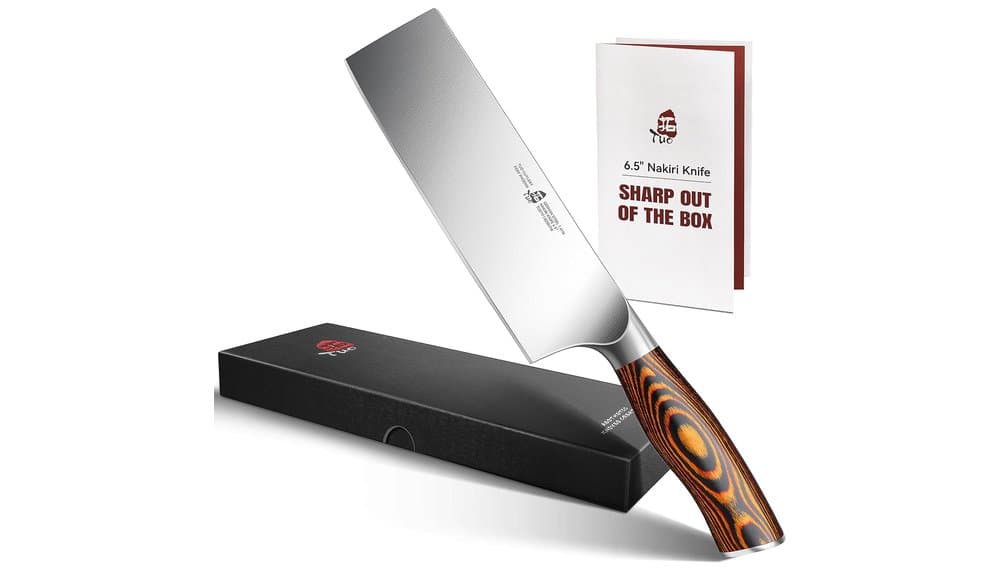
The pure Nakiri shape with its straight spine and straight edge is designed for a "tap-chop" motion from top to bottom. It excels at chopping herbs, slicing cabbage, cutting root vegetables, and slicing thin-skinned vegetables like tomatoes without crushing them. The length of 6.5 inches (16.5 cm) is judged by the community as an ideal format for the majority of home vegetable preparation tasks, offering enough length without becoming cumbersome.
See priceThe Handle: Comfort and Grip
The feedback is unanimous: the ergonomics of the Pakkawood handle is one of the major strengths of this knife. Pakkawood, a composite of wood and resin, combines the warm look of wood with superior resistance to moisture and temperature variations compared to solid wood. Its shape, described as a "D" but with gentle curves, naturally fits the palm and provides a secure and comfortable grip, even with wet hands.
The Full Tang construction (the blade runs through the entire handle) is mentioned by the brand and is essential from a durability standpoint. It ensures a perfect balance between the blade and the handle, and guarantees structural robustness that can withstand anything, eliminating the risk of breakage at the bolster. This balance significantly reduces fatigue during prolonged use, a non-negligible criterion for serious home cooks.
Construction, Durability, and Target Audience
The technical sheet indicates manufacturing by forging and vacuum heat treatment with nitrogen cooling. These modern processes ensure a fine and uniform grain structure in the steel, contributing to its sturdiness and resilience. Combined with the Full Tang, this construction promises lifelong durability if the tool is properly maintained.
Who is this knife for? The TUO Nakiri Fiery Series clearly targets the demanding amateur cook or enthusiast who wants to integrate a specialized knife into their arsenal without embarking on the investment (financial and in terms of maintenance) of a Japanese Nakiri in carbon steel (White Steel) or high-end stainless steel (like VG-10). It is an excellent first Nakiri or a daily workhorse for those who appreciate the form but want the simplicity of stainless steel.
It will be less suitable for professionals seeking extreme edge retention during intensive service, who will turn to harder steels (HRC 60+). Its role is precise: to be an effective, reliable, and pleasant vegetable specialist for daily use.
Technical Specifications
| Characteristic | Detail |
|---|---|
| Model | TUO Nakiri Knife 6.5" Fiery Series Chef's Knife |
| Blade Type | Nakiri (Japanese vegetable knife) |
| Blade Length | 6.5 inches (16.5 cm) |
| Blade Material | German stainless steel X50CrMoV15 (1.4116) |
| Processing | Forged, vacuum heat treatment, nitrogen cooling |
| Rockwell Hardness (HRC) | 56 ± 2 |
| Sharpening Angle | ~18° per side (double bevel) |
| Handle Material | Pakkawood (wood/resin composite) |
| Construction | Full Tang |
| Weight | ~231 grams |
| Maintenance | Hand wash required, immediate drying recommended |
What Users Say: Summary of Feedback
The analysis of thousands of customer reviews and online expert feedback reveals very clear trends.
Praise is abundant and converges on several points:
- Exceptional sharpness upon receipt: Phrases like "cuts like a razor" or "cuts paper" constantly recur. Users are impressed by the out-of-the-box sharpness.
- Unmatched comfort: The handle is described as "perfectly in hand," "comfortable even after hours of use," and its ambidextrous design is appreciated.
- Formidable efficiency on vegetables: It is praised for slicing tomatoes thinly without crushing them, chopping onions without making them cry excessively, and tackling hard root vegetables.
- Perceived excellent value for money: The majority of reviews consider this knife "well above its price," offering sensations and a finish not expected at this price level.
- Aesthetics: Its design with the "Fiery" (flames) finish on the blade is attractive and makes it a visually pleasing object.
Criticisms or remarks are less frequent but instructive:
- Inconsistent factory sharpening: A few users report receiving a knife less sharp than expected upon opening, requiring an immediate pass on a stone. This highlights the importance of having the means to maintain it at home.
- Respected usage limits: Some, having used it for meat with bones or unsuitable tasks, found it limited, confirming that it is indeed a specialized tool.
- Edge retention: Even if generally satisfied, users accustomed to very hard steels note that it loses its ultra-sharp edge more quickly and requires more frequent maintenance. This is the logical trade-off for its ease of resharpening and its HRC of 56.
Conclusion: A Vegetable Specialist That Delivers
The TUO Nakiri Knife 6.5" Fiery Series Chef's Knife is a convincing proposition for anyone looking for a high-performance, aesthetic, and durable vegetable knife. Its strength lies in the intelligent balance of its characteristics: robust and easy-to-maintain German steel, a Rockwell hardness of 56 that makes it accessible for sharpening by an amateur, and a handle ergonomics unanimously praised that turns the task into a pleasure.
It is not a tool for a Japanese professional chef with infinite edge retention, and it does not claim to be. However, in its role as a specialist dedicated to cutting vegetables, it excels and offers an experience very close to that of high-end models for a fraction of their cost. Its "buy-it-for-life" potential is real, provided it is accepted for what it is: an excellent specialized knife requiring regular and appropriate maintenance. For the serious home cook who wants to add a reliable and enjoyable-to-use Nakiri to their arsenal, it represents a very reasonable and highly recommended choice by the community of users.