VeoHome Enamelled Cast Iron Casserole Dish Review
Introduction
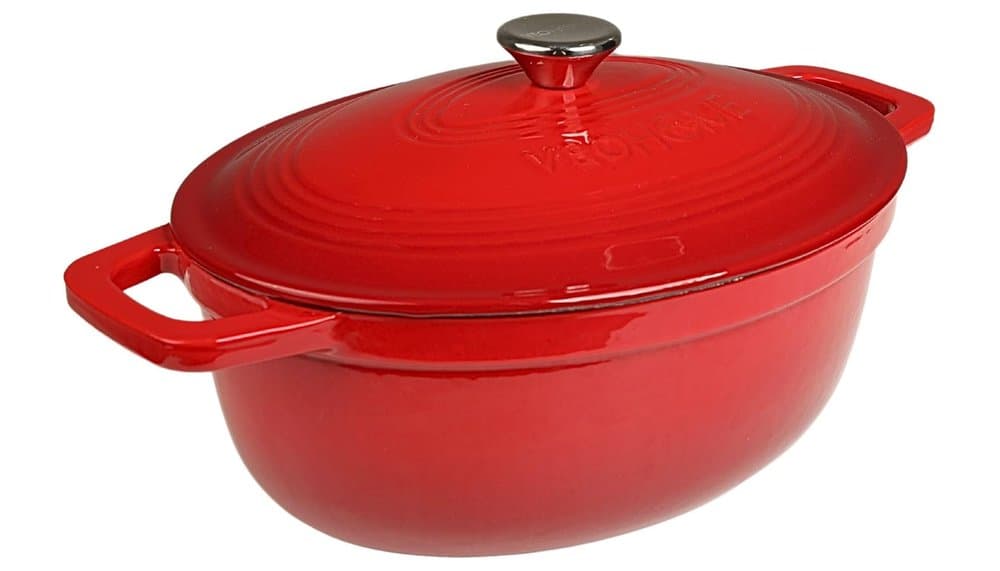
In the world of kitchen utensils designed to last a lifetime, the enamelled cast iron casserole dish holds an iconic place. It is a tool that transcends trends, promising decades of faithful service if cared for properly. This analysis focuses on the VeoHome Enamelled Cast Iron Casserole Dish, a product seeking to position itself as a serious alternative in this demanding segment. Our goal is not to have tested it in real conditions, but to dissect its technical specifications, cross-reference community reviews and expert observations to determine if it meets the criteria for a "buy-it-for-life" investment. For passionate cooks seeking robustness, impeccable thermal performance, and seamless versatility, every detail matters.
Strengths
The VeoHome casserole presents several weighty arguments, both literal and figurative, which explain its excellent reception by users.
- Absolute heating versatility: According to its specifications, it is compatible with all types of hobs, including induction, gas, ceramic, and electric, not forgetting the oven. This universality makes it a tool suited to any kitchen configuration, past, present, or future.
- Thermal performance inherited from cast iron: The base material, cast iron, is renowned for its homogeneous heat distribution and excellent retention. Testers and users confirm that this allows for slow, even, and energy-efficient cooking, ideal for stews, braises, and even bread baking.
- Robust construction and practical finish: Marketing and customer reviews highlight its heavy and solid construction, a guarantee of durability. The enamel provides a major advantage: it eliminates the need for complex seasoning, protects the iron from rust, and offers a relatively easy-to-clean surface, while being resistant to food acids.
- Perceived excellent value for money: Even without discussing price, the trend in feedback is clear: the community perceives it as a very competitive alternative to the iconic brands in the sector, offering the essential features for a lesser investment.
Weaknesses
No tool is perfect, and the VeoHome casserole has drawbacks inherent to its design and material, which users notice.
- Significant weight and bulk: With a weight approaching 7.1 kg for 6 liters, handling and storage can prove difficult. Several reviews note that it is "a bit heavy to handle" and that its size is "very wide, more than I expected."
- Enamel sensitivity to shocks and mistreatment: Online context and maintenance advice point to the relative fragility of the enamel. It is susceptible to chipping or scratching in case of impact with a metal utensil, intense dry heating, or a sudden thermal shock.
- Specific and demanding maintenance: Unlike a stainless steel pan, it requires precautions. Experts remind us to avoid prolonged soaking, putting it in the dishwasher (despite sometimes contrary claims from some manufacturers), and cooling it abruptly. Complete drying before storage is imperative to avoid any risk of rust in areas where the enamel might be damaged.
- Enamel "seasoning" process: Some users, as highlighted in one review, mention a "recommended seasoning before use" that can be "long and tedious." This typically refers to a simple greasing of the enamel before first use to improve its non-stick properties, but it can be confusing.
Detailed Analysis
Let's now dive into the technical and practical analysis to understand what lies behind the first impressions.
Materials and Manufacturing: The Cast Iron Heart
The VeoHome Enamelled Cast Iron Casserole Dish is, as the name indicates, made of cast iron. It is not a complex alloyed steel like the VG-10 of a Japanese knife, but a traditional material whose primary virtue is its high thermal mass. Cast iron accumulates heat slowly and redistributes it extremely evenly, eliminating hot spots. This translates in the kitchen to predictable cooking, where food simmers in its own juices without sticking. The enamel applied to the surface is a vitrification. It seals the iron to protect it from oxidation. This eliminates the main drawback of raw cast iron (rust maintenance) but introduces a new constraint: the ceramic can crack. The perceived sturdiness is high, with reviews speaking of "very solid" and "superior quality," which is consistent with the nature of the material.
Cooking Performance: Heat and Flavors
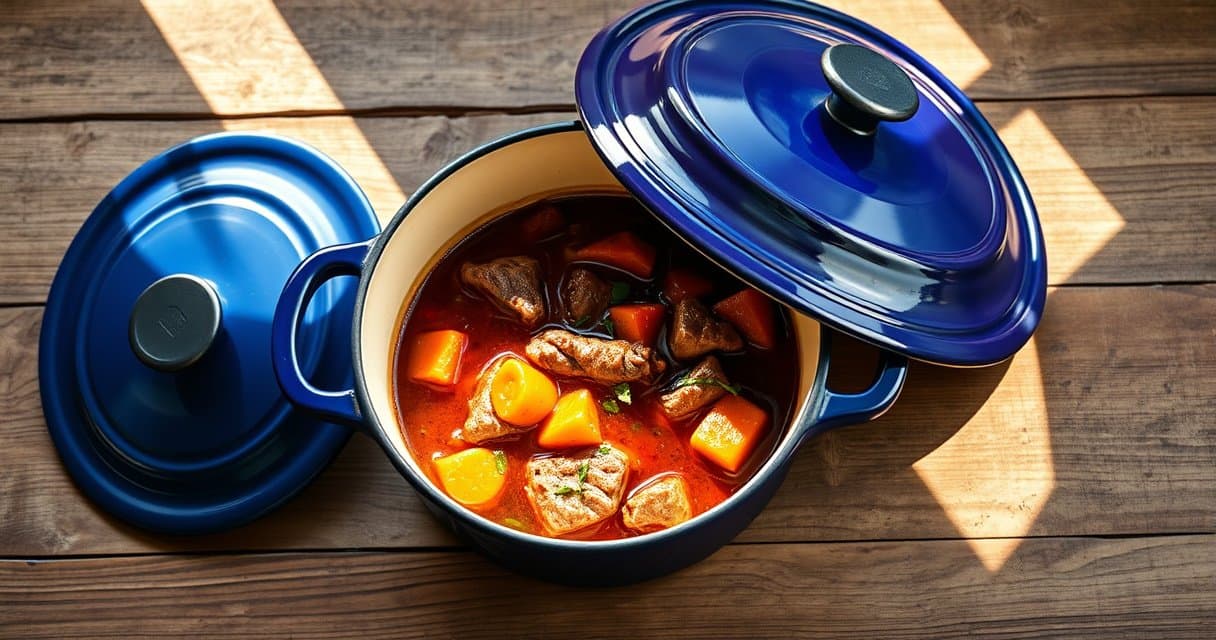
On paper, the specifications promise even cooking and the preservation of authentic flavors. User feedback and expert context largely validate this promise. Cooks report "perfect" results for stews, casseroles, and bread, with excellent moisture retention thanks to the well-fitted lid. It is this combination of slow heat diffusion and a closed environment that allows for achieving melting textures and concentrated flavors, characteristic of long "slow-cooked" dishes. One user goes so far as to say: "Better than a pressure cooker for me." Compatibility with the oven also makes it an ideal tool for roasts, where its ability to conduct heat through the sides ensures an even result.
See priceErgonomics and Handling: The Weight Challenge
Ergonomics is the point where compromises are most visible. The handles are generally fixed solidly, but their design must be evaluated considering the total weight of the utensile when loaded. Feedback is unanimous that it is heavy. This impacts handling, especially when transferring from a burner to the oven or table. For people with physical limitations, this can be a deal-breaker. However, for many cast iron enthusiasts, this weight is the price to pay for thermal mass and durability. It is a tool that you set and leave on the heat, more than one you constantly handle.
Durability and Lifetime Maintenance (Buy-it-for-Life)
This is the crucial criterion. The cast iron itself is virtually immortal; it does not deform or wear out. The potential point of failure is the enamel. A "buy-it-for-life" analysis therefore rests entirely on the user's ability to follow the rules of use:
- No metal utensils (prefer wood or silicone).
- No prolonged dry heating (risk of thermal cracking of the enamel).
- No thermal shocks (do not go from a very hot oven to cold water).
- Gentle cleaning with a sponge and soap, without abrasives.
- Immediate and complete drying before storage.
If these rules are followed, the VeoHome enamel, based on medium-term reliability feedback, seems to keep its promises. The brand announces availability of spare parts for 5 years, which is a good point for repairability (e.g., replacement of a lid knob). Compared to the historical market references, it may have an enamel that is perhaps slightly less thick or resilient, but the community notes that for serious and careful domestic use, it is quite capable of lasting for decades.
Who Is It For?
The VeoHome Enamelled Cast Iron Casserole Dish is made for the passionate cook seeking versatility and traditional results, but mindful of the budget. It is a professional-grade tool in its function (thermal performance, body durability), which requires in return meticulous care worthy of a professional. It will not suit those looking for a lightweight, maintenance-free utensil to throw in the dishwasher. On the other hand, it will be the perfect ally for the sourdough bread enthusiast, the Sunday bourguignon specialist, or the one who wants a single all-purpose casserole for all their heat sources.
Technical Specifications
| Characteristic | Detail |
|---|---|
| Product Name | VeoHome Enamelled Cast Iron Casserole Dish |
| Main Material | Enamelled cast iron |
| Capacity | 6 Liters |
| Shapes | Oval (32 cm length) and Round (28 cm diameter) |
| Item Weight | 7.09 Kilograms |
| Interior/Exterior Finish | Enamel |
| Hob Compatibility | Induction, Gas, Ceramic, Electric, Oven |
| Maintenance | Hand washing recommended |
| Oven Safe | Yes |
| Includes Lid | Yes, with interior condensation bumps |
| Available Colors | Red, Green, Blue (depending on shape) |
| Spare Parts Warranty | 5 years (according to manufacturer information) |
What Users and Experts Say
The synthesis of over 1,200 reviews (with an overall rating of 4.6/5) and analyses from the web context reveals very clear trends.
Praise is concentrated on:
- Culinary performance: The terms "perfect cooking," "even," "preserved flavors," and "ideal for bread" constantly recur. Heat and moisture retention are highly praised.
- Sturdiness and finish: Users describe it as "solid," "of beautiful quality," "very well made." The aesthetics, notably the vibrant colors, are also appreciated.
- Versatility: Compatibility with induction is often cited as a major advantage, as is moving from stovetop to oven without issue.
- Value for money: Even without mentioning figures, expressions like "good value for money," "quality for price," and the idea of a valid alternative to premium brands are omnipresent.
Criticisms and warnings focus on:
- Weight: This is the most frequently cited negative point. "A bit heavy to handle," "weighty," "bulky" summarize the sentiment well.
- Enamel sensitivity: Experts and isolated negative experience feedback warn against scratches and chipping in case of mistreatment. This does not appear as a widespread defect, but as a consequence of misuse.
- Learning curve: A few users were surprised by the need for an initial greasing ("seasoning") or burned the bottom through neglect during first use, highlighting that one must get used to the great thermal inertia of cast iron.
Web experts confirm this portrait, noting that VeoHome offers the essential features of a high-end casserole (heat diffusion, compatibility) with an enamel that, while well-performing, requires more precautions in daily handling to guarantee its absolute longevity.
Conclusion
The VeoHome Enamelled Cast Iron Casserole Dish is much more than a simple pot. It is a serious kitchen tool aimed at those who understand and value the unique properties of cast iron. Its analysis reveals a coherent product: its massive construction promises durability, its universal compatibility ensures versatility, and experience feedback confirms its excellence in slow cooking.
The "buy-it-for-life" verdict is conditional, but achievable. Its longevity does not depend on a manufacturing flaw, but almost exclusively on adherence to its maintenance protocol. The one who accepts its weight, uses suitable utensils, and cleans it with care will own a casserole capable of serving them for tens of years, perhaps even passing on those "old-fashioned" flavors to the next generations. For the passionate cook in search of a central, high-performing, and durable tool without the investment of a heritage brand, VeoHome presents itself as a relevant, robust, and remarkably well-rated option by those who already use it.