Vidsmow Sharpening Guide Set: Review & Test
Introduction
For those who invest in quality knives—whether made from VG-10 or white steel Japanese steel, or Western steel hardened to a high Rockwell hardness—sharpening is not a chore, but an essential ritual. It is the art of reviving the tool, restoring that cutting edge which makes the difference between cutting and tearing. But this demanding and technical discipline represents a major hurdle for many. The Vidsmow Sharpening Guide Set presents itself as a solution to this problem: an angle guide system aimed at democratizing stone sharpening by guaranteeing consistency and precision. On a site dedicated to "buy-it-for-life" culinary tools, we must analyze it without compromise: is this product a viable stepping stone to self-sufficiency, or a gadget with limitations too great for the serious cook? Let's dive into its specifications, user feedback, and its fit with a philosophy of durable tools.
Strong Points
The main strengths of the Vidsmow Sharpening Guide Set, as they emerge from the data, are centered on accessibility and repeatability.
- Secure and Reproducible Learning: The main asset, unanimously praised, is its ability to maintain a constant angle. For a beginner, consistently replicating a 15 or 20-degree angle by hand is the number one challenge. This guide eliminates it. According to user feedback, this makes it possible to obtain a "very decent and functional" edge while avoiding beginner mistakes that can round the cutting edge.
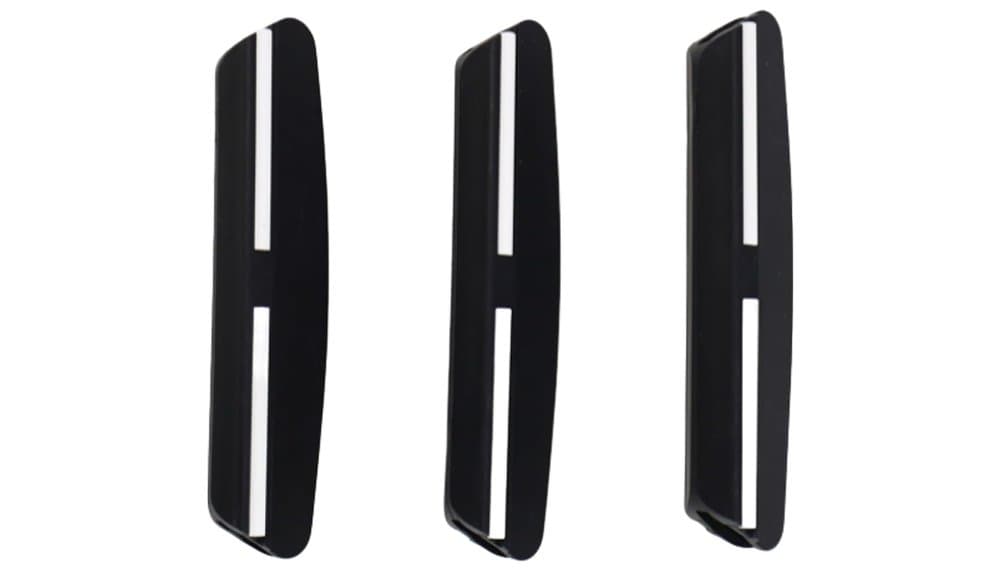
- Asserted Compatibility and Versatility: The set of three guides of different sizes is designed to fit a wide range of everyday blades, from chef's knives to paring knives. The manufacturers highlight use for both right and left-handed individuals.
- Simple and Portable Construction: With a weight of only 10 grams and minimal dimensions, the set is designed to be stored in a drawer. Its structure in reinforced plastic and ceramic is described as robust for its price, protecting the blade from direct contact with the plastic during sharpening.
Weak Points
The product's limitations are just as clear and often linked to the compromises of its simplified design.
- Limited Stability and Adaptability: This is the most frequently reported drawback. Customer reviews indicate that the guide "se mueve muchísimo" (moves a lot) or is "pas pour les couteaux plus petits" (not for smaller knives). Expert testers confirm: the fit and stability on atypical blades (very small, very wide, or with a pronounced heel) are problematic. This makes it a tool for "standard" blades.
- Slow and Tedious Process: Unlike mastered freehand sharpening (very fast) or a professional guided system, the setup and use are described as "slow." You lose speed for what you gain in safety. The accumulation of sharpening mud in the rails, requiring regular cleaning, contributes to this sluggishness.
- Precision and Finish Below Professional Standard: Compared to high-end systems (like Wicked Edge), the precision is judged as "good, but less impeccable." A slight lack of rigidity can be felt, affecting the fineness of the polish on very hard steels where absolute control is required.
- Materials and Long-Term Durability: Here, the "buy-it-for-life" analysis hits a wall. The product is entirely made of plastic, except for the ceramic inserts. No information on Rockwell hardness or the type of ceramic is available. Although deemed "solid for its price," it lacks the heirloom factor of a magnesite sharpening stone, a stainless steel guide, or a forged carbon steel knife. Its lifespan is that of its plastic parts.
Detailed Analysis
Philosophy and Target Audience
The Vidsmow Sharpening Guide Set does not claim to be a professional tool. It is the archetype of a teaching bridge. Its role is to allow an owner of nice knives, intimidated by freehand sharpening, to maintain their investment without risking damage. It transforms a subjective art into a more mechanical procedure. For the passionate cook who simply wants to keep their knives functional without becoming a seasoned sharpener, it has real utility. On the other hand, for the expert or someone seeking perfection on a knife with 62-64 HRC steel, this system will quickly be seen as limiting and imprecise.
See priceSuitability with Quality Steels
On paper, the principle is compatible with all steels. In practice, its effectiveness varies. For a knife in AUS-10 or a standard Western knife, it will give satisfactory results. For very hard steels with extreme edge retention (like some powder steels), sharpening requires a precision and "feel" that this plastic guide cannot fully provide. Furthermore, as experts note, forming the burr – a fundamental concept – remains the user's responsibility. The guide helps with the angle but does not exempt one from learning the basics of sharpening mechanics.
Ergonomics and Handling
Feedback is mixed. When well-adjusted on a standard blade, it offers a grip that eliminates the fatigue of focusing on the angle. However, the need to tighten the guide well, reposition it after each pass on the stone, and clean it breaks the fluidity. The experience is more procedural than intuitive, far from the direct and meditative relationship one can have with a free stone.
The "Buy-it-for-Life" Verdict
This is where the analysis is unequivocal. A "for life" object on our site is characterized by noble materials (steel, cast iron, durable wood), overbuilt construction, and the potential to improve with time (like the patina on a carbon steel wok). The Vidsmow Sharpening Guide Set is a consumable learning tool. Its durability is limited by its plastic nature. It does not "patinate," it wears out. Its goal is to bring you to a level where, perhaps, you will no longer need it. It is the antithesis of an heirloom but can be the trigger that allows you to care for objects that are.
Technical Specs
| Characteristic | Detail |
|---|---|
| Product Name | Vidsmow Sharpening Guide Set |
| Contents | 3 sharpening guides of different sizes |
| Main Material | Plastic |
| Blade Contact Material | Ceramic insert |
| Compatible | Right-handed & Left-handed |
| Total Weight | 10 grams |
| Dimensions (L x W x H) | 10 x 5 x 1 cm |
| Recommended Use | Common kitchen knives, workshop knives |
What Users Say
The synthesis of 15 customer reviews (average rating 3.7/5) and expert context reveals a clear landscape:
The praise comes mainly from satisfied beginners. They use terms like "no brainer," "begeistert" (enthusiastic), and emphasize that the guide "erspart erfolgreich die fehlstellung der winkel" (successfully avoids incorrect angle positioning). They achieve an edge they could not get manually.
The criticisms are recurrent and targeted:
- Stability Issues: "No se queda en la hoja, se mueve muchísimo" (It doesn't stay on the blade, it moves a lot). "Nicht für kleinere Messer geeignet" (Not suitable for smaller knives).
- Doubts About Quality/Usefulness: "Qualität leider sehr niedrig" (Quality unfortunately very low). "Un gadget sans réel intérêt... Pour tous les autres couteaux vous allez faire plus de mal que de bien" (A gadget without real interest... For all other knives you will do more harm than good).
- Usage Limits: Testers confirm it is "ideal for beginners" but may seem "limiting or too manual for experts."
The trend is clear: it is a product of mixed success, whose satisfaction depends entirely on the user's expectations and skill level.
Conclusion
The Vidsmow Sharpening Guide Set is a product with a simple proposition, which fills a specific niche with uneven results. For the serious cook at the start of their journey, who owns a few good standard knives and wants to learn to maintain them without risk, it represents a useful crutch. It can prevent costly mistakes and give the necessary confidence to get started.
However, analyzed through the demanding prism of buy-it-for-life and professional performance, it shows its limits. Its plastic construction, recurring stability issues on non-standard blades, and somewhat laborious process place it in the category of initiation accessories rather than definitive tools. It does not rival the precision of a high-end guided system, nor the freedom and speed of mastered freehand sharpening.
Our recommendation is therefore conditional: consider it a temporary teaching tool. Its goal should be to teach you the mechanics of a constant angle, so that you can eventually do without it and develop the "feel" of the free stone, the only method capable of perfectly adapting to each blade, regardless of its profile or steel. It is a means, rarely an end in itself, in the quest for a perfect edge.