Alpina Cast Iron Roasting Dish Review
Introduction
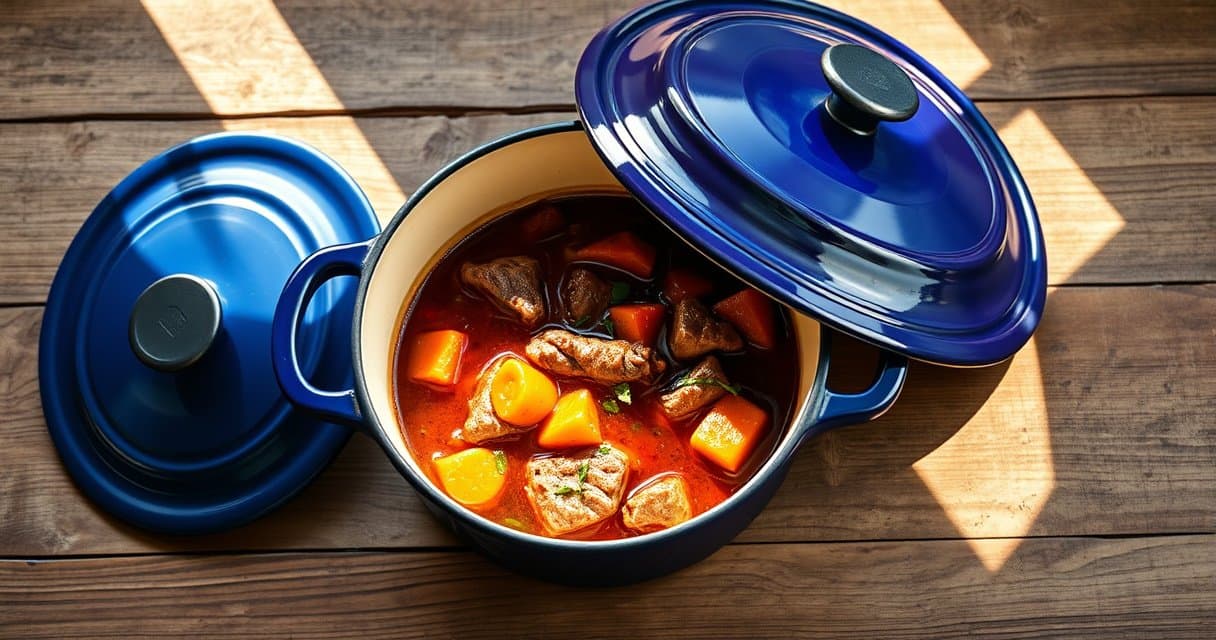
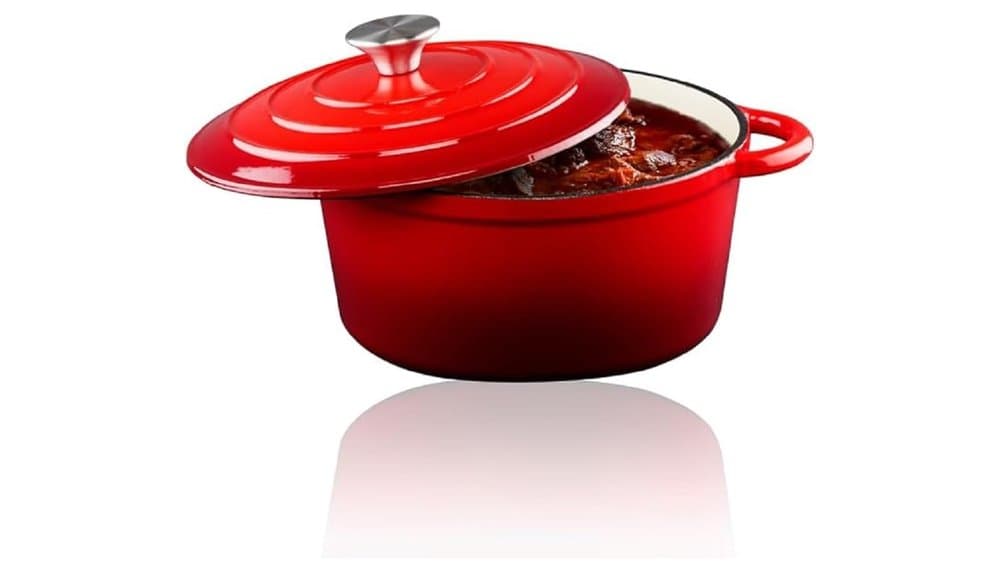
In the world of serious cookware, cast iron holds a special place. It's a material that speaks to cooking enthusiasts, promising unmatched thermal inertia and century-old durability. The Alpina Cast Iron Roasting Dish with Lid presents itself as a candidate for this legacy, an enameled cast iron cocotte with a diameter of 24 cm and a capacity of 3.8 liters. On a site dedicated to culinary tools designed to last, like Japanese VG-10 steel knives or carbon steel woks, such a piece must be evaluated against the same demanding criteria: the intrinsic quality of the materials, the finesse of craftsmanship, long-term ergonomics, and pure performance. This is not a disposable utensil, but an investment for the kitchen. Our analysis is based on the product's technical specifications, feedback published by the user community, and observations reported by online testers and experts, in order to determine if this item lives up to its promises for the exacting and demanding cook.
Strengths
The analysis of specifications and feedback converges on several major strengths for this Alpina cocotte.
Absolute cooking versatility is its first strong point. According to its specifications, it is compatible with all types of stovetops, including induction, and is oven-safe. This makes it a unique tool for searing, braising, roasting, and gratinating, ensuring a seamless transition from stovetop to oven. Online testers confirm this versatility, praising its performance for dishes as varied as roast chicken, long stews, or even bread baking.
The second pillar is its enameled cast iron construction. Raw cast iron is the material of choice for optimal heat retention and diffusion. The enamel coating, on the other hand, brings crucial ease of maintenance and eliminates the need for regular seasoning. The community notes that this finish also provides an elegant style with its bright red color, which is not negligible for a utensil intended to stay in view.
Finally, user feedback highlights its excellent perceived value for money. Compared to the ultra-premium market references, the Alpina is often described as a solid and performing alternative at a more accessible entry point, without sacrificing the core functionalities expected from a cast iron cocotte.
Weaknesses
However, the ideal does not exist, and feedback, both from users and experts, points out inherent compromises with this type of product.
The most cited and most predictable flaw is its substantial weight. Empty, it weighs 4.6 kilograms, requiring a certain physical strength to handle. Users note that this can be a hindrance for storage or for people with limited wrist strength. This is the price to pay for the thermal mass of cast iron.
Some online expert reviews raise questions about finish and quality control compared to the sector leaders. While the majority of users are satisfied, a few isolated customer reviews report enamel defects or chips upon receipt. This suggests possible variability in final quality control, an important dimension from a "buy-it-for-life" perspective.
Finally, an ergonomic point is noted: the lid handle. Testers mention that it can become uncomfortably hot during prolonged oven use and that its grip is not always optimal, especially with thick oven mitts. This detail, while not affecting cooking performance, impacts the daily user experience.
Detailed Analysis
Let's now dive into a thorough technical evaluation, feature by feature, to understand what truly defines the value of the Alpina Cast Iron Roasting Dish.
Materials and Construction: The Foundation of Durability
At the heart of this product lies cast iron. It is not a complex alloy like knife steels (VG-10, AUS-10), but its quality lies in its density and its ability to absorb and then release heat extremely evenly. Unlike raw cast iron which requires seasoning, the Alpina is coated with a vitrified enamel. This enamel is the key to its ease of maintenance and its rust resistance. According to the specifications, it is advertised as dishwasher safe – a notable advantage over bare cast iron or more delicate enamels. Long-term durability will primarily depend on the integrity of this enamel. Feedback reporting occasional chipping reminds us that enamel, while resistant, remains fragile against violent mechanical shocks. The construction as a whole is described as robust and without major design flaws, which is the minimum expected for a piece of this nature.
See priceThermal Performance: Where Cast Iron Excels
It is on the stove and in the oven that cast iron justifies its existence. Its heat retention capacity is exceptional. Once hot, it maintains a stable temperature, ideal for long braising or roasting where fluctuations are detrimental. Testers and users agree that the heat diffusion is perfectly homogeneous, eliminating hot spots that could burn the bottom of a sauce. However, this inertia has a downside: preheating is relatively slow. This must be taken into account and anticipated. Compatibility with all heat sources, including induction, is a real technical plus, made possible by the ferromagnetic nature of cast iron. Its oven resistance (the included lid also has a heat-resistant knob) makes it a perfect transition tool.
Ergonomics and Handling: The Weight/Performance Compromise
Ergonomics is the point where compromises are most visible. The side handles of the cocotte are molded into the piece. They are solid and adequately sized, but, like the whole piece, they become very hot. The use of potholders is absolutely mandatory, which is normal for this type of equipment. The lid is heavy and its knob, although resistant, is sometimes described as a bit small or becoming very hot. Its fit, however, is noted as very good, ensuring good moisture retention for braising. The total weight of 4.6 kg is an unavoidable physical fact. It provides stability and thermal inertia, but it demands muscular investment. For a tool designed to last a lifetime, this weight is almost a guarantee of solidity, but it may exclude some users.
Maintenance and Very Long-Term Durability
The "buy-it-for-life" promise rests on the object's ability to age without losing its functions. The enamel is the critical element here. If shocks and abrupt temperature changes (which could crack it) are avoided, it should last for decades. The dishwasher advantage, confirmed by the manufacturer, is a major asset for hygiene and daily ease, although gentle hand washing is still recommended to preserve the enamel's shine over the very long term. No information is provided on the availability of spare parts (such as lid knobs), which is often the Achilles' heel of absolute durability. As is, with proper care, nothing seems to prevent this cocotte from being passed down.
Technical Specifications
| Feature | Detail |
|---|---|
| Product Name | Alpina Cast Iron Roasting Dish with Lid |
| Diameter | 24 cm |
| Capacity | 3.8 liters |
| Main Material | Enameled cast iron |
| Color | Red |
| Weight | 4.6 kg |
| Compatible With | Induction, gas, electric, ceramic, oven |
| Oven Safe | Yes (lid included) |
| Care | Dishwasher (according to manufacturer) |
| Interior Finish | Enamel (type unspecified) |
What Users Say
The synthesis of 32 customer reviews (average rating 4.3/5) and online expert analyses paints a clear consensus, with identifiable points of tension.
The praise is majority and convergent:
- Perceived Quality and Aesthetics: The terms "very good quality," "beautiful cocotte," "magnificent," and "excellent cocotte" come up constantly. The aesthetic aspect of the product, especially its red color, is a real plus for users.
- Culinary Performance: One user reports a "perfect... roast beef cooking," and another notes the "good conduction" of heat. Experts confirm this ability to roast and gratin evenly.
- Value for Money: This is a leitmotif. "Very good value for money," "at a correct price," "for a reasonable price" are recurring formulations that clearly position the Alpina as a safe bet compared to the high-end.
The criticisms, less numerous, are instructive:
- Quality Control Issues: One review is extremely negative (1/5), denouncing a product "chipped in 3 places" upon receipt. This type of feedback, although isolated in the visible reviews, alerts to a possible inconsistency in the control or delivery chain.
- Weight and Bulk: "The weight is too heavy and the pan is too high," summarizes a Dutch user. This is not a surprise, but it confirms that this aspect is indeed a deterrent for a portion of clients.
- Brand Expectations: The expert context notes that in comparison with brands like Le Creuset or Staub, the enamel or finish may appear "slightly less perfect." This corresponds to the positioning logic of Alpina as a more accessible alternative.
Conclusion
The Alpina Cast Iron Roasting Dish with Lid presents itself as a serious and fully justified tool in a passionate cook's kitchen. Its analysis reveals a product that masters the essentials: an enameled cast iron construction offering high-level thermal performance, total versatility (induction, oven), and ease of maintenance theoretically compatible with a very long service life. It embodies a "buy-it-for-life" philosophy through its materials and robust construction.
However, it demands certain know-how and compromises from its owner. Its significant weight makes it a stable but physically demanding utensil. The few reviews reporting enamel defects remind us of the importance of carefully inspecting the product upon receipt. Finally, ergonomic details, like the lid handle, could be optimized.
Ultimately, for the serious cook seeking the benefits of enameled cast iron without the investment of iconic brands, the Alpina represents a rational and performing choice. It asks to be treated with the respect due to a work tool: gradual preheating, protection from shocks, and careful storage. If these conditions are met, everything indicates that it can become a durable and reliable pillar of the cookware collection, capable of producing excellent dishes for decades to come. It is a piece that deserves its place alongside well-tempered knives and perfectly seasoned woks.