Amazon Basics 400-1000 Grit Sharpening Stone Review
Introduction
Maintaining a sharp edge is the fundamental act that separates a collection of knives from a truly functional kitchen arsenal. For enthusiasts of Japanese knives, hardened Western steels, or good old chef's knives, the choice of a sharpening stone is not trivial. It impacts the knife's effectiveness, longevity, and the pleasure of cutting. The Amazon Basics 400-1000 Grit Sharpening Stone positions itself on the market as a particularly affordable entry-level option. But in a world where one speaks of Shapton, Naniwa, or Suehiro, what is this dual-sided stone really worth? Here, we are not in subjective testing, but in a cross-analysis: what do its specifications, the feedback from thousands of users, and the comments from connoisseurs say? Can it claim a place in the workshop of a serious cook who thinks in terms of durability and performance?
Strengths and Weaknesses
Strengths
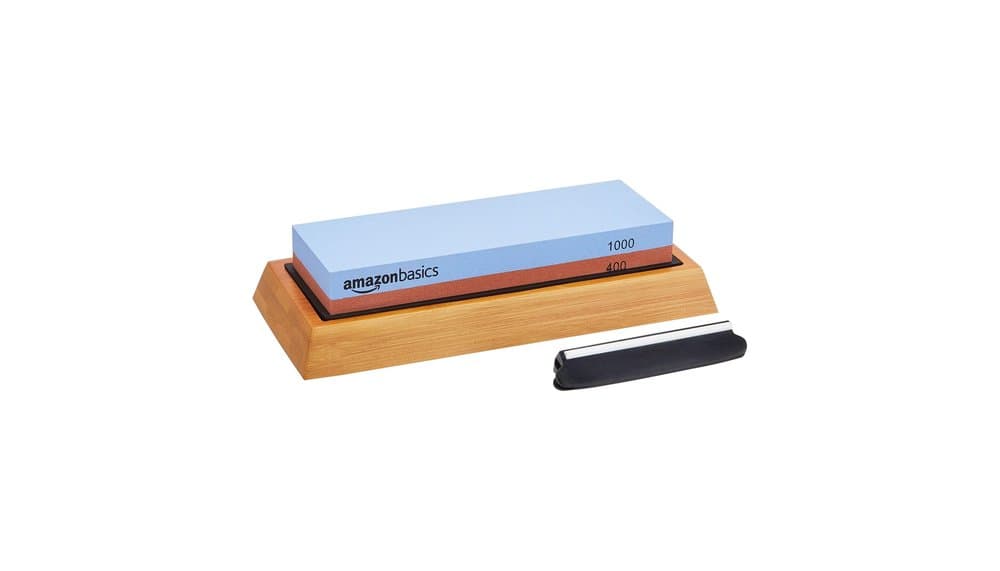
- Accessibility and Immediate Usability: The kit is complete with a non-slip bamboo base and an angle guide. For an absolute beginner, this removes a layer of apprehension.
- Relevant Grit Range for Restoration: The 400/1000 grit combo covers the essential bases: repair (400) and routine sharpening/refinement (1000).
- Initial Perception of Excellent Value for Money: A majority of customer reviews highlight satisfaction relative to the entry cost for functional results.
Weaknesses
- Durability and Stone Wear: The community and expert testers note that the stone, especially the 400-grit side, tends to wear down and dish relatively quickly, challenging its "buy-it-for-life" status.
- Limited Performance on Hard Steels: It quickly shows its limitations when facing modern alloyed steels (such as VG-10, AUS-10, X50CrMoV15 hardened), where abrasion becomes slow and laborious.
- Finish and Maximum Sharpness: The 1000 grit, while sufficient for a working edge, is often deemed insufficient for achieving a razor edge or a fine polish worthy of enthusiast standards.
Detailed Analysis: A Tool for Initiation, Not Expertise
Materials and Construction: Between Practicality and Compromise
On paper, the product is presented as a dual-sided water stone with a bamboo base and silicone feet. The dimensions (18 x 6.1 cm) are standard and offer a correct working surface for most kitchen knives. However, when discussing materials for a tool meant to last, it is the quality of the abrasive itself that matters. Unlike a high-end sharpening stone where the composition and density of the binder are known, here the specifications remain vague ("Stone"). Feedback from experienced users corroborates this impression of a softer and less homogeneous material compared to stones from specialized brands. The bamboo base is a plus for stability, but it does not compensate for the stone's intrinsic limitations.
See pricePerformance Against Different Steels: The Great Divide
This is the heart of the matter for our audience. How does this stone perform against a carbon steel knife (White Steel #2) with a hardness of 62-63 HRC, or a Western knife in X50CrMoV15 at 58 HRC?
- On soft or low-end steels: According to feedback, performance is perfectly acceptable. The stone bites enough to reform an edge on a standard kitchen knife. This is where it finds its primary utility.
- On hard and alloyed steels (VG-10, AUS-10, etc.): The analysis is clear. As noted by a knowledgeable user in the reviews, as soon as one moves to more wear-resistant modern steels, the process becomes "laborious." The stone wears down faster than it removes metal from the blade. For a professional chef's knife or a high-performance Japanese knife, this translates into endless and frustrating sharpening sessions. The edge sharpness achieved with the 1000 grit will be functional, but far from the polish and bite that a similar grit on a higher-quality stone would allow.
Accessories and Ergonomics: A Helping Hand for Beginners
The kit includes two notable elements:
- The Angle Guide: This is a pedagogical tool. It helps conceptualize the constant angle required for sharpening. However, purists and experts quickly abandon it, as it does not allow for the finesse and "feeling" of freehand sharpening, which is crucial for preserving the complex profile of certain blades.
- The Non-Slip Bamboo Base: It is consistently praised in reviews for its effectiveness. It keeps the stone stable during use, a non-negligible point for safety and comfort, especially for a beginner.
Durability and Maintenance: The Gap with the "Buy-It-For-Life" Philosophy
This is the major point of divergence. A "buy-it-for-life" product is characterized by robust materials and minimal maintenance that preserves its function. Here, the pattern is reversed. The stone requires constant maintenance: pre-soaking, frequent flattening (to make it flat again) as it dishes, and cleaning. More problematically, its wear rate is high. It is not designed to last for decades. It is designed to teach and be useful for a time, before the user, if they become serious, turns to a more durable and performant tool. In this regard, it is diametrically opposed to the durability of a diamond plate (which remains perfectly flat) or a dense Japanese stone like the Shapton Pro.
Technical Specifications
| Characteristic | Detail |
|---|---|
| Product Name | Amazon Basics 400-1000 Grit Sharpening Stone |
| Type | Dual-sided water sharpening stone |
| Grits | 400 grit (red/blue side) / 1000 grit (blue/red side) |
| Dimensions (L x W x H) | 18 x 6.1 x 2.8 cm |
| Weight | 0.65 kg |
| Stone Material | Abrasive stone (composition unspecified) |
| Included Accessories | Non-slip bamboo base, blade angle guide |
| Maintenance | Use with water, clean with water |
What Users and the Community Say
The synthesis of over 4700 customer reviews (overall rating of 4.3/5) and expert analyses paints a very clear, almost bipolar landscape.
The Beginner / Occasional User Perspective (Majority of 5-star reviews):
- Immediate Satisfaction: Terms like "amazing," "like new," "very easy to use" constantly recur. For those who have never sharpened a knife before, the results represent clear progress.
- Appreciation for the Complete Kit: The stable base and the guide are seen as valuable aids.
- Praise for Value for Money: The majority feel they got much more than what they paid for.
The Demanding User / Enthusiast Perspective (3-star reviews and below, specialized forums):
- Premature Wear: The observation of a stone that dishes and wears down too quickly is a recurring theme.
- Technical Limitations: Inability to efficiently handle hard steels, finish result (1000 grit) judged too coarse for an optimal edge.
- Verdict: Considered a good stepping stone to discover the discipline, but quickly limiting as one's skills and knife quality improve. Many recommend skipping this step and directly investing in a diamond plate or a good quality entry-level Japanese stone from a reputable brand to save time, achieve better results, and gain peace of mind.
Conclusion
The Amazon Basics 400-1000 Grit Sharpening Stone perfectly fulfills the mission for which it was designed: to democratize access to manual sharpening. It is the ideal, low-cost, and reassuring entry point for someone who wants to move away from pull-through sharpeners and learn the fundamental techniques on common kitchen knives.
However, when evaluated against the strict criteria of a site dedicated to high-performance and durable kitchen tools, it cannot claim the status of a professional or "buy-it-for-life" tool. Its materials, limited durability, and reduced performance on premium steels place it below the requirements of a serious cook equipped with Japanese carbon steel knives or modern alloyed stainless steel knives.
Our conclusion is therefore nuanced: it is an excellent educational tool, but it is a transitional tool. It will teach you if sharpening becomes a passion. And the day you seek to unlock the potential of a VG-10 blade at 61 HRC or maintain the fine edge of a Nakiri in Blue Steel, you will naturally look towards more specialized and enduring equipment. It is a beginning, rarely an end.