Amazon Basics Pre-Seasoned Cast Iron Skillet Review
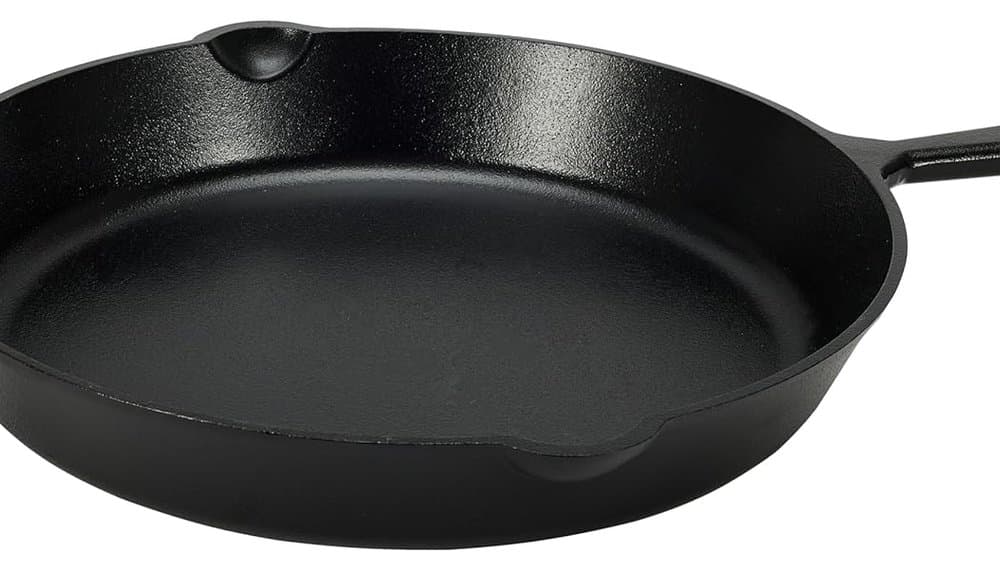
Analysis of the Amazon Basics Pre-seasoned Cast Iron Skillet (38.8 cm)
In the world of durable cookware, cast iron holds a special place. An ancestral material, it embodies the "buy-it-for-life" ideal through its resilience and its ability to improve over time. The Amazon Basics Pre-seasoned Cast Iron Skillet presents itself as an entry-level proposition in this market. Our analysis will dissect this skillet from the demanding perspective of the serious cook, evaluating its materials, construction, real potential, and long-term viability against established references.
Strengths
Based on user feedback and comparative tests, several strengths stand out for this skillet.
- Affordable entry price: This is its main selling point. It allows access to the benefits of cast iron without a high initial investment.
- Fundamental qualities of cast iron: Like any good piece of cast iron, it offers excellent heat retention and even distribution, ideal for perfect searing, frying, and dishes going from stovetop to oven. It is compatible with all heat sources, including induction and campfires.
- Functional pre-seasoning: The majority of users confirm that the factory pre-seasoning allows for immediate use. Food does not stick catastrophically from the first use, which makes it easier to get started.
- Structural robustness: The bare cast iron construction is intrinsically strong and shock-resistant. It is not afraid of metal utensils and withstands very high temperatures.
Weaknesses
The compromises related to its economic positioning are clearly identified by the community.
- Problematic weight and ergonomics: At nearly 5 kg, this 38.8 cm skillet is consistently described as very heavy, even for cast iron. The main flaw highlighted by testers is the design of the main handle: it is considered too short and its profile does not offer a comfortable and secure grip, especially with oven mitts. The second helper handle helps but does not compensate for this ergonomic flaw.
- Grainy surface finish: Compared to brands like Lodge, its cooking surface has a rougher, grainier finish. This can hinder initial non-stick performance and requires slight polishing and personal re-seasoning to reach an optimal state.
- Durability of the pre-seasoning: Several reviews report a sensitivity to rust if maintenance is not meticulous. The factory coating seems minimalistic and must be reinforced quickly to avoid oxidation, even with careful drying.
- Handle heat: As is often the case with cast iron, the main handle gets burning hot during stovetop use, always requiring a towel or potholder.
Detailed Analysis
Materials and Construction
There is no mystery here: the skillet is made of bare cast iron. It is not enameled cast iron. It is this massive material that gives it its heat retention and slow heat diffusion properties. On paper, the specifications state oven safe up to 260°C, a suitable temperature for most cooking, although some high-end models can withstand more. The weight of 4.9 kg for a 38.8 cm diameter indicates a substantial thickness of material, a guarantee of thermal stability and longevity.
See price"Buy-It-For-Life" Evaluation
The "for life" potential is real, but conditional.
- Intrinsic durability: Cast iron is almost indestructible if not cracked by violent thermal shock (sudden change from cold to very hot). From this point of view, the object is solid.
- Limiting factor: maintenance: The actual longevity depends entirely on the user. The negative feedback concerning rust shows that the factory pre-seasoning is not sufficient protection in the long term. To make it an heirloom, one must consider this skillet as a raw base to personalize: light sanding of the most prominent roughness followed by several cycles of oven seasoning with a polymerizable oil (like flaxseed oil) is highly recommended by purists.
- Comparison with references: Faced with a similar-sized Lodge, often cited as a reference, testers note a deficit in ergonomics and finish. Lodge typically has a longer, better-designed handle and a slightly less rough surface. The Amazon Basics seems to be a functional copy that cuts corners on the details that make a difference in daily intensive use.
Cooking Performance
On pure performance, it delivers on its cast iron promises. Once properly hot, it sears excellently and develops beautiful Maillard reactions. Its significant mass prevents untimely temperature drops when adding food. Its thermal inertia is high, which requires anticipation in heat control – this is a characteristic of cast iron, not a flaw. The surface, once properly seasoned by the user, becomes increasingly non-stick.
For What Type of Cook?
This skillet is suitable for:
- The cook curious about cast iron who does not want to invest a significant sum for a first experience.
- The one who is motivated to maintain it (immediate drying, occasional oiling, re-seasoning if necessary).
- Occasional use for large quantities (searing steaks for a crowd, making a large vegetable sauté).
It will be less suitable for:
- The cook seeking daily ergonomics: its weight and short handle make it less manageable.
- Those who want a perfectly finished and optimal product right out of the box without customization work.
- For cooking requiring quick thermal responsiveness (cast iron is slow to heat up and cool down).
Technical Specifications
| Characteristic | Detail |
|---|---|
| Material | Bare Cast Iron |
| Diameter | 38.8 cm (approximately 15.25 inches) |
| Capacity | 5.9 quarts (approximately 5.6 liters) |
| Weight | 4.9 kg |
| Finish | Pre-seasoned (polymerized vegetable oil) |
| Compatible with | All stovetops (gas, electric, induction, halogen, ceramic). Oven. |
| Oven Safe | Up to 260°C |
| Handles | One long main cast iron handle and a secondary helper handle |
| Maintenance | Cleaning with hot water (avoid excess soap), immediate and thorough drying, occasional oiling. Hand wash only. |
What Users Say
A synthesis of 13,985 reviews (average rating of 4.4/5) and expert feedback reveals clear trends.
Praise focuses on:
- The value for money for a first cast iron skillet.
- The cooking performance once hot: impeccable sear, even heat.
- The versatility (stovetop, oven, grill).
- The perceived feeling of sturdiness and durability.
Recurring criticisms are:
- Weight and maneuverability: "extremely heavy", "difficult with one hand". The handle is the most cited pain point.
- The need for re-seasoning: Several users indicate having had to re-season the skillet upon receipt to improve non-stick performance and prevent rust. One user even notes that the pre-seasoning "wore off" quickly.
- Rust appearance: Some report oxidation problems even with careful maintenance, pointing to the quality of the original pre-seasoning.
- Rough finish: The surface is described as less smooth than that of direct competitors, sometimes requiring a longer "breaking-in" period.
The community's advice is unanimous: to succeed with this skillet, you must lightly oil it after each drying and not hesitate to perform one or several oven seasoning cycles using the classic method (thin coat of oil, baking in an upside-down oven, rinsing with hot water). This initial work transforms the experience.
Conclusion
The Amazon Basics Pre-seasoned Cast Iron Skillet is an ambiguous product. On one hand, it unquestionably delivers the fundamental advantages of cast iron: thermal inertia, heat retention, and a potential durability of several decades. Its price makes it an attractive entry point.
However, its status as an economic alternative comes at the cost of significant compromises on ergonomics and finish. Its poorly designed handle and significant weight make it less pleasant to handle daily. Its minimal pre-seasoning almost always requires a personal investment of time to strengthen it and avoid rust.
Our verdict: It is a functional tool that can perfectly become a good kitchen companion if you are willing to adopt it and "make it your own" through careful re-seasoning, and if you can tolerate its lack of ergonomic finesse. For intensive and demanding use where comfort of use is paramount, it is often reported that the additional investment in a specialized brand like Lodge is justified. For the kitchen tinkerer who likes to personalize their tools and is looking for a robust base at a low price, the Amazon Basics represents an opportunity. In both cases, it confirms a golden rule of cast iron: its final performance depends less on the brand than on the attention and regular maintenance provided by its owner.