AnySharp Knife Sharpener Test and Review
Introduction
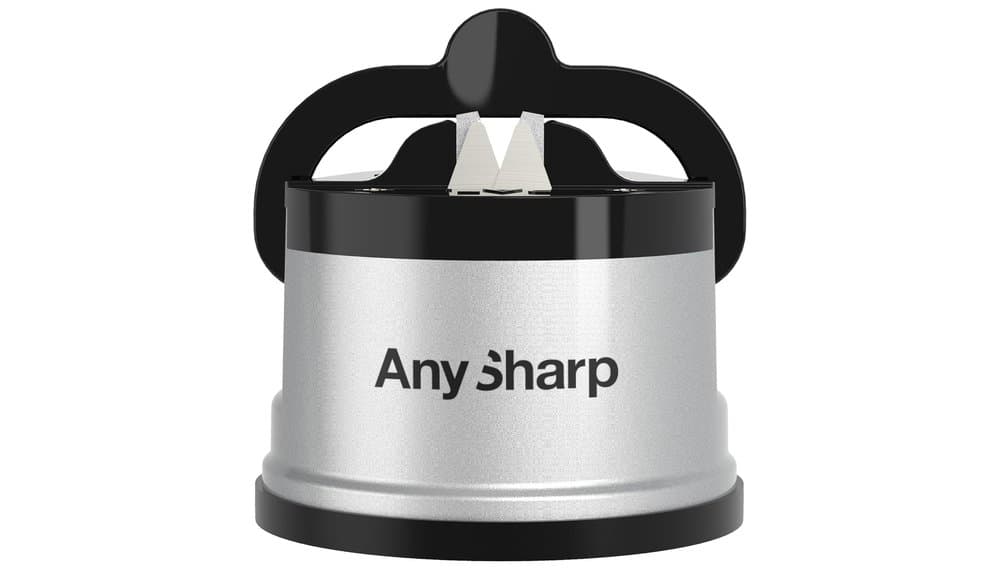
On a site dedicated to high-performance and durable kitchen tools, the analysis of a product like the AnySharp Knife Sharpener is necessarily approached with pragmatism. Here, we focus on objects designed to last and to seriously support culinary passion. When faced with knives made from VG-10 Japanese steel, carbon steel, or high-carbon stainless steel, what is the true role of this compact sharpener with assertive marketing? We will dissect its specifications, compare its promises with feedback from the community and testers, and determine its place, or lack thereof, in the arsenal of a demanding cook.
Immediate Strengths
Based on user feedback and expert analyses, the AnySharp presents concrete advantages that explain its broad commercial success with the general public.
Remarkable Accessibility and Safety
The PowerGrip suction cup system is the major asset praised by most. Users confirm that it attaches solidly to most smooth work surfaces (glass, ceramic, clean laminate), freeing both hands to guide the knife. This eliminates the risk of injury from a moving sharpener, a non-negligible safety point for domestic use.
Radical Simplicity of Use
No skill is required. The angle is preset to 20 degrees, a standard for many mainstream Western knives. One simply pulls the blade through the slot several times. For common, slightly dull kitchen knives, testers emphasize that it restores a functional edge very quickly, allowing for cutting tomatoes or meat without force. Its compact size is also an asset for storage.
Weaknesses and Structural Limits
When analyzed through the lens of quality knives and a "buy-it-for-life" philosophy, the AnySharp's weaknesses become glaring.
An Aggressive Material and Mechanism
The abrasive element consists of tungsten carbide blades. This material is extremely hard and works by tearing away metal to reform an edge. It is an effective but brutal process. According to feedback, it is common to see metal shavings being removed, especially on very dull blades. For budget or soft steel knives, several users report this can create chips or "holes in the edge." This is not sharpening; it is abrasive re-edging.
See priceUnsuitable for Quality Knives and Japanese Blades
This is the fundamental breaking point. Japanese knives (in white/blue steel, VG-10, etc.) or high-end Western chef's knives have precise heat treatments, specific Rockwell hardnesses (often between 58 and 65 HRC), and complex bevel geometries (single, double, asymmetric). The AnySharp, with its single fixed angle and carbide blades, will:
- Destroy the original geometry of the edge, often finer than 20°.
- Excessively tear metal from a hard blade, wearing it prematurely.
- Not allow for precision sharpening or polishing of the edge. The result will be a biting but irregular and fragile edge, far from the "razor" edge sought on this type of tool.
The Promise on Serrated and Double-Edged Knives
Opinions on its ability to sharpen serrated blades are very divided. Some use it successfully on the straight part of the blade (non-serrated). Others, as highlighted by a customer review, have outright destroyed their bread knife trying. Expert testers generally recommend not using it for this, as systems adapted for serrations are completely different.
Questionable Durability and Build Quality
The body is entirely made of plastic. While the polymer blade guide is designed to protect the back of the edge, the overall construction does not inspire confidence for a decade of intensive use. The lifespan of the carbide jaws is limited, and although replacement parts are advertised, this is far from the longevity of a good whetstone which can last a lifetime.
Detailed Analysis for the Passionate Cook
For the enthusiast of fine knives and high-performance tools, the AnySharp cannot be considered a primary sharpening tool. Its function is different: it is an emergency patcher or a maintainer for daily service knives, those one doesn't mind sacrificing a little.
Ergonomics are good for its role: once fixed, it is stable. But the "ergonomics of use" for serious sharpening are non-existent, as it allows neither control of pressure, choice of angle, nor the feel of metal on stone.
"Heat distribution" is irrelevant here, but one could speak of abrasion distribution: it is uniform only if the blade is perfectly straight and if the user pulls it perfectly straight. A clumsy motion can create an uneven sharpening.
Long-term durability is its weakest point. On paper, the plastic and carbide can last, but the true durability concerns your knives. A sharpener that wears metal so aggressively significantly reduces the total lifespan of your blades, removing much more material than sharpening with stones would. For a "buy-it-for-life" knife, it is counterproductive.
Technical Specifications
| Feature | Detail |
|---|---|
| Product Name | AnySharp Knife Sharpener |
| Main Material | Plastic |
| Abrasive | Tungsten carbide blades |
| Sharpening Angle | Preset to 20° |
| Mounting System | PowerGrip Suction Cup |
| Dimensions (L x W x H) | 6.3 x 6.3 x 7 cm |
| Weight | 59 grams |
| Advertised Function | Sharpens smooth blades and (with caution) partially serrated blades |
| Manufacturer Warranty | Limited Lifetime Warranty (on components) |
Important Note: The specifications sorely lack essential information for an informed enthusiast: the exact type of carbide, its grit, its hardness. This vagueness is itself an indicator of the target audience.
What Users and Testers Say
The synthesis of thousands of customer reviews and web expert analyses reveals a very clear picture, in two parts.
The praise (majority) focuses on:
- Immediate effectiveness: "Restores bite quickly", "my knives cut again".
- Safety: "Both hands are free", "no more risk of cutting oneself".
- Simplicity: "No technique required", "accessible to everyone".
- The perceived value for money for basic use.
Recurring criticisms (often from more demanding or unlucky users) highlight:
- Finicky suction cup: "Doesn't hold on wood" or on slightly textured surfaces.
- Aggressiveness on soft steels: "It makes holes in the edge of budget knives".
- Destruction of serrated knives: Clear reviews indicating damaged blades.
- Unsuitability for good knives: Many note that one should absolutely not use it on quality, chef's, or Japanese knives.
- A limited result: It provides a "jagged" edge under the microscope, which cuts but does not glide like an edge polished on a stone.
Expert testers confirm this divide: a practical and valid tool for daily cooking with standard knives, but to be absolutely avoided for a valuable knife or one requiring a precision edge.
Conclusion
The AnySharp Knife Sharpener is a product that excels in its category: that of fast, unpretentious sharpeners for troubleshooting common domestic knives. Its commercial success is perfectly understandable.
However, in the ecosystem of a site dedicated to durable, high-performance tools like Japanese knives, carbon steel woks, or cast iron, it finds no place as a recommendable tool. Its abrasive mode of action, fixed angle, and plastic construction make it the antithesis of the "buy-it-for-life" philosophy. For the serious enthusiast, investing in a double-grit whetstone (for example, 1000/3000 grit) and learning the technique – a rewarding and precise skill – is the only way to maintain and reveal the potential of one's blades over the very long term. The AnySharp remains a practical gadget for a kitchen drawer, but a gadget whose limits must be known, lest one permanently damage fine tools.