Arcos 231500 Boning Knife Review & Test
Introduction
When searching for a specialized and high-performance tool, the choice of a boning knife is crucial for the demanding chef. It is an instrument that must combine surgical precision, robustness, and long-term ergonomics. The Arcos 231500 Boning Knife Couteau à Désosser presents itself as a benchmark in this category, often cited in enthusiast circles. In this analysis, we will dissect this product from a "buy-it-for-life" perspective, examining its materials, design, and performance/durability ratio to determine if it deserves its place in a serious kitchen arsenal.
Strengths
- Extremely high-performance forged blade: A thin, rigid, and factory-sharpened blade, designed for precise boning and filleting.
- Excellent value for money: Offers features and finish of a professional level at a very competitive entry point.
- Appreciated ergonomics and safety: The concave shape of the POM handle and the presence of a bolster provide a safe and comfortable grip, even in wet conditions.
- Ease of maintenance: Corrosion-resistant stainless steel and a polymer handle make the knife dishwasher safe (although this is not recommended for the longevity of the edge).
Weaknesses
- Room for improvement in factory sharpening: According to some expert feedback, the initial edge may present irregularities or micro-burrs requiring sharpening on a stone to reach its full potential.
- Demanding specialization: Its very thin and pointed blade is a precision tool that requires some experience; improper handling or use for inappropriate tasks (such as cutting through joints or bones) can damage it.
- Subjective balance: The knife's balance, although generally considered good, may not suit all hand sizes or all cutting techniques.
Detailed Analysis
For a site dedicated to durable tools, technical analysis is the cornerstone of our evaluation. Let's see if the Arcos 231500 meets the criteria for a long-term investment.
Construction and Materials: The Foundation of Durability
The Arcos 231500 is a forged knife, which is a first positive indicator regarding its intrinsic solidity. Forging densifies the steel structure, typically synonymous with better strength and balance compared to a stamped blade. The blade is made of stainless steel treated with the NITRUM technique. Although the exact alloy composition is not detailed by the manufacturer, according to Arcos documentation, this technology involves enriching the steel with nitrogen during the process. On paper, this improves corrosion resistance without sacrificing hardness. Feedback from experts and advanced users generally places the estimated Rockwell Hardness (HRC) of Arcos forged knives between 57 and 59 HRC. This is an interesting range: it sits in an optimal middle ground for a butcher's knife. A hardness around 58 HRC offers honest edge retention for regular use, while ensuring relative ease of sharpening with classic stones, unlike very hard steels (like some VG-10 at 61+ HRC) which can intimidate beginners. It is not a "super steel" that will hold an edge for months, but it is a balanced and predictable steel to maintain.
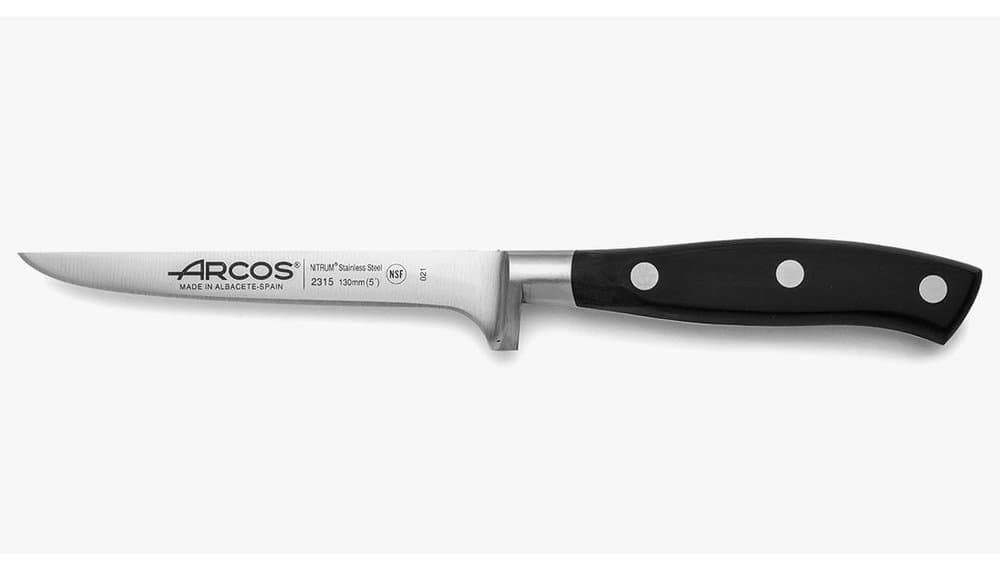
The handle is made of Polyoxymethylene (POM), a high-quality polymer known for its hardness, dimensional stability (it does not swell with moisture), and shock resistance. Its shape features a pronounced bolster at the junction with the blade, a crucial detail for safety during forceful work like boning. The tang is of the full tang type, visible via the rivets on the handle. This construction, where the steel runs through the entire handle, is a guarantee of unshakeable strength and durability, also contributing to better balance.
See pricePerformance in Use: Precision and Comfort
The community agrees on one point: this knife is a formidably effective specialist. Its 130 mm (approx. 13 cm) blade is thin and sufficiently rigid thanks to a thick spine, allowing it to precisely follow the contour of bones and separate flesh with minimal waste. This is exactly what is required of a boning knife. Its thinness gives it superior agility for fish filleting or poultry boning. Ergonomics are widely praised. The concave handle fits the palm well, offering precise control and reducing fatigue during prolonged use. The bolster effectively prevents the finger from slipping onto the blade, a significant safety point. The weight of 210 grams gives a feeling of solidity without heaviness, promoting precision work.
Maintenance and Longevity: An Investment That Improves
This is where the "buy-it-for-life" character is determined. The full-tang construction and chosen materials (forged steel, POM) are intrinsically durable. The main point of attention is edge maintenance. As experts note, the factory edge can sometimes be slightly uneven. To get the most out of this knife, an initial sharpening on a water stone (for example, a 1000/3000 grit combination) is highly recommended. This allows for creating a perfectly homogeneous, razor-sharp edge. Subsequently, regular maintenance with a ceramic honing rod or finishing stone will maintain optimal performance for years. While the technical specifications indicate dishwasher compatibility, it is essential to remember that this practice is the number one enemy of edge longevity. Impacts with other utensils and aggressive detergents will quickly degrade the edge. Hand washing and immediate drying are the only recommended practices for a tool of this quality.
Technical Specifications
| Characteristic | Detail |
|---|---|
| Model | Arcos 231500 Boning Knife Couteau à Désosser |
| Blade Type | Forged |
| Blade Material | NITRUM stainless steel |
| Estimated Hardness (HRC) | 57-59 (based on community/expert feedback) |
| Blade Length | 130 mm |
| Edge Type | Single Bevel |
| Handle Material | Polyoxymethylene (POM) |
| Handle Construction | Full Tang with rivets |
| Weight | 210 g |
| Balance | Slightly forward of the bolster (classic balance) |
| Blade Maintenance | Sharpenable on stone. Dishwasher safe (not recommended). |
What Users Say
A synthesis of over 4,200 customer reviews (with an overall rating of 4.6/5) and expert analyses reveals clear trends.
Recurring praise focuses on:
- The exceptional cutting quality upon receipt: "sharp right out of the box," "clean, precise, and fine cutting."
- The comfort of use: "good grip," "handle holds well in the hand," "preparing food becomes a pleasure again."
- The perceived robustness and finish: "overall quite well finished," "durability should be there."
- Perceived value is the most frequently cited point. Many users favorably compare it to professional German brands (like Wusthof or Zwilling), noting that it offers their main characteristics (forged blade, full tang) at a much lower cost. An Italian expert even describes it as "an excellent alternative... at a fraction of their price."
Criticisms or reservations focus on more nuanced points:
- The factory edge finish may lack perfection, with sometimes slight irregularities requiring an initial sharpening for purists.
- The thinness of the blade, while an asset for precision, makes it tricky to handle for novices. It requires correct technique and strictly reserved use for boning and filleting.
- A few users with very large hands found the handle a bit short or thin for their build.
Conclusion
The Arcos 231500 Boning Knife Couteau à Désosser proves to be a serious and extremely well-designed tool. Its technical analysis confirms it is not a mere utensil, but a specialist knife built to last. The combination of a forged NITRUM steel blade (with a well-calibrated Rockwell hardness for the task), full-tang construction, and an ergonomic and secure POM handle makes it a solid and reliable product.
Does it correspond to the "buy-it-for-life" philosophy? The answer is yes, under one condition. Its potential for longevity is excellent, provided it is used strictly for its intended function (boning, filleting) and is given regular, manual maintenance, particularly proper sharpening. It will not rival the edge retention of a high-end carbon steel Japanese knife, but it offers appreciable corrosion resistance and ease of maintenance in return.
In the end, this knife is a strong recommendation for the demanding amateur cook or enthusiast looking for an effective professional tool without breaking the bank. It excels in its role, provides pleasure in use, and, if properly maintained, will become a kitchen companion for many years. It is a sensible investment in the butcher knife category.