BIYM 600-1500 Corundum Whetstone Review & Sharp Test
Introduction
In the world of sustainable culinary tools, a sharp knife is not a luxury, it's a necessity. Maintaining the edge is as crucial as the quality of the blade itself. Today, we analyze the BIYM 600-1500 Corundum Double-Sided Whetstone, a product presented as an all-in-one solution for home sharpening. Our goal: to determine if this tool, through its specifications and the feedback it generates, can claim a place in the kit of a serious cook who adheres to the "buy-it-for-life" philosophy. Is it a lasting companion for your carbon steel, VG-10, or AUS-10 knives, or simply a short-lived accessory?
Strengths and Weaknesses: A First Look
Before diving into the details, here is what immediately stands out from the analysis of the specifications and community feedback.
Strengths:
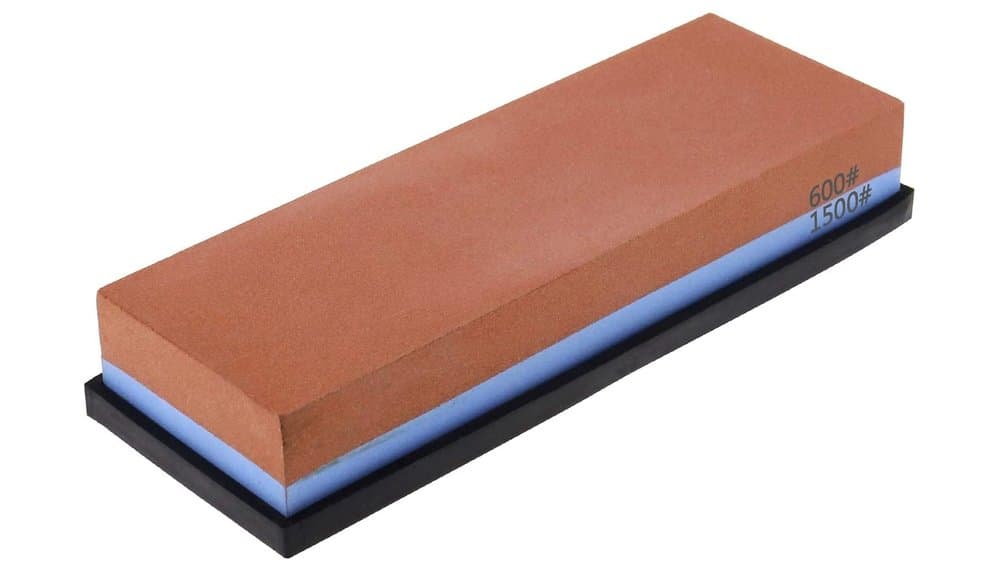
- Built-in versatility: The combination of 600 and 1500 grits on a single block allows for both reprofiling a damaged edge and polishing it.
- Ease of handling: The included non-slip silicone base and the principle of water sharpening make it a product often recommended for beginners.
- Compact and practical format: Its dimensions (18.3 x 6.1 cm) make it an easy-to-store and handle tool.
Weaknesses:
- Fineness limit: The 1500 grit is considered a low ceiling for those seeking an optimal razor edge or a mirror finish, requiring the addition of finer stones.
- Durability in question: The community and testers emphasize that the longevity of the stone itself may be inferior to high-end models, with a risk of uneven wear or dishing.
- Restrictive size: For long chef's knives (over 20 cm), the width of the stone can make the movement less stable and fluid.
Detailed Analysis: Beyond the Promises
The Raw Material: White Corundum
The BIYM 600-1500 is made of white corundum, a synthetic aluminum oxide. It's a classic and economical material in the world of water stones. On paper, it offers a good compromise between aggressiveness and control. Compared to diamond stones (faster and more durable) or ceramic stones (for micro-finishing), white corundum positions itself as the "educational" and versatile option. Its action is less harsh than a diamond stone of the same grit, allowing a beginner to better feel the contact with the blade and correct their angle without risking removing too much material too quickly. However, this same gentleness can be perceived as a relative slowness for restoring an edge to a very dull blade.
Grit in Practice: 600 and 1500 Grit, For What Use?
The value of this stone lies in this duality. Let's analyze each side:
- 600 grit side (coarse grain): This is the repair side. It is designed for reprofiling work, for example to fix a chipped edge or restore an angle to a completely dull blade. According to user feedback, it is effective for this task, but its use should be measured. On hard steels (like VG-10 at 60-61 HRC), it will require some time and patience. On softer steels, it will bite faster. This is a side to use sparingly, only when necessary.
- 1500 grit side (fine grain): Presented as the polishing side, it serves to refine the edge created by the 600 grit and remove coarse scratches. It produces a functional and noticeably improved edge for daily kitchen use. However, experts are unanimous: a 1500 grit represents an intermediate finish. For a high-performing Western or Japanese kitchen knife, a complete sharpening would require continuing with finer grits (3000, 5000, 8000) to obtain a razor edge and a perfectly clean cutting bevel. The BIYM 600-1500 is therefore an excellent tool for regular maintenance, but not for refinement.
Construction, Ergonomics, and the "Durability" Factor
The stone comes with a non-slip base, a non-negligible detail for safety and work quality. A stable base is essential for maintaining a constant angle. The overall size, while convenient for storage, can be a hindrance for sharpening long blades, where a continuous motion is preferable.
In terms of durable construction ("buy-it-for-life"), the analysis is nuanced. The stone itself is a consumable. The question is not whether it will last a hundred years, but whether its wear rate is acceptable and if it resists dishing. Here, community feedback indicates a point of caution. Compared to stones from reputable brands (Shapton, Naniwa), the binder for the corundum in the BIYM seems less dense and less resistant. This translates to a stone that may wear out faster, especially if the pressure is not perfectly uniform, leading to dishing in the center. For occasional use, this may be sufficient. For regular and demanding use, this is a limitation to consider.
For Which Knives and Which Users?
This stone finds its audience:
- The beginner home cook who wants to learn the basics of sharpening without a heavy investment.
- The user wanting regular maintenance for a set of standard kitchen knives (common stainless steels, soft carbon steels).
- The DIYer for sharpening scissors, tools.
It shows its limits with:
- Ultra-hard steels (>62 HRC) where its cutting speed will be slow.
- Razor-edge purists who will demand a more advanced grit progression.
- Professionals or enthusiasts with a high volume of sharpening, for whom stone durability will be a primary criterion.
Technical Specifications
| Characteristic | Detail |
|---|---|
| Model | BIYM 600-1500 Corundum Double-Sided Whetstone |
| Material | White corundum (synthetic aluminum oxide) |
| Grit | Double-sided: 600 grit (coarse) / 1500 grit (fine) |
| Dimensions (L x W x H) | 18.3 x 6.1 x 3 cm (approx. 7.2" x 2.4" x 1.2") |
| Weight | 740 g |
| Usage | Water use (15 min pre-soak recommended) |
| Included accessories | Non-slip silicone base |
| Compatible with | Straight knives, tools, scissors. Not suitable for serrated blades and ceramic knives. |
What Users and the Community Say
The synthesis of customer reviews and online expert discussions paints a consistent picture.
The praise revolves around simplicity and perceived value. Customer reviews, such as one noting "Good stone that brings old knives back to life" or "Good stone. Does the job", highlight its effectiveness for an immediate tangible result. The ease of use, especially thanks to the non-slip base, is a major plus for novices. Many consider it an excellent first stone to "get the hang of it".
Criticisms and reservations, often expressed in comparative expert analyses, focus on two aspects:
- Limited fineness: The 1500 grit is systematically presented as a step, not an end. For an optimal edge on a good kitchen knife, you need to go further.
- Material durability: This is the most frequent sticking point. The stone is described as soft or fast-wearing compared to established references. Testers advise using the entire surface well to avoid premature dishing in the center.
The trend is clear: it is a product appreciated for its value for money and practicality in the context of moderate domestic use, but recognized as having technical and longevity limitations compared to higher-end products.
Conclusion
The BIYM 600-1500 Corundum Double-Sided Whetstone is an entry-level stone that honestly fulfills its role as an initiation and basic maintenance stone. Its intelligent double-grit formula, coupled with the non-slip base, makes it an almost ideal starter kit for the home cook who wants to regain control over the edge of their knives without breaking the bank.
However, from a "buy-it-for-life" perspective focused on sustainable performance, it shows its limits. Its white corundum construction seems to lack the density and wear resistance that characterize stones designed to last decades. The 1500 grit, although useful, constitutes a ceiling that is too low for those who want to exploit the full potential of a professional high-carbon steel knife.
Our verdict is therefore nuanced. This stone is an excellent entry point into the world of sharpening. It will teach you the technique, serve you well, and allow you to keep your knives in working condition. But for the demanding user who already owns quality knives, it will likely only be a first step. It will accompany you until your demand for edge perfection and tool durability naturally pushes you towards stones with a more extensive grit range and more robust construction.