De Buyer FK2 Santoku Knife Review & Test
Introduction
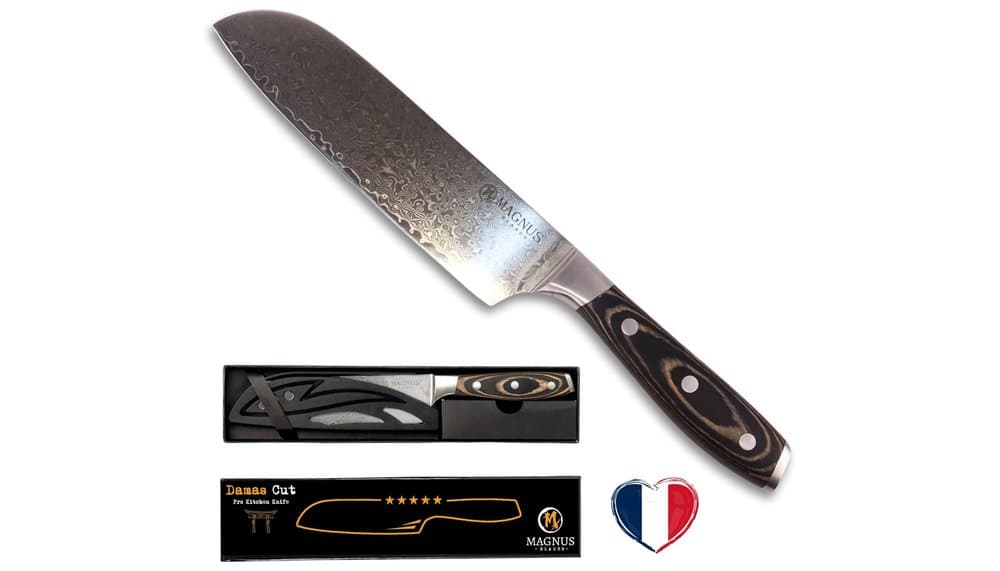
In a market saturated with santoku knives, the De Buyer FK2 Santoku Slicer Knife presents itself as a singular proposition, at the crossroads of French and Japanese traditions. We analyze this tool from the demanding perspective of "buy-it-for-life", dissecting its materials, manufacturing, and behavior in real-world situations. Made by a French Maison labeled Entreprise du Patrimoine Vivant (EPV) since 1830, this knife promises to marry Japanese finesse with hexagonal robustness. But does this promise hold up to the demands of a serious cook? Let's dive into the analysis.
Strengths
- Made in France with the know-how of a historic manufacturer, ensuring strong quality control and traceability.
- Flexible and perforated blade (Santoku cells) designed to reduce food sticking and cutting effort.
- Adjustable counterweight system for a customized balance between blade and handle, unique on the market.
- Ergonomic and non-slip handle in metal, offering a secure grip, suitable for right-handed and left-handed users.
- Excellent out-of-the-box sharpness according to feedback, with appreciated versatility for vegetables, herbs, and fine slicing.
Weaknesses
- Metal handle prone to marks and dirt, requiring meticulous cleaning after each use.
- Usage limitations: the thin and flexible blade is not designed for heavy-duty tasks (bones, frozen foods).
- Substantial thickness at the heel (bolster), which can hinder complete sharpening of the blade on a stone, a challenge for long-term maintenance.
- Handle design perceived as less elegant or more basic than high-end models in wood or composite materials.
Detailed Analysis of the De Buyer FK2 Santoku Slicer
Materials & Manufacturing: The French DNA
The heart of the tool is its blade. According to specifications, it is made of forged stainless steel. De Buyer does not specify the exact type of steel (like VG-10 or AUS-10), which positions it towards a robust professional stainless steel rather than a high-end Japanese carbon steel. The forging provides superior density and durability compared to a stamped blade, which is a first positive point for longevity.
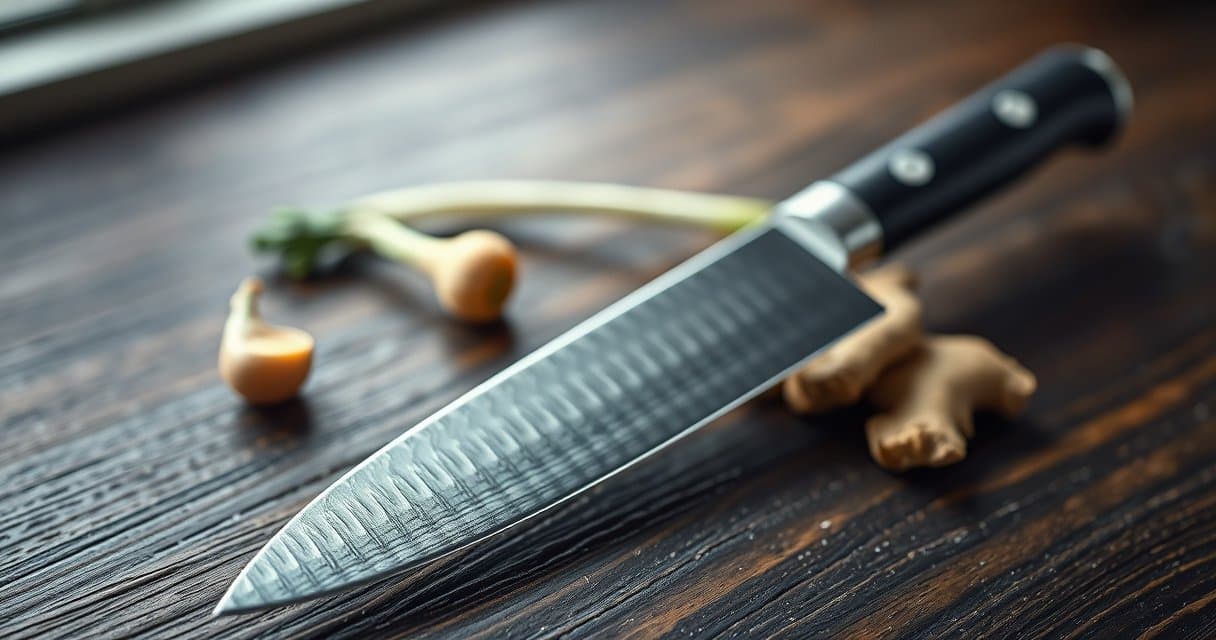
The most distinctive feature is the presence of Santoku cells (dimples) on the side of the blade. These hollows create air pockets that, in theory, reduce the sticking of moist foods (like salmon, potatoes) to the blade, facilitating cutting and slice release. The tip of the blade is described as fine and extra-flexible, an essential quality for a slicer knife intended for making thin, precise slices of cooked meat or fish.
See pricePerformance & Ergonomics: Between Control and Flexibility
Balance is a major selling point of this knife. The adjustable counterweight system at the end of the handle is a practical innovation. It allows each user to modify the weight distribution to find the perfect balance point that suits their grip and cutting motion, a rare and appreciable feature for prolonged use.
Testers and users emphasize that the ergonomic handle in metal, with its non-slip texture, provides a secure and comfortable grip, even with wet or greasy hands. The junction between the blade and the handle is reinforced by a thick bolster and a full tang, signs of robust construction meant to last. However, the community notes that this metal handle tends to retain marks (fingerprints, grease) and requires immediate and thorough cleaning to maintain its appearance.
In action, feedback converges: the out-of-the-box sharpness is very high-performing, allowing for thin slices with minimal effort. Its versatility is praised for daily tasks like mincing vegetables, chopping herbs, or preparing fish fillets. Be warned, however: its flexibility and thinness make it a specialist for slicing and precise cutting, not an all-purpose knife for forceful tasks.
Maintenance & Durability: A Long-Term Commitment
Here, the message is clear. The knife is strictly for hand washing only. Putting it in the dishwasher would irreparably damage the handle, blade, and destroy the balance. This is an accepted constraint for a professional tool.
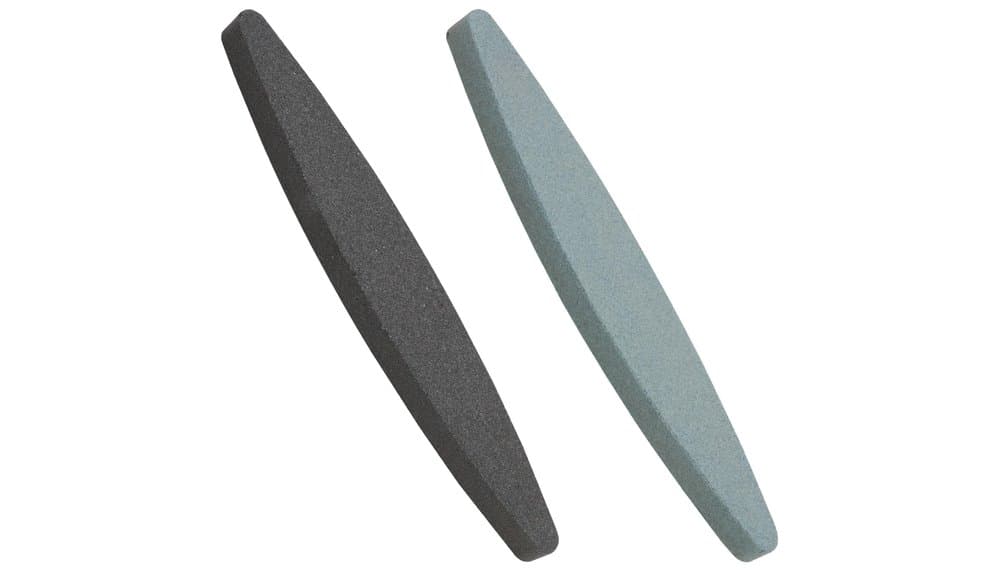
The real challenge for its "buy-it-for-life" longevity lies in sharpening. The thick bolster, while reinforcing construction, creates a stopper that can complicate running the entire length of the blade across a sharpening stone. For perfect maintenance over decades, one will either need to adapt their sharpening technique or rely on a professional equipped to handle this detail. The stainless steel, while less prone to corrosion than carbon steel, will require regular sharpening to maintain its ultra-performant edge, especially on hardwood or end-grain cutting boards.
Technical Specifications
| Characteristic | Detail |
|---|---|
| Model | De Buyer FK2 Santoku Slicer Knife |
| Blade Length | 30 cm (and 17 cm according to web context) |
| Blade Material | Forged stainless steel |
| Surface Treatment | Santoku cells (dimples) |
| Blade Profile | Fine, flexible, smooth edge |
| Handle Material | Metal (with non-slip texture) |
| Construction | Full tang, thick bolster |
| Balance | Integrated adjustable counterweight system in the handle |
| Weight | Approximately 227 g |
| Maintenance | Hand wash only |
| Manufacturing | France |
What Users & Experts Say
A synthesis of available customer reviews and expert tests reveals a strong consensus on several points.
Praise focuses mainly on the immediate cutting quality. Users describe a pleasurable experience, noting that slicing ham or salmon becomes "a real pleasure", often surpassing electric tools. The handle's ergonomics are consistently praised for comfort and secure grip. The versatility of the santoku is also appreciated, even though its design is intended for fine slicing.
Recurring criticisms are fewer but targeted. The metal handle is singled out for its tendency to get dirty easily, requiring cleaning vigilance. Some purists or fans of Japanese design find its aesthetic too industrial or basic. Finally, experts remind users of its limited field of application to tender foods, strongly advising against any work involving bones or frozen products.
Conclusion: Who is This Knife For?
The De Buyer FK2 Santoku Slicer Knife is a professional and distinctive tool. It is not for the casual user looking for a universal, no-maintenance knife.
It is an excellent option for the serious cook seeking a high-end slicer, made in Europe with historic craftsmanship, and who appreciates functional innovations like the adjustable counterweight. Its value-for-money is often highlighted compared to premium Japanese brands.
Conversely, it is less suitable for those who dread manual maintenance or who are looking for a traditional Japanese carbon steel knife with an easy sharpening philosophy. Its metal handle and imposing bolster are deliberate choices that will either appeal or deter.
Final verdict: If you accept hand washing it, mastering its sharpening despite the bolster, and are looking for an exceptional slicer-santoku for fish, cooked meats, and vegetables, the FK2 is a solid and durable investment. It is a specialist's tool that will reward technique and care with years of precise and efficient service.