eModwey e-146 Knife Sharpening Guide Review & Test
Analysis: Is the eModwey e-146 sharpening guide built to last?
In the world of quality knives, be they VG-10 Japanese steel or carbon steel, sharpening is a ritual as essential as cutting itself. For enthusiasts and beginners alike, the challenge remains maintaining a consistent angle. The eModwey e-146 sharpening guide presents itself as an entry-level solution promising to democratize this skill. But can a tool designed to accompany knives that last a lifetime be made of plastic and survive the rigors of regular use? We analyze this product from a "buy it for life" perspective, deciphering its specifications and confronting its promises with community feedback and tester observations.
Strong Points
The main strength of the eModwey e-146 lies in its accessibility. Manufacturers position it as a tool for beginners, and on this point, the community agrees. Its fixed-angle guide system eliminates the main difficulty of freehand sharpening: the need to memorize and consistently reproduce a precise angle. According to user feedback, it effectively allows for achieving a functional and decent edge on standard Western kitchen knives without prior skills.
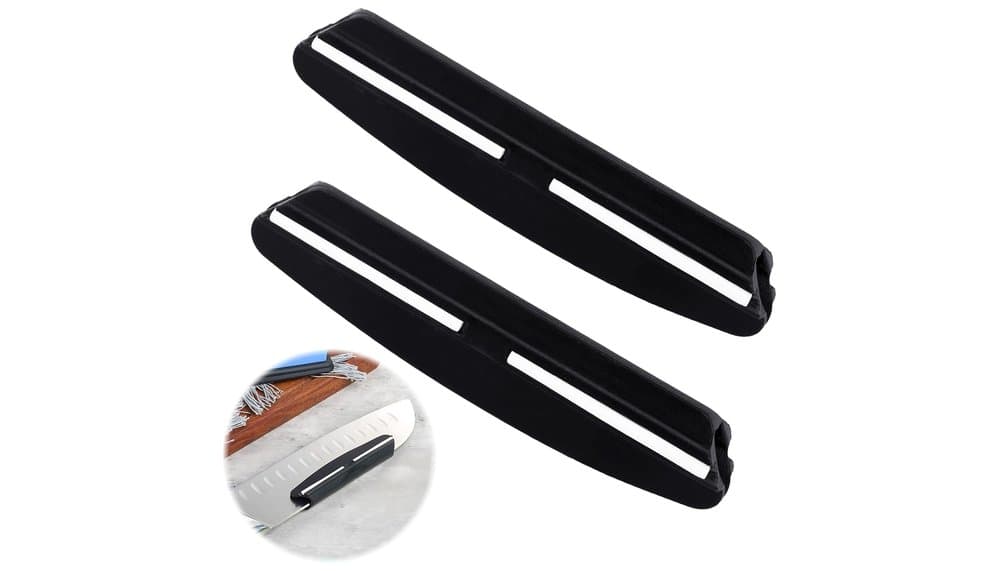
Its minimal footprint and featherweight (20 grams) make it an accessory that is easy to store and transport, far from the bulk of more complex sharpening systems. The two-piece kit delivery is also seen as a positive point, offering an immediate spare part or the possibility to configure two different angles without having to disassemble the guide.
Weak Points
The product's weaknesses, however, are directly linked to its construction philosophy and its usage limits. The first black mark is its material durability. While we are used to analyzing the longevity of forged steel or cast iron, here, the base material is high-density plastic. Despite the mention of a "ceramic reinforcement," numerous user and tester reports mention premature breakage, particularly at the clipping parts or the angle-holding mechanism, sometimes after only a few uses. This inherent fragility places it at the opposite end of a "buy it for life" philosophy.
Its ergonomics are limited. Several users, especially those with large hands, describe the guide as small and uncomfortable to grip firmly during prolonged sharpening. Finally, its versatility is restricted. It is not well-suited for Japanese-style single-bevel knives, very wide blades, or small pocket knives. Experienced users quickly find it restrictive and imprecise compared to the freedom of a freehand stone.
Detailed Analysis: A tool in its rightful place
Construction and Materials: Plastic versus the stone
The technical sheet is unequivocal: the main material is plastic. The term "high density" and the addition of a ceramic protective layer aim to reassure, but in practice, this does not transform it into a heirloom object. Unlike a stabilized wood or micarta handle that gains a patina, or a sharpening stone that wears but can be resurfaced, this guide is a consumable. Its longevity will depend on frequency of use and user delicacy. For a serious cook who sharpens regularly, the probability of seeing a part break or wear out is, according to feedback, not negligible.
See priceErgonomics and Handling: A compromise for learning
The advertised ergonomics is a point of divergence. While the minimalist design allows for an intuitive grip, it does not guarantee long-term comfort. Sharpening a dull knife on a medium-grit stone can take several minutes. Holding a small plastic object with firm, constant pressure during that time can become uncomfortable, even causing tension. It is a tool designed to teach the movement and angle, not to be the primary tool of an avid sharpener.
Performance and Precision: Good for the essentials, limited beyond
On paper, the guide promises precise sharpening. In practice, testers point out that it fulfills its mission for standard angles (around 20 degrees) on common kitchen knives. It is effective for restoring a functional edge. However, precision has its limits. The angle setting is fixed and likely less fine than on rack-and-pinion systems. For hard steels like VG-10 or White Steel #2, where angle control to the exact degree influences edge retention and the fineness of the edge, this solution lacks finesse. It also does not allow for creating micro-bevels or adapting the angle to a specific use (skinning vs. vegetable cutting).
Target Audience: The absolute beginner, and only them
The eModwey e-146 finds its niche with the totally novice person, intimidated by the freehand stone, who wants to get a decent result on their domestic knives without investing in an expensive system. It is a stepping stone. For the passionate cook who already owns carbon steel knives or Japanese blades and aims for mastery, this tool is a dead end. It will teach you the basic mechanics, but you will quickly need to move past it to progress and preserve the geometry of your best blades. Professionals or demanding enthusiasts will prefer the freehand stone or much more robust and adjustable guide systems.
Technical Specifications
| Characteristic | eModwey e-146 Detail |
|---|---|
| Product Name | eModwey e-146 Knife Sharpening Guide |
| Main Material | High-density plastic with ceramic coating |
| Weight | 20 grams |
| Dimensions | 2 x 1.5 x 10 cm |
| Contents | 2 identical angle guides |
| Compatibility | Manual sharpening stones, standard kitchen knives |
| Angle Adjustment | Fixed (value not specified, generally suitable for Western knives ~20°) |
| Color | Black |
What Users and Testers Say
The synthesis of available customer reviews and expert analyses paints a contrasting landscape, but with very clear trends.
The recurring positive points revolve around ease of use for novices. Comments like "gets the job done" or "perfect aid for perfect sharpening" summarize this sentiment. Satisfied users are those who, without experience, managed to sharpen a knife without complicating their lives. The double delivery is also often cited as a plus.
The negative points are more numerous and more specific. They consistently point to two problems: durability and potential damage to knives.
- Fragility: Terms like "fragile," "brittle," and "total garbage" recur in several reviews. Users report breakage at the fixing clip or the angle-holding part after a limited number of uses.
- Risk to Knives: One review clearly states that the product "marks stainless steel knives." This suggests that the fixing system or the guide material itself can scratch or damage the flat of the blade, which would be unacceptable for a valuable knife.
- Usage Limits: Testers confirm the guide is unsuitable for high-end or atypical blades. Its clamping and design do not adjust to all geometries, making it unusable for part of a serious collection.
The modest score of 3.4/5 stars perfectly reflects this polarization: either it works for a basic use and the user is happy, or the guide breaks or proves unsuitable, leading to marked disappointment.
Conclusion: A fragile stepping stone, not a lifelong companion
The eModwey e-146 Knife Sharpening Guide is a product with a clear promise and well-defined limits. It is not, and does not claim to be, a "buy it for life" tool. Its plastic construction, although reinforced, does not rival the robustness of a tool designed for decades of use. It represents a minimal investment for initial learning.
Our analysis concludes that this accessory can be a useful crutch for the complete beginner wishing to discover sharpening without stress, provided it is used with extreme caution regarding its clamping on the blade. However, for the serious cook who invests in high-carbon steel knives or Japanese blades with differential hardening, this guide is insufficient and potentially risky. It will not allow the level of control and precision required to maintain these professional tools. Its real cost could be that of quick disappointment, sending you back to the indispensable learning of freehand sharpening or towards investing in a more serious and durable guide system. To sharpen a knife for life, you need a guide also designed to survive it. This is clearly not the case with the eModwey e-146.