Fackelmann 66273 Vita3 Triply Stainless Steel Wok Test
Introduction
The wok is the archetype of versatile cookware, capable of searing, stir-frying, deep-frying, and simmering. On a site dedicated to durable culinary tools, we are not interested in disposable models with synthetic coatings, but in pieces forged to last. The Fackelmann 66273 Vita3 Triply Stainless Steel Wok Pan 28 cm presents itself precisely as a wok built for life, made of solid stainless steel. But does this promise hold up under the rigorous examination reserved for carbon steel, cast iron, and knife steels? Here, we dissect this product from a "buy-it-for-life" perspective, analyzing its materials, construction, heat behavior, and relationship with the demanding user.
Key Strengths
- Robust Triply construction: A triplex structure of 18/10 stainless steel with an aluminum core ensures excellent heat distribution and proclaimed exceptional longevity.
- Total versatility across heat sources: Stated compatibility with induction, gas, ceramic/glass cooktops, and oven (up to 200°C), making it a tool suitable for any kitchen, domestic or professional.
- Inherent health and durability: Complete absence of synthetic non-stick coatings (PFAS), guaranteeing healthy cooking and a product that will not degrade over time, but will develop character with use.
- Indestructible maintenance: Polished stainless steel surface resistant to scratches, dishwasher safe and compatible with metal scouring pads, simplifying cleaning even after the most stuck-on cooking.
Weaknesses (or Points of Attention)
- Required learning curve: Like any bare stainless steel utensil, it requires mastery of temperature and preparation (preheating, water droplet test, use of oil) to minimize food sticking.
- Weight and handling: At 1.15 kg for the wok alone, it is noticeably heavier than a traditional carbon steel wok. This weight, a guarantee of its robustness, can complicate "tossing" movements and make it less agile.
- Limited "wok hei" performance on standard burners: Its construction with a relatively flat and thick bottom, optimal for even heat diffusion, is not ideal for reproducing authentic "wok hei" (the breath of the wok, that smoky, charred taste), which requires a rounded bottom and extreme temperatures over a powerful flame.
Detailed Analysis of the Fackelmann Vita3 Triply Wok
Materials and Construction: The Heart of Durability
What interests us here is the equivalent of VG-10 or white steel for a knife, or wrought iron for a skillet. Fackelmann relies on 18/10 stainless steel (18% chromium, 10% nickel). This grade offers excellent corrosion resistance and total chemical inertia, preserving the taste of acidic foods. It is a "buy-it-for-life" material by nature: it does not rust, does not warp under normal use, and contains no coating to wear out.
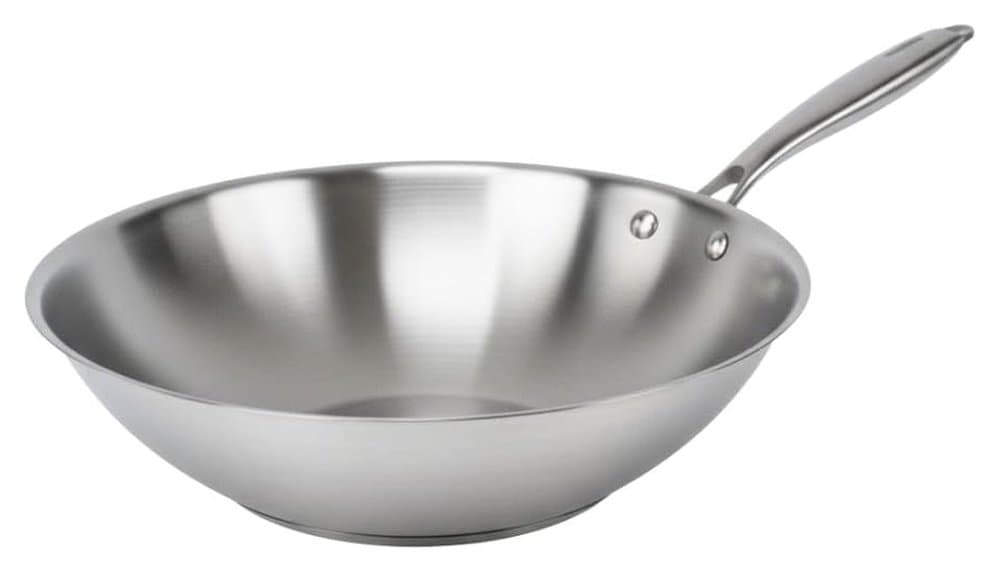
The real innovation lies in its Triply construction. It is not a simple sheet of stainless steel, but a sandwich: an outer and inner layer of 18/10 stainless steel encapsulating a thick aluminum core. Aluminum, an excellent thermal conductor, compensates for stainless steel's historical weakness (its poor conduction) by distributing heat evenly across the entire surface, particularly on the bottom which is the critical area. This construction eliminates hot spots, essential for perfect searing. Independent testers emphasize that this structure, combined with robust rivets for handle attachment, gives the wok a perceived solidity that is very high.
See priceHeat and Fire Performance
On paper, the specs announce universal compatibility. The user community confirms this versatility, especially on induction where heat diffusion is considered efficient and uniform. However, its culinary performance diverges from that of a traditional carbon steel wok.
The carbon steel wok excels in its reactivity: it heats up very quickly and cools down instantly when food is removed, a key behavior for fast Asian cooking. The Fackelmann, with its greater mass and aluminum core, acts as a heat accumulator. It takes longer to heat up, but once at temperature, it maintains it well and distributes it very evenly. This is an asset for cooking where one seeks uniform searing on a large volume (vegetables, meat pieces), but it is a disadvantage for hyper-reactive fire control. Based on feedback, it excels in stir-fries, light simmering, and even shallow frying, but will not replicate the character of a restaurant wok over a 30,000 BTU flame.
Ergonomics and Handling
The handle is attached by rivets, a mark of serious manufacturing preferable to screws that can loosen. It is entirely made of stainless steel. User feedback describes it as solid and well-attached, offering good security. However, its ergonomics are spartan: the bare steel can become hot during prolonged cooking (even if the brand presents it as "safe") and, crucially, it offers no thermal insulation or non-slip texture. For extended cooking sessions, using a towel or pot holder is imperative, which can be seen as a constraint or simply the normal protocol for a professional tool.
The weight of 1.15 kg, combined with food, makes it a substantial utensil. Testers note that this can tire the wrist during repeated "tossing" maneuvers, a technique where carbon steel woks (often < 1 kg) are much more agile. This is a clear compromise: robustness and thermal inertia are paid for in lightness and reactivity.
Maintenance and "Seasoning" Potential
This is a major point of divergence with carbon steel or cast iron. 18/10 stainless steel does not "season" (develop a polymerized oil layer) in the same way. It does not form a natural non-stick patina. Its non-stick quality relies on technical mastery: proper preheating, using the right amount of oil, and controlling the temperature. It's a different philosophy.
In return, its maintenance is radically simple. The steel resists the most aggressive abrasives. Users appreciate being able to clean without reservation with a metal scouring pad to remove caramelized residues, and then put it in the dishwasher without worry. It returns to an "as new" state after each use, which is impossible with a seasoned carbon steel wok. This is a strong point for those who want a hygienic, hassle-free tool.
Technical Specifications
| Feature | Detail |
|---|---|
| Product Name | Fackelmann 66273 Vita3 Triply Stainless Steel Wok Pan |
| Diameter | 28 cm (height: 8.5 cm) |
| Main Material | 18/10 Stainless Steel |
| Construction | Triplex (Stainless Steel/Aluminum/Stainless Steel) |
| Base | Suitable for induction |
| Compatibility | Induction, gas, ceramic/glass, oven (up to 200°C) |
| Coating | None (bare stainless steel surface) |
| Handle Attachment | Rivets |
| Handle Material | Stainless Steel |
| Weight | 1.15 kg |
| Capacity | 5.2 liters |
| Maintenance | Dishwasher safe, metal scouring pads allowed |
| Warranty | 2 years |
What Users Say
A synthesis of customer reviews and expert feedback reveals a clear consensus.
Recurring positive points revolve around the perceived excellent build quality and versatility. Buyers are satisfied with its robustness, finish, and the fact it works perfectly on induction hobs. The ease of cleaning is consistently praised, with many mentioning using the dishwasher without issue. The quality of heat diffusion is also validated, with mentions of even cooking without hot spots.
The negative points or points of attention are equally clear. The main pitfall is food sticking for novices. Several testimonials indicate that without good preheating and oiling technique, eggs or lean meats can stick. This is not presented as a product defect, but as the necessity of a learning curve. Weight is the second frequently raised point, describing it as heavy and less maneuverable than expected for a wok. Finally, a few comments note that for very specific Asian recipes requiring marked "wok hei," a carbon steel wok over high flame remains unmatched.
Conclusion
Is the Fackelmann 66273 Vita3 Triply Stainless Steel Wok Pan 28 cm a "buy-it-for-life" tool? The answer is a frank yes, but conditional.
It embodies the philosophy of durable cookware: noble materials (18/10 stainless steel), solid construction (triply, rivets) that defies the years, technical versatility (all hobs, oven), and uncompromising maintenance. It will not age, will not wear out, will not release any chemicals. For the serious cook who prioritizes health, absolute longevity, and versatility across all heat sources (especially induction), and who is ready to master the technique of bare stainless steel, this wok is an extremely judicious and probably definitive investment.
However, one should not look for the soul of a traditional wok in it. It is heavier, less reactive, and demands more technique than a carbon steel wok. It represents the excellence of modern and durable engineering rather than the faithful replica of an ancestral tool. If your ultimate criterion is agility and reactivity for ultra-fast Asian cooking over a powerful flame, a carbon steel wok remains the reference tool. But if you are looking for a unique, indestructible, healthy, and versatile utensil that will last for decades while excelling in the vast majority of skillet or wok cooking techniques, the Fackelmann Vita3 constitutes a kitchen centerpiece that will be hard to do without.