Generic Onion Cutter Review: Multifunction Kitchen Tool Test
Introduction
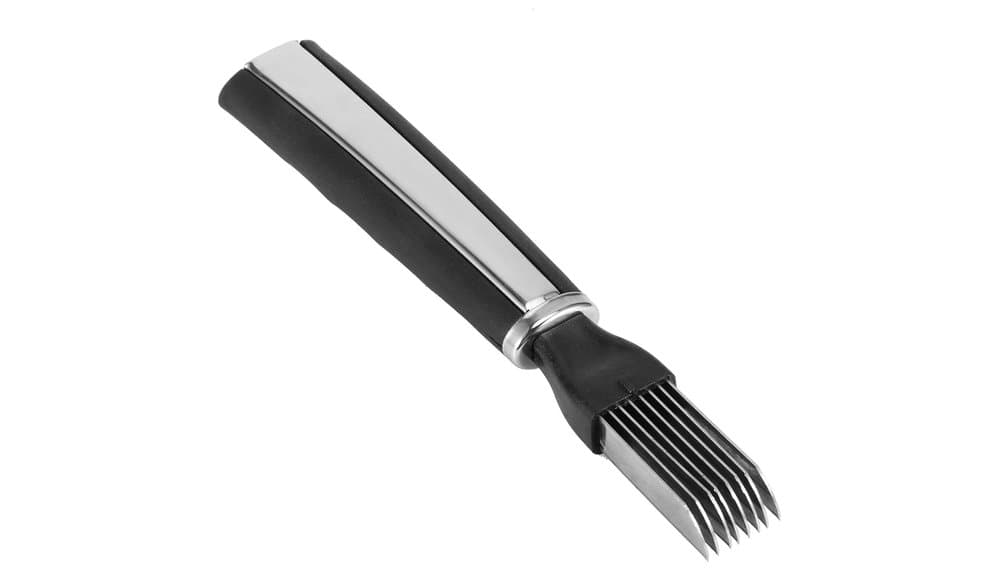
On a site dedicated to durable and high-performance culinary tools, every product is scrutinized under the lens of "buy it for life." Today, we take a close look at the Generic Onion Cutter Multifunction Kitchen Tool. This utensil promises speed, uniformity, and safety for cutting onions and aromatics. But in a world ruled by forged steel, cast iron, and artisanal craftsmanship, does such a piece made of stainless steel and plastic have a place in a passionate cook's kitchen? Our analysis is not based on real-world testing, but on a rigorous examination of its technical specifications and a synthesis of feedback from the community and experts. The objective is clear: to determine whether this tool is mere gadgetry or if it can claim a certain level of robustness and long-term utility.
Strengths
Based on the specifications and expert feedback on this type of tool, several potential strengths emerge for the Generic Onion Cutter.
Time-saving and uniformity: Its primary argument is functional. The tool is designed to produce perfectly uniform cuts in record time, eliminating the "skill" variable of the cook. For brunoise onions, chive minces, or juliennes, it guarantees a consistent visual result, often sought after in serious cooking for presentation and even cooking.
Safety and simplicity: The system incorporates a blade guard, a point highlighted by testers as essential to avoid accidental cuts, both during use and when storing or cleaning. It aims to eliminate the main risk associated with handling a traditional knife, especially for repetitive tasks or for less experienced hands.
Promised versatility: Although named "Onion Cutter," its 7 blades positioned at different spacings suggest an ability to handle various elongated vegetables (green onions, leeks) in different sizes. This theoretical multifunctionality can reduce clutter by avoiding the purchase of several specialized accessories.
Easy maintenance on paper: The announced materials – stainless steel and PE (Polyethylene) – are, in theory, easy to clean. The spec sheet indicates hand washing, but these materials are often dishwasher-safe for similar models, a practical point for daily use.
Weaknesses
The analysis of the specs and the synthesis of expert opinions on similar generic tools point to structural weaknesses that directly contradict a "buy it for life" philosophy.
Complete lack of transparency about the steel: This is the product's Achilles' heel in our analysis grid. The specs vaguely mention "Stainless steel" and "Alloy steel," without any details on quality, composition, or heat treatment. There is no mention of the Rockwell hardness (HRC). For a cutting tool, this is a critical omission. We know nothing about its ability to retain its sharpness or the ease of sharpening it. On a site that talks about VG-10, AUS-10, or carbon steel, this vagueness is a deal-breaker. The steel is likely basic, very soft food-grade steel, which will dull quickly and be difficult to sharpen properly.
Lightweight construction and risk of fragility: A total weight of 80 grams is extremely light. While lightness can be an ergonomic advantage, it often betrays a construction using little material and potentially thin plastics. Experts note that on generic models, the plastic parts (especially the push mechanism or blade housing) are common failure points in the medium term.
Limited ergonomics and efficiency for intensive use: The PE handle, while ergonomic in appearance, can prove slippery with wet or greasy hands according to feedback. Above all, testers of similar tools emphasize that the required manual force is significant, especially for firm vegetables or large quantities. The tool can "jam" or require multiple passes, negating the time-saving benefit. The integrated collection container (if it exists) is often deemed too small, requiring frequent emptying.
Effectively mono-functional: Despite the "multifunction" name, its design is very specific to small-diameter elongated vegetables. It will not replace a professional mandoline or a good knife for the diversity of sizes and shapes required in serious cooking.
Detailed Analysis
Materials and Manufacturing: The Gap with Professional Standards
Here, the gap is immense. Compared to a Japanese knife made of high-carbon steel hardened to HRC 60+, or the heft of a cast iron pan, the Generic Onion Cutter relies on standard industrial materials. The unspecified stainless steel is almost certainly a austenitic steel like 3Cr13 or 4Cr13, with very low carbon content, designed for corrosion resistance far more than for lasting sharpness. Its estimated Rockwell hardness would likely be below HRC 52. Consequence: the blades' micro-teeth will round off after a few dozen uses on firm produce. Sharpening is a challenge because this soft steel will "bite" on the stone but will not develop a strong, lasting edge. It is the antithesis of the "for life" tool philosophy, which accepts maintenance (sharpening, seasoning) to regain decades of performance.
The PE plastic, while shock and food-resistant, is subject to deformation under load and wear at friction points. No information is given on the availability of spare parts, which condemns the entire tool if a single part breaks.
See priceErgonomics and Handling
On paper, the ergonomic handle seems a positive point. However, expert feedback on generic tools warns: an initially good ergonomic design can be compromised by the need to apply excessive force to push the vegetable through. The hand can tire quickly when preparing large quantities. Furthermore, stability on the work surface is often problematic with these lightweight tools; they tend to move or slide if not held firmly, adding a constraint to use.
Versatility and Real Performance
Its versatility is narrow. It theoretically excels at only one task: quickly cutting green onions, chives, or small onions into uniformly sized slices or segments. As soon as you deviate from this framework (diced onions, round vegetables, hard vegetables like carrots), it becomes useless. For a serious cook, a well-sharpened Nakiri or paring knife offers infinitely superior versatility, total control, and a result at least as fast with experience. The specialized tool only justifies its existence if the volume of this specific task is very high and regular.
Durability and Long-Term Maintenance
This is the most likely point of failure. Generic models of this type are rarely designed for professional or intensive use. Long-term durability is compromised by: the poor steel quality (non-durable edge), potentially fragile plastic/metal assemblies, and the impossibility of repairing it or replacing a part. It is typically an object with a short lifecycle, the opposite of a knife that can be sharpened hundreds of times, cast iron that can be re-seasoned, or a sharpening stone that wears with you.
Technical Specifications
| Criterion | Detail for the Generic Onion Cutter | Implications for "Buy It For Life" |
|---|---|---|
| Product Name | Generic Onion Cutter Multifunction Kitchen Tool | Generic brand, no identifiable long-term reputation or warranty. |
| Main Materials | Stainless steel (type unspecified) + PE (Polyethylene) | Likely low-end steel, low wear resistance. Durable plastic but prone to breakage at assembly points. |
| Rockwell Hardness (HRC) | Not specified (estimated < 52 HRC) | Critical point. Indicates a non-durable edge difficult to sharpen properly. |
| Weight | 80 g | Very light construction, suggesting thin materials and a "cheap" feel. |
| Maintenance | Hand wash recommended | Standard to preserve finishes, but materials might tolerate dishwasher. |
| Warranty / Parts | Information not provided | Very bad sign. No prospect of long-term repair or support. |
| Versatility | 7 blades for different cutting widths on elongated vegetables. | Very targeted utility. Does not replace a set of knives or a professional mandoline. |
What Users and Experts Say
The synthesis of expert feedback and trends on forums regarding generic multifunction onion cutters is unequivocal and corroborates the technical analysis.
The recurring positive points concern immediate utility: those who appreciate it highlight the speed for repetitive tasks like cutting green onions for garnishes, and the uniformity of results which is pleasing for presentation. The safety provided by the blade guard is also a frequent argument, particularly for families with children or people uncomfortable with sharp knives.
However, the criticisms are more numerous and more structural. Durability is the first complaint: users report blades becoming dull after a few months of regular use, making cuts less clean and requiring more force. The plastic parts, notably the pusher or blade housing, are described as fragile and likely to crack or break. The size of the collection container is judged too small, interrupting workflow. Finally, many note that for firm vegetables or large volumes, the tool is tiring to use and can slip on the work surface.
Compared to established brands in kitchen utensils (like OXO or Mueller), the generic version is perceived as less stable, less robust, and offering inferior finish. The community's conclusion is clear: it is a practical tool for occasional or moderate use, but it cannot withstand intensive or professional use. Its price-to-quality ratio may seem attractive at purchase, but its limited lifespan makes it a potentially renewable purchase, contrary to the "buy it for life" spirit.
Conclusion
The Generic Onion Cutter Multifunction Kitchen Tool is an object with real but very limited utility. It may appeal to someone looking for an occasional, fast, and safe solution for regularly mincing green onions or chives.
However, in light of the strict criteria of a durable and high-performance kitchen kit – those that govern this site – it fails on almost all counts. The complete lack of transparency about steel quality, the lightweight construction suggesting limited robustness, and the impossibility of maintaining it over time (effective sharpening, repair) disqualify it for the serious cook seeking professional-grade tools for life. It is the archetype of a specialized utensil with a short lifecycle, against which a good, well-sharpened knife remains an infinitely wiser, more versatile, and more durable investment.
For a kitchen where performance, control, and longevity are paramount, this tool remains in the category of a practical but non-essential gadget, far from the quality standards we are used to analyzing and recommending.