Giesser Professional Knife Sharpener with Stand Review
Introduction
In the world of kitchen utensils designed to last, sharpening is an art as crucial as the choice of the knife itself. Between the demanding technique of the sharpening stone and the sometimes destructive simplicity of low-end electric sharpeners, is there a durable and effective solution? It is in this niche that the Giesser professional knife sharpener with stand positions itself. The heir to German know-how over two centuries old, this tool promises professional, repeatable, and safe sharpening. Our analysis will dissect this product from the "buy-it-for-life" perspective: its construction, materials, ergonomics, and its ability to maintain the sharpness of our most valuable blades over time. Is it the ideal ally for the demanding chef who cherishes their VG-10 steel knives, carbon steel knives, or blades hardened to 60 HRC?
Strong Points
- Robust construction and exemplary stability: The integrated stand and heavy base ensure solid attachment to the countertop, eliminating vibrations during use.
- Repeatable and safe sharpening: The guide system maintains a constant sharpening angle, eliminating the main difficulty of manual sharpening on a stone. This guarantees safety for the blade and the user.
- Quick efficiency for routine maintenance: Restores a functional, cutting edge to the majority of kitchen knives in just a few passes.
- Ease of use and accessibility: No prior technical skill is required. It makes quality sharpening accessible to all skill levels.
- Dual function and replaceable rods: Generally features two stages (coarse/refining) and is designed to allow replacement of abrasive rods without tools, thereby extending the product's life.
Weak Points
- Limited to standard blade profiles: The fixed angle may not suit knives with very specific bevels (like some single-bevel Japanese knives), very thick blades (hunting knives), or scissors.
- Non-optimal finish for purists: While it provides an excellent working edge, it generally does not produce the razor-sharp mirror edge achieved on a progression of fine-grit stones or a strop.
- Storage footprint: Its robust construction and stand make it bulkier than a small manual sharpener, requiring dedicated storage space.
- Necessary rod maintenance: Like any abrasive system, the rods must be cleaned regularly of metal particles to maintain their effectiveness.
Detailed Analysis
Construction Philosophy and "Made in Germany" Quality
Giesser, with its heritage beginning in 1776, relies on a reputation for robustness and durability. Although customer reviews sometimes raise questions about the exact origin of manufacture (some mention France), the promise carried by the brand is that of a professional-grade object. On paper, the specifications announce quality stainless steel metal parts. This contrasts with the multitude of lightweight plastic sharpeners that populate the market. For the demanding user, this approach is essential: it is a workshop tool designed to withstand years of regular use, not a disposable accessory.
See priceSharpening Mechanics: Stability, Constant Angle, and Blade Preservation
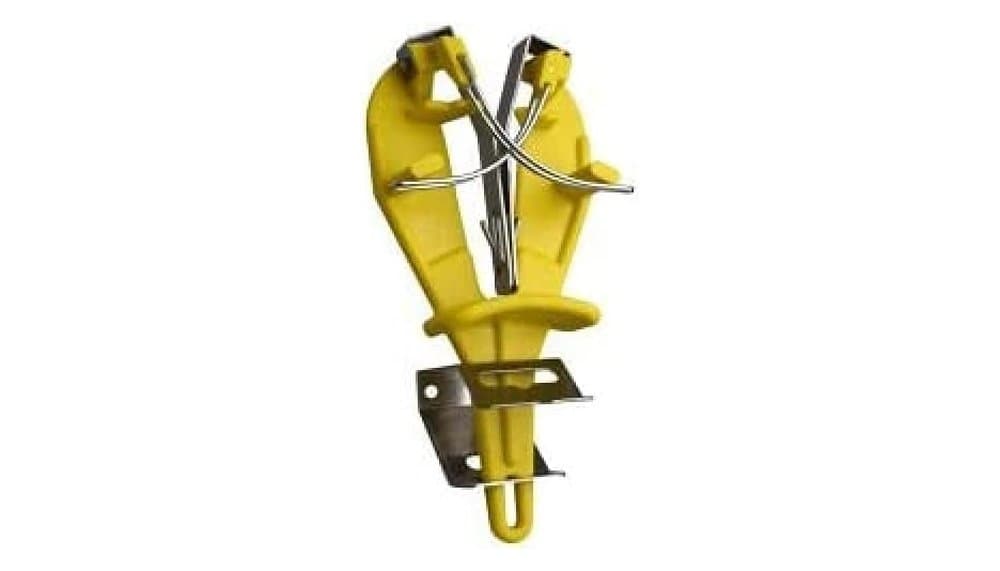
The principle of this sharpener is mechanically simple and intelligent. By securely fixing the device to the table via its stand, all parasitic movement is eliminated. The knife is then pulled towards you, guided in a rail that sets the angle. This is the point that interests us most here.
For an owner of high-hardness knives (a Japanese knife in white steel or VG-10 hardened to 58-62 HRC), the main challenge of sharpening on a stone is precisely maintaining this 15° or 20° angle with perfect regularity. A varying angle wears the blade unevenly and can create an unstable burr. The Giesser solves this problem. Expert testers emphasize that this consistency is much less aggressive on the blade than the abrasive rollers of many electric sharpeners, which remove a significant amount of material.
However, this strength is also its limit. A handmade Japanese knife with an asymmetric bevel (70/30 or 90/10) cannot be sharpened optimally with a fixed symmetrical angle system. This tool is therefore perfectly suited to the vast majority of Western knives and double-bevel Japanese knives (San Mai), but may be unsuitable for the most specialized pieces in a collection.
Ergonomics and Prolonged Use: The Comfort of Repetition
The ergonomics are radically different from those of a stone. Here, no need to bend over a wet work surface or coordinate complex movements. The action is vertical, repetitive, and requires no physical effort. Handling is intuitive and fast, which encourages regular maintenance – key to preserving a blade's life. For a professional chef or an enthusiast who needs to sharpen several knives in a row, this reduction in fatigue is a significant advantage. User feedback abounds in this direction: the tool makes the task easy and without apprehension.
Long-Term Durability and Upgradability
The "buy-it-for-life" perspective is not limited to the chassis. The possibility of replacing the abrasive rods without tools is a major argument. This means that when the ceramic or tungsten carbide rods are worn (after years of use), the user will not have to throw away the entire appliance. They can regenerate it with new rods, ensuring several decades of service. This is a design philosophy that is durable and economical in the very long term, in line with the values of our site.
For the hardest blades, it is important to note that the standard rods (often ceramic) may wear out faster. The user community notes that for perfect maintenance on premium steels, a final pass on a fine-grit sharpening stone (for example, a 3000-grit or higher water stone) remains ideal for refining the edge and removing the microscopic burr. The Giesser then becomes the primary, fast, and effective re-sharpening tool, while the stone is reserved for occasional "finishing".
Technical Specs
| Characteristic | Detail |
|---|---|
| Brand / Heritage | Giesser, founded 1776 |
| Claimed Manufacture | Made in Germany (subject to verification, see reviews) |
| Type | Professional manual sharpener with table stand |
| Function | Dual-stage (typically: reshaping / refining) |
| Main Materials | Quality stainless steel, alloys, abrasive rods (ceramic/carbide) |
| Key Feature | Fixed sharpening angle (typically ~20°) guided |
| Stability | Integrated table-mounting stand |
| Maintenance | Tool-free replaceable abrasive rods |
| Dimensions (approx.) | 28.5 x 15 x 7 cm |
| Weight | Relatively heavy for stability (approx. 1-2 kg) |
| Color | Characteristic yellow accents |
What Users and the Community Say
A synthesis of 106 global reviews (average rating 4.3/5) and online expert analyses reveals a clear consensus.
The recurring positive points are unanimous:
- Surprising ease of use: "Even my wife uses it without fear," some report. This is the most frequent compliment.
- Immediate effectiveness: Users note that "dull" knives regain a satisfactory edge in under a minute.
- Perceived solidity: Comments on "robust construction," "pro feel," and good hand-feeling are numerous.
- Ideal alternative to the stone: For those who do not want or cannot master the water stone, it is described as "the best alternative," "reliable and repeatable."
The points of caution or negatives are fewer but instructive:
- A question of origin: A recurring negative review (1 star) states that the product received was not stamped Giesser and would be manufactured in France, casting doubt on the exact supply chain. This is a point to verify upon purchase.
- Technical limits: As anticipated, some regret that it is not suitable for their specific Japanese knives or that it does not produce a "perfect razor edge."
- Size: A few users find the item "larger than expected" and impractical for daily storage.
Analysis of specialized forums confirms this trend: testers consider this type of guided sharpener (and the Giesser in particular for its construction) an excellent tool for routine maintenance for the serious cook, provided its limits relative to perfect mastery of the stone are understood and accepted.
Conclusion
The Giesser professional knife sharpener with stand is not a universal tool, but it fulfills a specific mission excellently. It will never match the absolute finesse and customization offered by an expert hand on a progression of Japanese stones. On the other hand, for the cooking enthusiast equipped with good knives (mainly Western or double-bevel Japanese) who primarily seeks efficiency, consistency, and durability in the weekly maintenance of their blades, it represents an extremely relevant investment.
Its robust construction, philosophy of replaceable parts, and foolproof mechanism make it a product designed to last for several decades. It removes the psychological and technical barrier to sharpening, ensuring your knives will always be sharp, thus preserving their long-term integrity. It is the reliable, daily maintenance tool, while the stone remains the ultimate instrument of mastery for the perfectionist. For the demanding amateur who does not wish to become a sharpening expert but demands a professional edge on their tools, the Giesser with stand stands out as a very convincing buy-it-for-life solution, provided the brand's authenticity is verified upon acquisition.