Global 40th Anniversary Knife Set Review: 3-Piece Test
Analysis of the Global Stainless Steel 40th Anniversary Kitchen Knife Set of 3
The world of durable kitchen knives is defined by fundamental choices: carbon steel vs. stainless, riveted handle vs. one-piece construction, heavy balance vs. light blade. The Global Stainless Steel 40th Anniversary Kitchen Knife Set of 3 enters this conversation with a very clear proposition: offering the essence of the modern, high-performance Japanese knife, without maintenance compromises, in a collector's case. We will dissect this set from a "buy-it-for-life" perspective, examining the materials, manufacturing, ergonomics, and real value for the demanding cook.
Strengths
- High-performance CROMOVA 18 steel: An exclusive Japanese stainless steel, recognized for its high hardness, excellent edge retention, and corrosion resistance.
- One-piece construction and unique balance: The blade and handle are forged from a single piece of steel, ensuring perfect hygiene and a precise balance point that promotes control.
- Versatility of the selected trio: The choice of three models (chef's knife, kiritsuke, utility knife) intelligently covers the essential kitchen tasks.
- Iconic finish and design: The "dimpled" handle finish and sleek aesthetic are brand signatures, here associated with a limited anniversary edition.
- Simplified maintenance compared to carbon steel: No need for ultra-immediate drying to avoid rust as with carbon steel, while maintaining high performance.
Weaknesses
- Subjective handle ergonomics: Its thinness and cylindrical shape can be uncomfortable for large hands or during very prolonged use.
- Requires a technique adjustment: The lightness and blade-forward balance require an adjustment for users accustomed to heavier Western knives.
- Demanding sharpening: The high hardness of the steel requires appropriate tools (quality water stone) and rules out low-end electric sharpeners.
- High price for a 3-piece set: As a limited edition and premium brand, the investment is significant.
- Potential blade fragility: A hard steel is more susceptible to micro-chipping if it comes into contact with bones or hard surfaces; it demands careful technique.
Detailed Analysis
The Steel and the Blade: The Heart of CROMOVA 18
What interests us here is the metallurgical composition. Global uses its exclusive CROMOVA 18 steel. This is neither VG-10 nor AUS-10, but a Japanese stainless alloy containing molybdenum and vanadium. Based on brand tests and specifications, this steel achieves a Rockwell Hardness (HRC) of approximately 56-58. This range is crucial.
It sits in a technical sweet spot: it is high enough to offer excellent edge retention, far superior to that of mainstream stainless knives (often around HRC 52-54). The blade will last longer between sharpenings when cutting fibrous products like root vegetables. However, it does not reach the extreme hardness (HRC 60+) of some Japanese carbon steels (like Shirogami or Aogami). This gives CROMOVA 18 a notable advantage: it is more forgiving to sharpen. It will be easier to sharpen on a water stone than a harder, more brittle steel, while still being a step above in terms of ease of daily maintenance compared to carbon steel (no rust).
The edge is sharpened to a double bevel of 15 degrees (30 degrees total), which is more acute than the European standard (often 20 degrees per side). This contributes to the feeling of a clean and precise cut, but also demands respectful handling to avoid chipping.
See priceConstruction, Balance, and Comfort of Use
Global's philosophy is immediately recognizable: a one-piece construction where the blade and handle are made from a single piece of steel. The handle is then hollowed and filled with sand, which allows for weight and balance adjustment. The result, according to expert and user feedback, is a perfectly neutral or slightly blade-forward balance. This characteristic, combined with an overall light weight, provides a feeling of control and lightness appreciated for precision work and slicing motions.
However, it is on the handle that opinions diverge. Its cylindrical and thin design, covered in small craters (the "dimples") for a better grip, is a signature. Testers highlight that these dimples are effective, even with wet or greasy hands. But the community also notes a critical point: for people with large hands or for very long work sessions (like preparing a banquet), this handle can create pressure points and be considered less comfortable than ergonomic riveted handles in wood or resin. It is a matter of anatomy and personal preference.
The Model Selection: A Logical Triad
The choice of the three knives in this set is not random and shows thoughtful versatility:
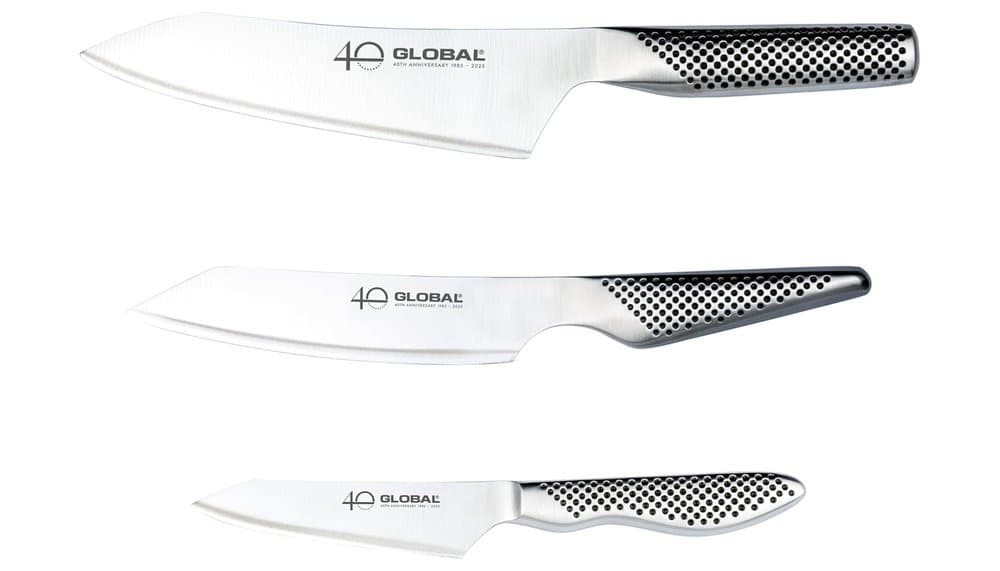
- The Oriental Chef's Knife (G-4, 18 cm): The ultimate versatile knife. Its taller blade and adapted profile make it an ideal tool for chopping, slicing, and mincing.
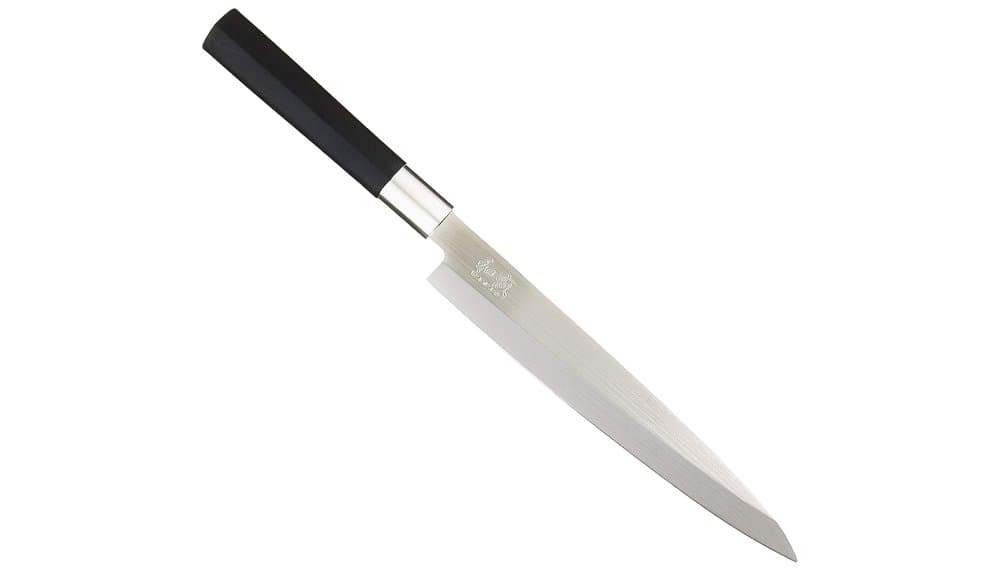
- The Kiritsuke Knife (GS-110, 15 cm): The distinctive element of this anniversary set. A hybrid between a chef's knife and a santoku, its lifted tip and straight edge are perfect for precise cuts, vegetable work, and filleting small fish. It adds a touch of Japanese specialization.
- The Utility Knife (GS-58, 11 cm): The precision tool for peeling, trimming, and delicate tasks.
This combination effectively covers more than 95% of a home cook's needs. The inclusion of the kiritsuke is a real plus compared to a standard set, offering a differentiated cutting experience.
Durability and Maintenance: The "Buy-It-For-Life" Pact
The durability of these knives is intrinsically linked to the care given to them. The one-piece construction eliminates the risk of a loose handle, a common point of failure. The CROMOVA 18 stainless steel resists corrosion superbly.
However, the pact is clear: no dishwasher. The chemical and mechanical aggression of the machine will irreparably damage the edge and can attack joints on models with handles (not the case here, but the principle remains). Hand washing and immediate drying are imperative.
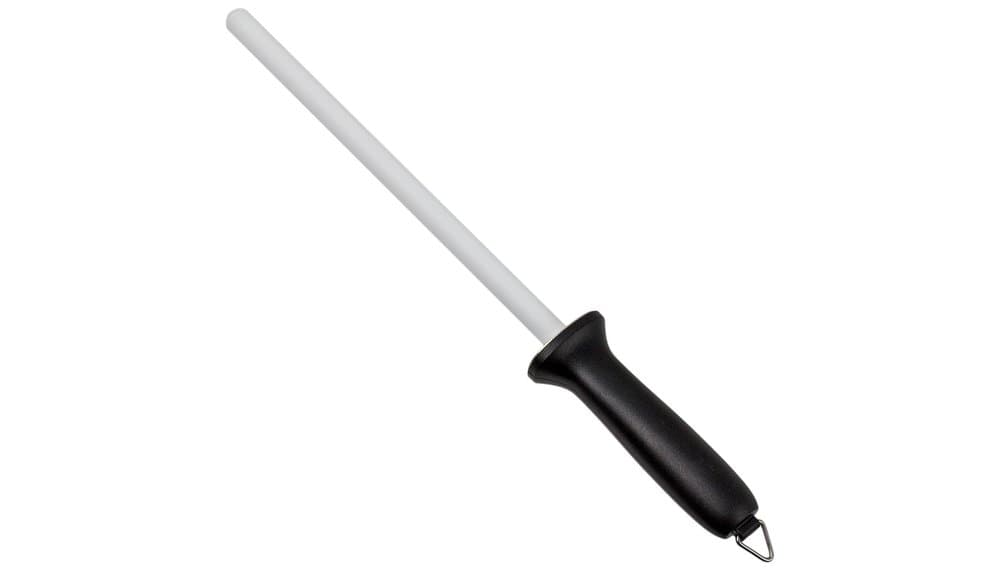
Sharpening is the second key to longevity. With an HRC 56-58 steel, you will need to invest in a quality sharpening stone (e.g., 1000/3000 grit) or use a manual ceramic rod sharpener designed for Japanese angles. Abrasive electric sharpeners are to be avoided. With proper care, these knives are designed to last for decades.
Technical Specifications
| Characteristic | Detail |
|---|---|
| Brand / Model | Global / 40th Anniversary Set G-458110AN |
| Blade Composition | Japanese stainless steel CROMOVA 18 (Global exclusive) |
| Estimated Hardness (HRC) | Approximately 56-58 Rockwell |
| Sharpening Angle | Double bevel at 15° (30° total) |
| Construction | One-piece (blade and handle from a single piece) |
| Handle Finish | Smooth surface with non-slip dimples |
| Set Contents | 1 Oriental Chef's Knife 18 cm (G-4)<br>1 Kiritsuke Knife 15 cm (GS-110)<br>1 Utility Knife 11 cm (GS-58) |
| Maintenance | Hand wash only. Immediate drying recommended. |
| Manufacturing Origin | Made in Japan |
What Users and Experts Say
The synthesis of available customer reviews and expert tests paints a strong consensus on several points.
Praise is unanimous on the finesse of the cut and the lightness of the knives. Users speak of a feeling of a "knife that melts in the hand" and that "glides through food effortlessly". The Japanese manufacturing quality and the design of the anniversary edition are also very frequently praised. The high average rating (4.7/5) confirms this overall satisfaction.
The criticisms, however, focus on two recurring aspects. Firstly, handle ergonomics is divisive. While many appreciate it, a significant minority reports discomfort, a feeling of "too thin" or "slippery" despite the dimples, especially during prolonged use with wet hands. Secondly, several comments highlight the need to relearn how to use a knife: its lightness and balance require less pressure and a different technique than that used with a massive German knife. Finally, all agree on the fragility of the edge if mistreated: these knives are scalpels, not cleavers. They will not forgive cutting on glass or granite surfaces.
Conclusion
The Global Stainless Steel 40th Anniversary Kitchen Knife Set of 3 is much more than an aesthetic case. It is a coherent and demanding technical proposition. It is aimed at the serious cook who understands and accepts the contract: in exchange for precise cutting, superior edge retention, and simplified maintenance compared to carbon steel, they must adopt precise cutting technique and a rigorous care protocol (hand wash, stone sharpening).
Its main point of caution is its very personal ergonomics. We strongly recommend, if possible, holding a Global knife before committing, as the handle is a daily-use characteristic that does not suit everyone.
For those seeking the essence of a high-performance Japanese knife, without the constraints of carbon steel, and who appreciate the iconic design and light balance, this limited set is a solid and durable investment. It is a professional tool for the home that, treated with respect, will become a lifelong kitchen companion. Conversely, the user accustomed to the "rocking" motion and reassuring weight of traditional Western knives might be disoriented and should consider this purchase with more caution.