HENDI Hokker Professional Gas Stove Review
Introduction
In the world of kitchen tools designed to last a lifetime, where carbon steel and cast iron reign supreme, there is a category of equipment often overlooked: the heat source itself. What good is a perfectly seasoned carbon steel wok if the induction cooktop or domestic burner cannot provide it with the "wok hei", that instant and enveloping firepower? The HENDI Hokker Professional Gas Stove presents itself as the answer to this problem. This is not just a simple cooktop, but a freestanding professional gas burner, designed to support the heaviest cookware and deliver restaurant-kitchen worthy power. Our analysis examines this appliance from the demanding perspective of "buy-it-for-life": its construction, materials, its suitability for the serious cook's arsenal, and its ability to become the timeless pillar of a high-performance kitchen.
Strengths and Weaknesses
Strengths
- Raw Professional Power: With 6.0 kW, the burner offers extremely fast temperature rise and intense heat, essential for searing, frying, and wok techniques.
- Robust and Durable Construction: The 18/0 stainless steel chassis and enameled cast iron support grate promise exceptional mechanical and thermal resistance, with a maximum supported load of 50 kg.
- Integrated Gas Versatility: Compatible with propane and butane out of the box, and delivered with a natural gas conversion kit, it adapts to almost any installation setup.
- Enhanced Safety: The inclusion of a thermocouple (gas safety shut-off) and electronic ignition makes it a safer appliance than a basic professional burner.
- Freestanding and Stable Design: Its "hokker" (on legs) format makes it completely autonomous, stable, and at an ideal height for vigorous cooking maneuvers.
Weaknesses
- Potentially Less Precise Flame Control: Unlike domestic models with many settings, feedback indicates that the adjustment range, although progressive, can be trickier at very low power levels.
- Noise Level and Consumption: A power of 6 kW generates significant gas flow and combustion noise, which is normal for a pro appliance but can be surprising in a home environment.
- Variable Assembly and Quality Control: Several user reviews report sloppy assembly upon delivery (loose parts, missing screws) or cosmetic defects (scratches), pointing to sometimes neglected final quality control.
- Lack of "High-End" Finish: This is a functional professional tool. Testers note that the finish, while robust, is utilitarian and may have welds or edges less perfect than on a premium consumer brand appliance.
Detailed Analysis of the HENDI Hokker Professional
Construction and Materials: An Industrial Philosophy
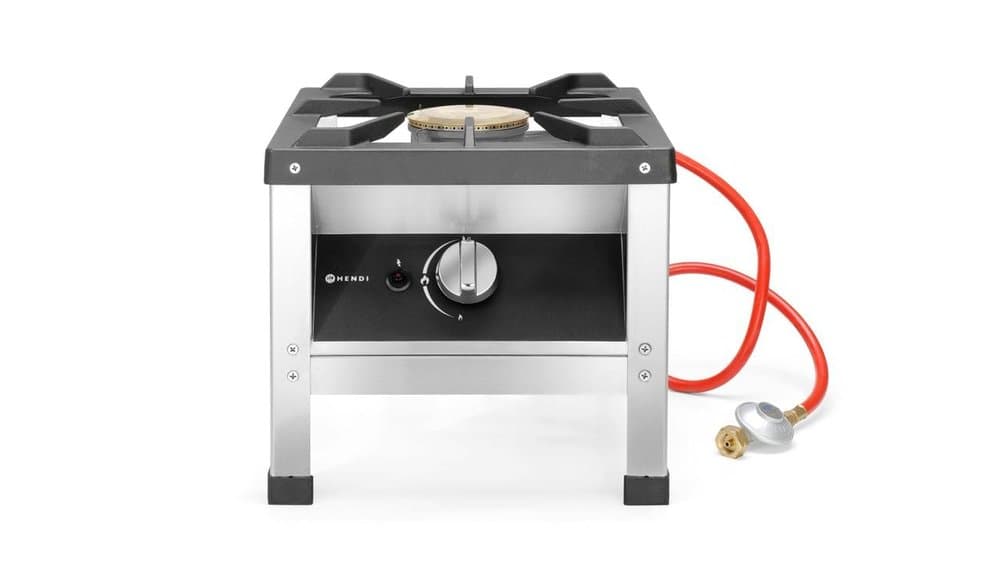
The HENDI Hokker does not play in the same league as domestic cooktops. Here, materials are chosen for resistance to thermal and mechanical shock, period. The chassis is made of 18/0 stainless steel – a chrome-rich grade offering good corrosion resistance and structural rigidity. This is far from thin stamped sheet metal; it's a construction designed to support 50 kg distributed evenly, meaning a filled cast iron wok or a large capacity stockpot, without any flexing.
The centerpiece in terms of contact with the cookware is the enameled cast iron support grate. Cast iron, the beloved material for kitchen durability, excels in heat retention and distribution. Its enamel coating facilitates maintenance and prevents rust. This massive grate ensures absolute stability, even during vigorous stir-frying movements. According to specifications and feedback, it is this stainless steel/cast iron combination that forges the "buy-it-for-life" character of the appliance: few elements are likely to fail over time, aside from standard wear parts like the burner itself.
See priceThermal Performance and Suitability for High-End Cookware
The Hokker's reason for being is its power: 6.0 kW (approximately 20,500 BTU/h). For context, a classic domestic burner operates around 3.5 kW. This difference is crucial. It allows reaching the ideal searing temperature for a carbon steel wok (above 250°C) in just a few seconds, a prerequisite for food to cook quickly rather than simmer, retaining crunch and color. The community of discerning amateur cooks emphasizes that it is this power that unlocks the true potential of good utensils: formation of a perfect seasoning, instant thermal reaction to flame changes, ability to maintain temperature even when adding a large quantity of cold ingredients.
The flame distribution, annular and concentric, is designed to follow the curved shape of a wok, but also works perfectly with a cast iron Dutch oven or a large sauté pan. Experts note that the responsiveness is immediate: you lower the flame, the heat drops instantly, offering control worthy of a professional environment.
Ergonomics and Handling
The ergonomics of such a tool are different from those of a built-in stove. The single, large control knob is reported to be firm and offer progressive travel. However, several users note that the adjustment range is less suited to very gentle simmering than to high-heat cooking. The minimum flame can still be relatively high. It is therefore not the ideal versatile tool for gently melting butter, but rather the specialized tool for cooking requiring high calorific power.
The height under the grate (approximately 390 mm total) is often cited as a major asset. It places the bottom of the wok at a comfortable height for handling with broad movements, without bending. The stability of the unit, due to the weight (nearly 12 kg) and the wide base, is unanimously praised, even during energetic "tossing" movements.
Safety and Installation
The presence of a thermocouple is a decisive argument for indoor use. This safety device cuts off the gas supply if the flame goes out accidentally (due to overflow, draft...), eliminating a major risk. The electronic ignition (piezo) removes the need to have a lighter at hand, a significant convenience.
The gas versatility is an underrated strong point. Delivered ready for propane/butane (cylinder) with a regulator and hose, and including the kit to connect it to city gas, this appliance fits into very diverse configurations: domestic kitchen with fixed connection, workshop/garage use, or even for occasional events. It obviously requires adequate ventilation in the room, as its power generates significant combustion.
Technical Specifications
| Characteristic | Detail |
|---|---|
| Model | HENDI Hokker Professional Gas Stove (147801) |
| Power | 6.0 kW |
| Fuel | Propane / Butane Gas (Natural Gas Conversion Kit included) |
| Chassis Material | 18/0 Stainless Steel |
| Support Grate | Enameled Cast Iron |
| Max Supported Weight | 50 kg |
| Ignition | Electronic (Piezo) |
| Safety | Thermocouple (gas safety shut-off) |
| Dimensions (LxWxH) | 400 x 440 x 390 mm |
| Weight | Approximately 11.85 kg |
| Included Accessories | Cast iron grate, pressure regulator, gas hose, GZ 50 conversion kit |
What Users and Testers Say
A cross-analysis of customer reviews and expert feedback online paints a clear consensus, with recurring points of attention.
The praise is unanimous on several points:
- Power and Performance: Terms like "monster," "professional," "incredible power" constantly come up. Wok users are particularly enthusiastic, noting a "night and day" difference from their usual cooktop.
- Perceived Sturdiness: The construction in solid stainless steel and the cast iron grate inspire confidence. Expressions like "very robust," "indestructible," "pro quality" dominate positive comments.
- Value for Money: For professional power and materials, the community generally considers the appliance a good investment.
- Ease of Installation: Once the initial assembly issue is resolved (see below), connection to a gas cylinder is described as simple and intuitive.
Criticisms mainly focus on:
- Quality Control and Logistics: This is the most frequent sticking point. Several buyers received the appliance partially disassembled, with missing screws, or with scratches and signs of wear on the stainless steel parts or on the burner hood, suggesting a refurbished unit or inadequate packaging.
- "Raw" Finish: Some note visible welds and unfinished edges on the stainless steel structure, which fits an industrial aesthetic but may disappoint those seeking perfect finishing.
- Noise and Flame Control: The roar of the flame at full power is notable, and the difficulty in obtaining a very small, stable flame is mentioned by those who wish to use it for all types of cooking.
Conclusion
The HENDI Hokker Professional Gas Stove is not a kitchen appliance like the others. It is a specialized tool, designed for a specific mission: to deliver professional-grade firepower that is reliable and durable. Its analysis through the "buy-it-for-life" lens is overall very positive. The chosen materials – 18/0 stainless steel and enameled cast iron – are those of permanence, resistant to heat, shock, and time. Its ability to support 50 kg and its 6.0 kW power make it the ideal partner for the most demanding utensils: carbon steel woks, massive cast iron pots, large basins.
However, adopting it requires understanding its character. This is not a versatile and discreet cooktop, but a professional auxiliary burner, noisy, power-hungry, and with rougher control at low temperatures. The main risk identified by the community is not related to its design, but to its logistics: careful checking of assembly and condition upon receipt is necessary.
For the serious cook who practices Asian stir-frying, frying, large-volume confits, or who simply seeks the ultimate heat source for their cast iron and carbon steel utensils, the HENDI Hokker represents a concrete and durable solution. It bridges the gap between limiting domestic equipment and unaffordable professional gear, with the compromises that implies in terms of refinement and versatility. It is an investment in pure performance, a tool that, once properly installed, should perform unfailingly for decades.